
Published by VFuture Media – Your Gateway to Future Tech
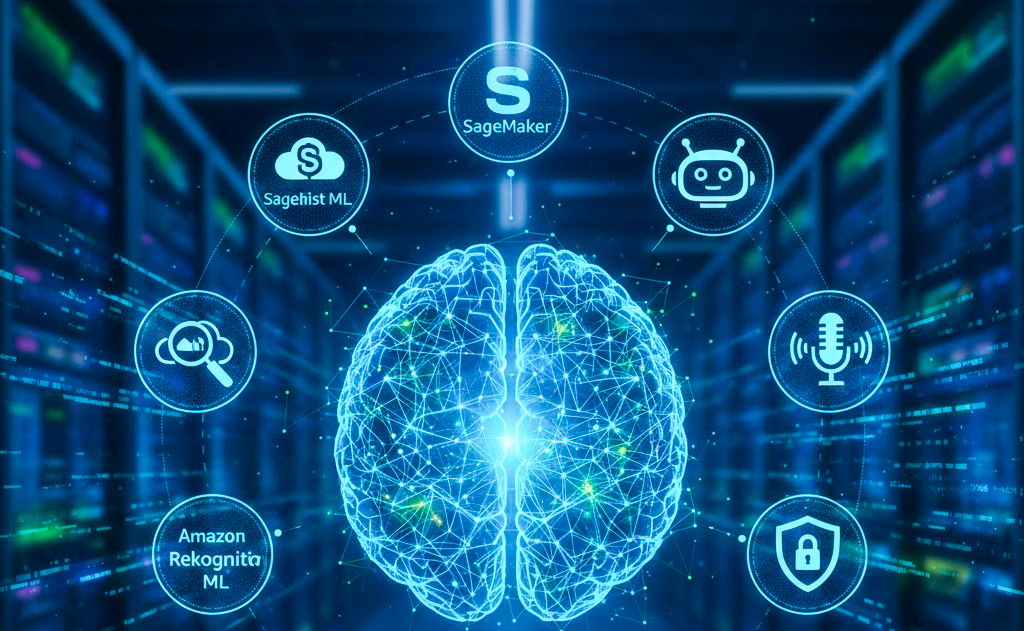
Artificial Intelligence (AI) and Machine Learning (ML) are at the core of modern cloud innovation. Amazon Web Services (AWS) offers a comprehensive suite of AI and ML services that help organizations build, train, and deploy intelligent applications at scale.
Whether you are preparing for AWS AI/ML interviews, Cloud Architect roles, or Machine Learning Engineer positions, this guide covers frequently asked AWS AI & ML interview questions with clear explanations, optimized for both learning and SEO visibility.
Why AWS AI & ML Services Matter in Interviews
Companies increasingly expect cloud professionals to:
- Understand managed AI services
- Design scalable ML pipelines
- Optimize cost, performance, and security
- Apply real-world AI use cases
AWS simplifies ML adoption by offering three layers of AI/ML services:
- AI Services (Pre-trained)
- ML Services (Amazon SageMaker)
- Frameworks & Infrastructure
AWS AI Services – Interview Questions & Answers
1. What are AWS AI Services?
AWS AI Services are pre-trained machine learning services that allow developers to add intelligence to applications without building ML models from scratch.
Examples:
- Amazon Rekognition
- Amazon Comprehend
- Amazon Polly
- Amazon Lex
- Amazon Textract
- Amazon Transcribe
2. What is Amazon Rekognition used for?
Amazon Rekognition analyzes images and videos to:
- Detect objects, faces, and scenes
- Perform facial recognition
- Identify unsafe content
- Enable real-time video analysis
Interview Tip:
Used in security surveillance, social media tagging, and content moderation.
3. Explain Amazon Comprehend
Amazon Comprehend is a Natural Language Processing (NLP) service used to:
- Extract key phrases
- Detect sentiment
- Identify entities (names, places, brands)
- Classify documents
Use Cases: Customer feedback analysis, call-center insights, compliance monitoring.
4. What is Amazon Textract?
Amazon Textract automatically extracts:
- Text
- Tables
- Forms
from scanned documents and PDFs.
Common Interview Scenario:
Automating invoice processing or KYC document validation.
5. Difference between Amazon Lex and Amazon Polly?
| Service | Purpose |
|---|---|
| Amazon Lex | Build chatbots and voice assistants |
| Amazon Polly | Convert text into natural speech |
Lex powers conversational AI, while Polly handles text-to-speech.
Amazon SageMaker – Core ML Interview Questions
6. What is Amazon SageMaker?
Amazon SageMaker is a fully managed machine learning service that enables:
- Data preparation
- Model training
- Model tuning
- Deployment
- Monitoring
All within a single environment.
7. Key components of Amazon SageMaker?
- SageMaker Studio – Web-based IDE
- Notebook Instances
- Training Jobs
- Hyperparameter Tuning
- Endpoints
- Model Monitor
- Pipelines
8. What is SageMaker Autopilot?
SageMaker Autopilot automatically:
- Preprocesses data
- Selects algorithms
- Trains and tunes models
- Explains predictions
Ideal for: Teams with limited ML expertise.
9. What is SageMaker Model Monitor?
It detects:
- Data drift
- Model quality degradation
- Bias in predictions
Interview Highlight:
Critical for production ML governance.
10. Difference between Batch Transform and Real-Time Endpoints?
| Feature | Batch Transform | Real-Time Endpoint |
|---|---|---|
| Use Case | Large offline predictions | Low-latency inference |
| Cost | Cheaper | Higher |
| Availability | On-demand | Always running |
AWS ML Frameworks & Infrastructure Questions
11. What ML frameworks are supported by AWS?
AWS supports:
- TensorFlow
- PyTorch
- MXNet
- Scikit-learn
- XGBoost
Available via SageMaker built-in containers or custom Docker images.
12. How does AWS support GPU workloads?
AWS provides:
- EC2 GPU instances (P3, P4, G5)
- Elastic Inference
- AWS Trainium & Inferentia chips
Interview Insight:
Trainium is optimized for training, Inferentia for inference at lower cost.
13. What is AWS Inferentia?
AWS Inferentia is a custom ML inference chip that delivers:
- Lower latency
- Lower cost
- High throughput
Used with Amazon SageMaker and EC2 Inf instances.
Security, Cost & Governance Questions
14. How do you secure ML models in AWS?
- IAM roles & policies
- VPC endpoints for SageMaker
- KMS encryption
- Private model endpoints
- CloudTrail auditing
15. How do you optimize ML costs on AWS?
- Spot Training Jobs
- Auto-scaling endpoints
- Serverless inference
- Right-sizing instance types
- Batch inference over real-time when possible
16. What is Responsible AI in AWS?
AWS promotes Responsible AI through:
- Bias detection
- Model explainability
- Human-in-the-loop workflows (A2I)
- Transparency & fairness controls
Real-World AWS AI/ML Interview Scenarios
17. How would you design a recommendation system on AWS?
Architecture:
- S3 for data storage
- Glue for ETL
- SageMaker for training
- SageMaker Endpoint for inference
- API Gateway + Lambda
- CloudWatch for monitoring
18. When would you choose AWS AI Services over SageMaker?
Choose AI Services when:
- You need fast implementation
- Accuracy is already sufficient
- No custom training required
Choose SageMaker for:
- Custom ML models
- Advanced tuning
- Domain-specific predictions
Final Thoughts
AWS AI & ML services are no longer optional skills—they are career accelerators. Interviewers increasingly test not just definitions, but architecture decisions, cost awareness, and real-world usage.
Mastering these concepts positions you strongly for roles such as:
- Cloud Architect
- ML Engineer
- AI Solutions Architect
- DevOps with MLOps focus
Stay Ahead with VFuture Media
Your trusted source for AI, Cloud, Robotics, Space, and Future Technologies.
Explore more interview guides, tech explainers, and innovation insights only on vfuturemedia
I’m Ethan, and I write about the tech that’s actually going to change how we live — not the stuff that just sounds impressive in a press release. I cover AI, EVs, robotics, and future tech for VFuture Media. I was on the ground at CES 2026 in Las Vegas, walking the show floor so I could give you a real read on what matters and what’s just noise. Follow me on X for daily takes.



Leave a Comment