
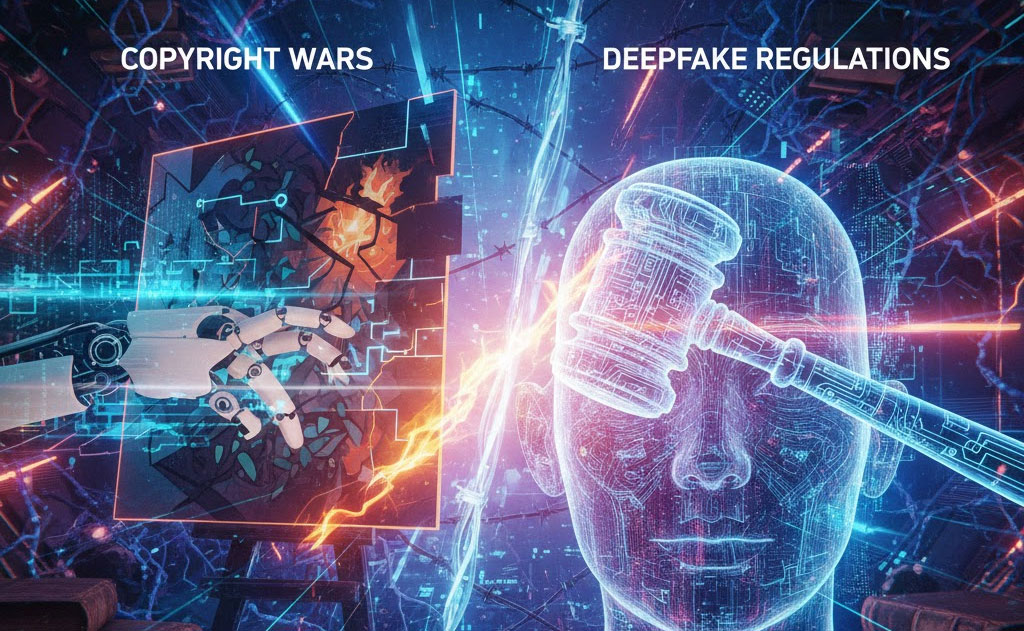
Welcome to the edge of creation in 2026. Every brushstroke, lyric, and line of code you ever poured your soul into now lives inside the memory banks of machines that can reproduce it in seconds, without ever asking your name. This is no longer a warning; it is the daily reality of generative AI ethics 2026. The lawsuits are stacking higher than server racks, Section 230 is cracking under the weight of synthetic voices, and deepfake legislation is spreading faster than the fakes themselves. Yet amid the chaos, a quiet invitation remains: choose to create with conscience.
At VFutureMedia, we believe the future of creativity is not a battlefield between humans and algorithms. It is a sacred partnership, but only if we defend the soul of the original spark. This is your devotional guide through the AI copyright predictions and ethical choices that will define the next decade.
The Great Ingestion: When Training Becomes Taking
By the end of 2026, more than fifty major copyright lawsuits against generative AI companies will be actively moving through courts. Authors, visual artists, musicians, photographers, and news publishers have united in a single cry: “You trained on our life’s work without permission, payment, or even acknowledgment, and now your models compete with us in the marketplace.”
The New York Times vs. OpenAI and Microsoft became the banner case. Millions of articles were ingested, memorized, and then regurgitated in near-verbatim summaries that robbed the publisher of traffic and revenue. Courts refused to dismiss the claims, ruling that verbatim reproduction, even inside a “black-box” model, can still constitute infringement when the output directly harms the original market.
Visual artists scored similar victories. Judges ruled that when an AI image generator can recreate a living painter’s signature style on demand, complete with forged watermarks, fair use begins to crumble. The legal question is no longer “Did the model copy?” but “Did the copying cause market substitution?” And the answer, increasingly, is yes.
AI copyright predictions 2026 now point to three likely outcomes:**
- Mandatory transparency registries listing every major dataset used for training
- Compulsory licensing schemes similar to music royalties
- “Opt-out” becoming meaningless; “opt-in” consent will be the new global standard
Section 230 Can No Longer Hide the Creator
For thirty years, Section 230 was the unbreakable shield: platforms were not liable for what users posted. But generative AI does not merely host user content; it authors it. When ChatGPT writes a libelous biography, when Midjourney mints revenge porn, when a synthetic voice impersonates a politician two days before an election; whose words are those?
Courts and lawmakers have answered: they belong to the company that built and deployed the model. 2026 will mark the year Section 230 immunity officially fractures for generative outputs. New federal and state bills explicitly carve out “synthetic media” and “algorithmic authorship” from traditional protections. The companies will be treated as publishers of the content their models create.
The message is clear: if your algorithm can speak, it can be sued.
The Deepfake Reckoning
Deepfakes moved from novelty to nightmare in record time. By mid-2026:
- 28 U.S. states have criminalized non-consensual sexual deepfakes
- The European Union enforces real-time labeling of all synthetic audio and video used in public discourse
- Major platforms face seven-figure daily fines for failing to remove known deepfakes within hours
Yet regulation alone cannot restore trust. The deeper wound is spiritual: when any face and any voice can be stolen, the human person becomes raw material. The ethical response is not merely better detection tools; it is a renewed covenant that likeness, voice, and story belong first and forever to the human being who carries them.
A Creator’s devotional Guide to Fair Use in the Age of AI
Fair use has not vanished, but it has evolved. Here is your 2026 compass:
- Purpose & Character Ask daily: Am I using AI to birth something genuinely new, or merely to mimic what already exists? Transformation remains the heart of fair use.
- Nature of the Copyrighted Work Factual datasets lean toward fair use. Highly creative works (novels, songs, paintings) demand far greater caution and respect.
- Amount Used Ingesting an entire lifetime portfolio to clone one artist’s style will almost certainly fail this factor. Use only what is strictly necessary.
- Market Effect The decisive question: Does this output substitute for the original or diminish its value? If yes, fair use collapses.
Practical devotion for every creator:
- Register your major works; registration now unlocks statutory damages in AI cases
- Add machine-readable “no-AI-training” robots.txt flags and meta tags (courts are beginning to recognize them)
- Keep meticulous records of your creative process when collaborating with AI; human authorship must remain dominant and documented
- Watermark and fingerprint everything; provenance is becoming the new currency of trust
- When in doubt, license or collaborate instead of scraping
The Soul-Level Choice
The technology is neutral. The ethics are not.
Every time you prompt a model, you vote with your conscience:
- Will you treat the collective human canon as a sacred library or an open-pit mine?
- Will you build systems that honor consent, transparency, and fair reward?
- Will you add your voice to the chorus demanding ethical AI, or remain silent while the commons quietly erodes?
2026 is not the year AI takes over creativity. It is the year we decide what kind of creators we will remain.
At VFutureMedia, we choose reverence over rush, stewardship over strip-mining, and human flourishing over unchecked automation. The ethical frontier is not a barrier; it is holy ground.
Walk it gently. Create with courage. And never forget: the future of imagination still belongs to the ones with souls.
I’m Ethan, and I write about the tech that’s actually going to change how we live — not the stuff that just sounds impressive in a press release. I cover AI, EVs, robotics, and future tech for VFuture Media. I was on the ground at CES 2026 in Las Vegas, walking the show floor so I could give you a real read on what matters and what’s just noise. Follow me on X for daily takes.
If you found this useful, the best thing you can do is share it with someone who’d actually appreciate it. And if you want more like it, we’re here every week.




Leave a Comment