
By Ethan Brooks Published: March 20, 2026 Updated: March 20, 2026
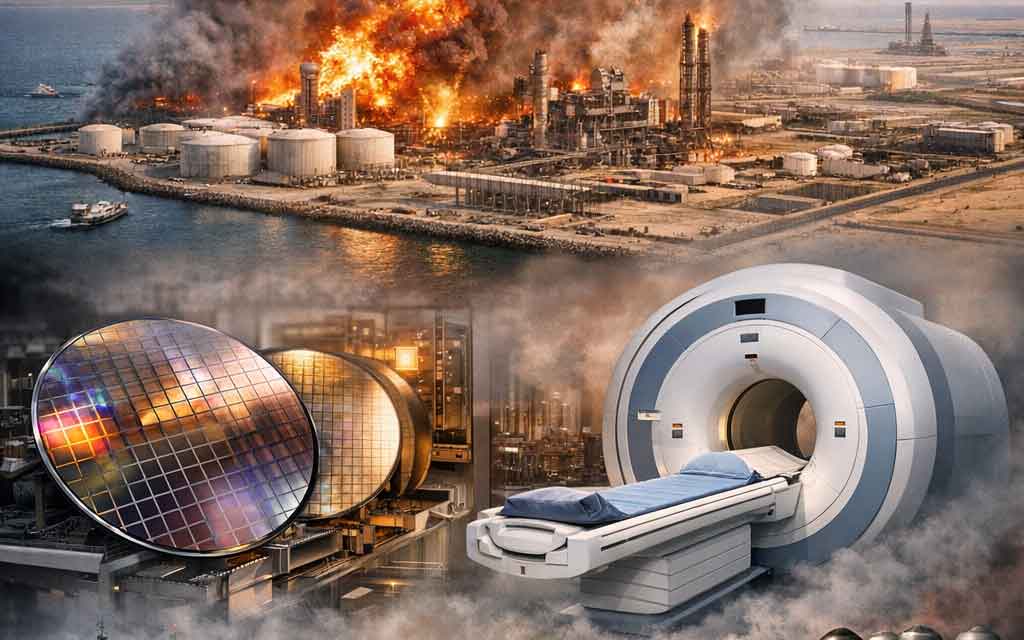
A single escalation in the Iran conflict has sent shockwaves through the global technology supply chain. Iranian missile and drone strikes on Qatar’s Ras Laffan Industrial City—the world’s largest LNG export hub and a critical helium production site—have effectively removed up to one-third of the planet’s commercial helium supply overnight. Helium, an irreplaceable gas used in semiconductor manufacturing and MRI scanners, is now in short supply, with spot prices surging 70–100% in days and long-term contracts under threat.
QatarEnergy CEO Saad al-Kaabi confirmed the damage: 17% of Qatar’s LNG export capacity is offline for 3–5 years, with helium output falling 14% due to permanent infrastructure harm. Production halted after initial strikes on March 2, 2026, and escalated with fresh missile attacks this week. No substitutes exist at scale. The result? Chip fabs in Asia are on a countdown clock, hospitals face MRI delays, and the entire tech industry is scrambling.
At VFuture Media, we cut through the headlines with verified facts from Reuters, CNBC, Scientific American, and official filings. This in-depth report details the attack, the science of helium dependency, country-by-country impacts, and what it means for consumers, companies, and the AI boom.
The Attack: How Iran’s Strikes Crippled Qatar’s Helium Output
Ras Laffan Industrial City processes natural gas and extracts helium as a byproduct. Three helium plants there supplied roughly 33% of global production (63 million cubic meters in 2025, per USGS data).
- March 2, 2026: Initial Iranian drone strikes force full LNG and helium production halt; QatarEnergy declares force majeure.
- March 18–19, 2026: Follow-up missile barrage causes “extensive damage” to two LNG trains and a gas-to-liquids facility. Fires were contained, but repairs will take years.
CEO al-Kaabi told Reuters: “I never in my wildest dreams would have thought that Qatar… would be in such an attack… from a brotherly Muslim country in the month of Ramadan.” He estimates $20 billion annual revenue loss and warns the region has been “set back 10 to 20 years.”
The Strait of Hormuz closure has trapped shipments, compounding the crisis. While oil dominates headlines, helium’s disappearance is the silent killer for high-tech manufacturing.
Why Helium Matters: The Invisible Lifeline of Modern Tech
Helium’s ultra-low boiling point (-269°C) and inert nature make it irreplaceable:
- Semiconductors: Cools wafers during etching and photolithography; enables precise temperature control for AI chips.
- MRI Scanners: Supercools magnets to generate powerful fields for medical imaging.
- Other uses: Fiber optics, aerospace, quantum computing, leak detection.
No other gas matches its performance without major requalification costs. The semiconductor industry recently overtook healthcare as helium’s largest consumer—fueling the AI data-center boom.
Country-by-Country: Who’s Bleeding the Most
South Korea — Most exposed. Imported 64.7% of its helium from Qatar in 2025 ($226.9 million). Samsung and SK Hynix fabs rely on it for advanced chip production. Analysts warn of production slowdowns within weeks if stocks run out.
Taiwan — Home to TSMC (18% of global chips). Bought 69% of helium from Gulf sources in 2024. Government says it is “monitoring” — industry insiders call it quiet panic. Any delay threatens Apple, Nvidia, and AI supply chains.
Japan — Major chip and MRI hub. No domestic production; relies on imports. Could face shortages first if outage lasts beyond 60 days. Iwatani Corp (top supplier) is drawing on U.S. stockpiles but warns of price pressure.
Singapore — Regional semiconductor and data-center hub. Heavy Qatar dependency highlighted by Scientific American. Early warnings of supply tightness already circulating.
India — Thousands of hospital MRI machines run on Qatari helium. Scan delays reported; costs rising. Broader impact on electronics manufacturing.
Germany — Linde (global gas giant) headquartered here. Spot prices up 100%; rationing underway alongside Air Liquide. Industrial users feeling pinch.
United States — Federal helium reserve depleting for years. Domestic fabs (Intel, GlobalFoundries) exposed despite some local production. HP, Dell, Lenovo already warning enterprise clients of 15–20% price hikes on servers and equipment.
United Kingdom — NHS hospitals facing MRI supply tightness. Zero domestic helium production.
France — Air Liquide HQ, but distribution-only. Cannot produce new helium; reliant on imports now disrupted.
China — Imports for chip fabs and MRIs. Strategic response: accelerating helium exploration in Siberian region and domestic projects.
Australia — One of few exporters (Amadeus Basin). Production ramping but “nowhere near enough” to fill Qatar’s gap.
Qatar — The source. All three helium plants offline. CEO confirms 14% capacity permanently damaged for up to five years.
Twelve major economies are now exposed. The U.S. Geological Survey and industry experts agree: the world cannot compensate for losing one-third of supply.
Market Reaction: Prices Soar, Rationing Begins
- Spot helium prices jumped 35–100% in one week.
- Major distributors (Linde, Air Products, Air Liquide) imposing surcharges and allocation limits.
- Semiconductor buyers prioritized over balloons and party suppliers.
- Analysts (Bank of America, Deutsche Bank) see short-term gains for industrial gas stocks but long-term pain for chipmakers.
Past surpluses (15% buffer) provide temporary cushion, but prolonged conflict means force majeure declarations and global shortages.
Real-World Fallout: From AI Chips to Hospital Scans
Chip fabs operate on razor-thin margins. A two-week clock is ticking for SK Hynix and TSMC. AI training clusters could slow; consumer electronics prices may rise.
Hospitals report MRI backlogs. One Indian chain already delayed 200+ scans. Quantum computing labs and aerospace projects face similar risks.
No quick fixes: New helium sources (Russia, U.S., Australia) take years to scale. Recycling helps but covers only a fraction.
What Companies and Governments Are Doing
- Chip giants: Diversifying suppliers, building stockpiles, exploring argon/nitrogen alternatives (costly and slower).
- Governments: South Korea and Taiwan activating emergency reserves. U.S. reviewing federal reserve release.
- Industry groups: Semiconductor Industry Association urging supply-chain resilience.
Frequently Asked Questions (FAQs)
Q: How long will this last? A: Repairs take 3–5 years for full LNG capacity; helium may recover faster but shortages could persist months.
Q: Will my phone or laptop get more expensive? A: Possible 5–15% indirect hikes if chip costs rise; most impact hits enterprise and data centers first.
Q: Are MRI scans affected now? A: Delays starting in import-heavy countries; priority given to medical use, but prices climbing.
Q: Can we just make more helium? A: No—produced as natural gas byproduct. New plants take years.
Q: Is this the end of the AI boom? A: No, but a serious speed bump. Companies with diversified supply chains will weather it best.
Final Thoughts: A Wake-Up Call for Tech Resilience
One strike in the Middle East has exposed how fragile our high-tech world really is. Helium isn’t glamorous, but without it, AI chips, medical imaging, and modern electronics grind to a halt.
The Iran-Qatar conflict reminds us: geopolitics and supply chains are inseparable. Diversification, recycling, and domestic production are no longer optional—they’re survival.
At VFuture Media, we track these stories so you stay ahead. Monitor your supply chain, support resilient tech policies, and watch for updates as the situation evolves.
Share this with colleagues in tech or healthcare. The helium crisis is here—knowledge is the first defense.
Sources & Further Reading (EEAT transparency):
- Reuters: Exclusive QatarEnergy CEO interview (March 19, 2026)
- CNBC: Iran war helium market impact
- Scientific American: AI chip dependency on helium
- USGS Mineral Commodity Summaries 2026
I’m Ethan, and I write about the tech that’s actually going to change how we live — not the stuff that just sounds impressive in a press release. I cover AI, EVs, robotics, and future tech for VFuture Media. I was on the ground at CES 2026 in Las Vegas, walking the show floor so I could give you a real read on what matters and what’s just noise. Follow me on X for daily takes.
You made it to the end, which means you actually care about this stuff. So do we. Check out our AI and EV sections for more stories worth your time.


Leave a Comment