
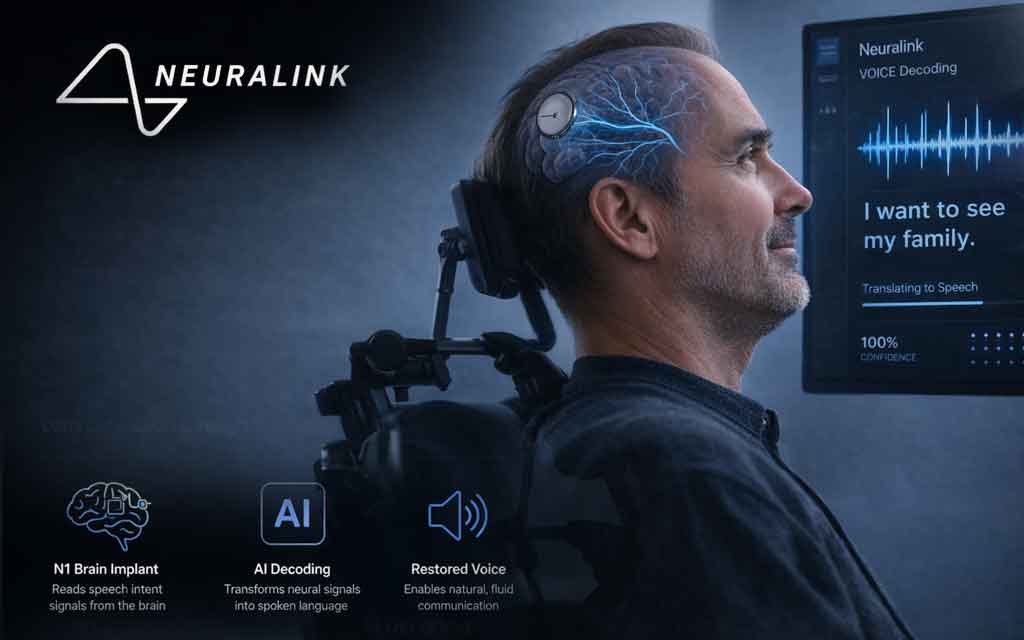
In one of the most emotionally powerful advancements in neurotechnology, Neuralink is successfully restoring the gift of speech to people who had lost it due to conditions like ALS (Amyotrophic Lateral sclerosis) and other neurological disorders.
Through its dedicated VOICE clinical trial, Neuralink’s N1 brain implant decodes intended speech signals directly from the brain and converts them into real-time text or synthesized voice — often sounding remarkably like the patient’s own pre-disease voice.
Kenneth’s Story: From Silence to Speaking with His Mind
In January 2026, Kenneth Shock became the second participant in Neuralink’s VOICE trial to receive the N1 implant specifically for speech restoration. Diagnosed with ALS in 2024, Kenneth had gradually lost his ability to speak over the years.
Now, by simply thinking the words he wants to say, the implant translates his neural activity into audible speech. In a moving demonstration shared by Neuralink, Kenneth looked at the camera and said:
“I’m talking to you with my mind.”
The system not only produces text but can generate spoken words in a voice that closely resembles his own, allowing him to say “I love you” to his wife and engage in natural conversations again after years of silence.
This marks a significant evolution from earlier Neuralink trials focused on cursor control and device operation. The VOICE study specifically targets brain regions involved in speech production, aiming for conversational speeds approaching 140 words per minute — close to natural human speech.
How Neuralink’s Speech Restoration Technology Works
The N1 implant, a coin-sized device with ultra-thin threads, is surgically placed in areas of the brain responsible for speech intention. It records thousands of neural signals per second and uses advanced AI algorithms to decode what the person intends to say — even when no muscle movement or sound is possible.
Key advantages over traditional assistive technologies (such as eye-tracking devices or slow speech synthesizers):
- Faster communication
- More natural interaction
- Use of the patient’s own voice characteristics
- Reduced physical and mental fatigue
Neuralink has received FDA Breakthrough Device Designation for speech restoration, accelerating development for patients with severe impairments caused by ALS, stroke, spinal cord injury, and similar conditions.
Broader Implications for the Future of Human-Computer Interaction
Elon Musk has highlighted that Neuralink is not only helping restore lost functions but is laying the foundation for seamless brain-machine symbiosis. While current applications focus on medical needs, the long-term vision includes higher-bandwidth communication and potential enhancements for healthy individuals.
This speech restoration milestone comes as Neuralink reports over 20 human participants across various trials, with the company scaling up implant procedures and refining both hardware and software.
For millions living with locked-in syndrome or progressive neurological diseases, this technology offers renewed hope for social connection, independence, and dignity.
What’s Next for Neuralink’s VOICE Trial?
Neuralink aims to expand the trial, improve decoding accuracy, and push toward real-time, high-speed conversational speech. The company is also exploring integration with other features, such as device control and potential sensory restoration.
As brain-computer interfaces move from experimental to practical assistive tools, ethical discussions around accessibility, data privacy, and long-term safety will become increasingly important.
VFuture Media will continue tracking Neuralink’s progress, patient stories, and the rapidly evolving field of neurotechnology.
This isn’t just restoring speech — it’s restoring human connection in ways once thought impossible.
What do you think — how soon could thought-to-speech technology become widely available? Share your views in the comments below.

Leave a Comment