
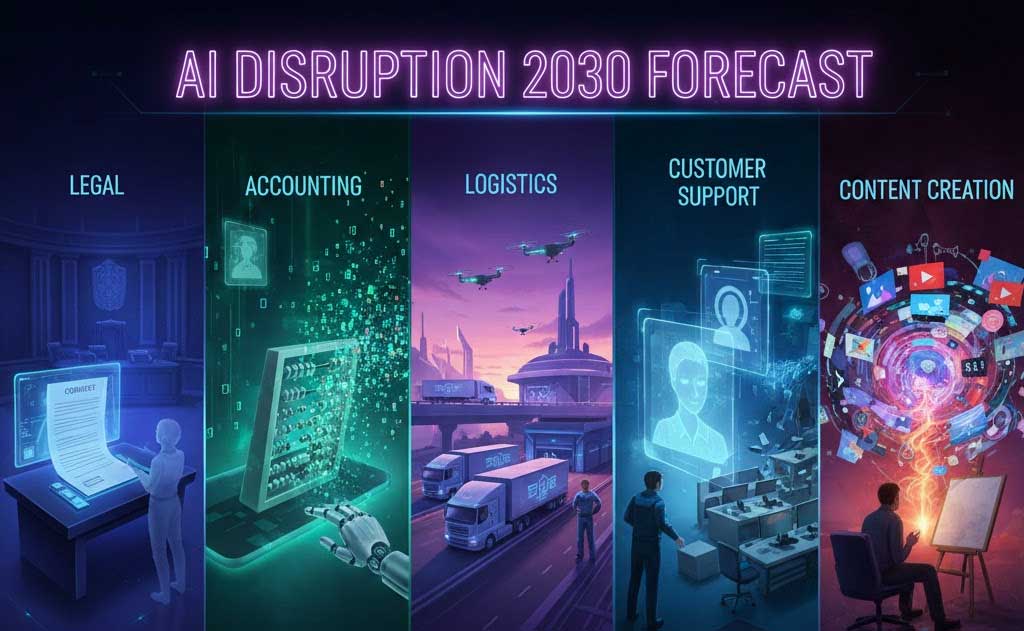
AI disruption 2030 forecast: Legal research/contract automation slashes paralegal roles, accounting routines vanish, logistics drivers replaced by AVs, customer support agents automated, content creation jobs gutted by generative models
It’s December 27, 2025, and the writing is on the wall: by 2030, emerging technologies—primarily AI agents, autonomous vehicles, and generative models—will fundamentally dismantle or “kill” swaths of traditional industries as we know them. Just weeks ago, fresh reports from McKinsey, Goldman Sachs, and the World Economic Forum reinforced projections: AI could automate 30% of work hours globally, displace millions in routine roles, while creating net new jobs—but concentrated in high-skill areas.
Here’s what most people get wrong: They think disruption means minor tweaks. The number that actually matters is scale—legal AI markets hitting $10B+, autonomous trucking saving billions in labor, generative content flooding media. What this means in plain English: Entire job categories vanish, forcing mass reskilling or obsolescence. Industries don’t die—they transform, often leaving legacy players behind.
#5: Content Creation – Generative AI Floods the Market
Generative tools like advanced GPT successors, Sora video generators, and multimodal models will produce articles, videos, music, and art at negligible cost.
Surprising fact: Goldman Sachs estimates 26-30% of media/creative tasks automatable; Pew projects 30% media jobs gone by 2035, accelerated to 2030.
Examples: BuzzFeed/CNET already used AI for content; by 2030, routine journalism, copywriting, graphic design commoditized.
Rhetorical question: If AI generates blockbuster scripts or viral ads cheaper/faster, why hire armies of creators?
Balanced view: High-end creativity (storytelling, originality) endures—but entry/mid-level roles evaporate.
#4: Customer Support – AI Agents Handle 80%+ Interactions
Agentic AI evolves chatbots into autonomous resolvers: refunds, troubleshooting, escalations without humans.
Surprising stat: Gartner predicts AI resolves 80% common issues by 2029; markets project agents at billions.
Examples: Ada, modern voice agents already replacing teams; 85% enterprises piloting.
Contrarian: Empathy for complex/emotional cases needs humans—but volume (95% routine) shifts to AI.
By 2030: Call centers shrink dramatically; offshore models collapse.
#3: Logistics – Autonomous Vehicles Eliminate Drivers
Self-driving trucks/drones/robots dominate freight, last-mile, warehousing.
Surprising fact: McKinsey: 45% TCO drop full autonomy; millions driver jobs at risk.
Examples: Waymo/Cruise scaling; projections 85% last-mile autonomous.
Rhetorical question: If trucks drive 24/7 without fatigue/salary, why employ humans?
Balanced: Regulation/safety delays—but hubs like Texas accelerate.
#2: Accounting – Routine Tasks Fully Automated
AI handles bookkeeping, audits, compliance, tax prep with near-perfect accuracy.
Surprising stat: WEF ranks clerks declining fastest; AI market $37B by 2030.
Examples: Tools already automate reconciliations; strategic advisory rises, routine falls.
Contrarian: Judgment/ethics need humans—but 30-50% roles displaced.
By 2030: Entry-level accounting vanishes; firms downsize clerical staff.
#1: Legal – AI Agents Orchestrate Workflows
Generative AI drafts contracts, researches case law, predicts outcomes; agents manage lifecycles.
Surprising fact: MarketsandMarkets: Legal AI $10.82B by 2030; $100B+ savings projected.
Examples: Harvey/CoCounsel already in firms; paralegals/junior associates hit hardest.
Rhetorical question: If AI cuts research 90%, drafts 60% cheaper, why bill hours for basics?
Balanced: Courtroom advocacy endures—but back-office legal industry shrinks massively.
Future Outlook: Adaptation or Obsolescence by 2030
By 2030: These techs create new roles (AI ethicists, prompt engineers, hybrid overseers)—but net displacement in listed industries.
Actionable takeaways:
- Workers: Upskill in AI collaboration, ethics, strategy.
- Businesses: Integrate agents/AVs/generative now—laggards fail.
- Investors: Back enablers (AI infrastructure, reskilling).
- Policymakers: Universal basic income? Retraining funds?
- Everyone: Disruption inevitable—embrace or get left behind.
2030 isn’t job apocalypse—it’s reconfiguration. Winners master the tools killing old industries.
FAQ
Will AI kill all jobs in these industries by 2030? No—transform; routine roles die, strategic/human-centric evolve.
Biggest disruption? Legal/accounting (white-collar shock); logistics (blue-collar scale).
New jobs created? Yes—AI oversight, ethics, integration; net positive long-term per WEF.
Safest industries? Hands-on (plumbing, nursing); creative judgment.
Timeline accurate? Projections vary; acceleration possible with agentic advances.
Content creation fully automated? Routine yes; original/high-art no.
Customer support humans needed? For complex/empathy; 80%+ automated.
Logistics drivers gone? Millions displaced; remote oversight remains.
Accounting jobs decline? Clerical yes; advisory grows.
Legal profession end? Back-office yes; advocacy/strategy no.
I’m Ethan, and I write about the tech that’s actually going to change how we live — not the stuff that just sounds impressive in a press release. I cover AI, EVs, robotics, and future tech for VFuture Media. I was on the ground at CES 2026 in Las Vegas, walking the show floor so I could give you a real read on what matters and what’s just noise. Follow me on X for daily takes.
If you found this useful, the best thing you can do is share it with someone who’d actually appreciate it. And if you want more like it, we’re here every week.




Leave a Comment