
As we hit the midpoint of 2026, the electric vehicle (EV) landscape is undergoing one of its most anticipated shifts: the long-promised arrival of solid-state batteries. For years, these next-gen power sources have been hailed as the “holy grail” of EV tech—offering dramatically higher energy density, faster charging, superior safety, longer lifespan, and reduced fire risk compared to traditional lithium-ion batteries.
In early 2026, real-world proof is emerging. Independent testing, pilot productions, and bold claims from startups and giants alike are turning hype into tangible progress. Two standout stories dominate headlines: Finland-based Donut Lab‘s audacious announcement of the world’s first production-ready all-solid-state battery already heading into vehicles, and rapid Chinese advances from companies like Dongfeng, Ganfeng Lithium, and others pushing toward mass integration later this year and into 2027.
For American drivers, investors, and EV enthusiasts, these developments signal a potential tipping point. Solid-state batteries could finally deliver the 500+ mile ranges, 5-10 minute charges, and affordable long-haul EVs that resolve range anxiety and make EVs competitive with gas cars on every front.
In this in-depth guide, we’ll break down the 2026 EV trends surrounding solid-state batteries, spotlight Donut Lab’s controversial yet groundbreaking claims, explore China’s aggressive push, compare timelines from global players, and discuss what it all means for the U.S. market. Whether you’re shopping for your next EV or tracking future tech investments, here’s everything you need to know.
What Are Solid-State Batteries and Why Do They Matter for EVs in 2026?
Traditional lithium-ion batteries use a liquid electrolyte to shuttle lithium ions between the anode and cathode. This design works well but has limitations: flammability risks, degradation over time, slower charging, and energy densities typically capped at 250-300 Wh/kg (watt-hours per kilogram).
Solid-state batteries replace the liquid with a solid electrolyte—often ceramic, sulfide, or polymer-based. Benefits include:
- Higher energy density — Up to 400-650 Wh/kg, enabling 500-1000+ mile ranges in practical EV packs.
- Faster charging — Some claim 5-10 minute full charges without overheating.
- Improved safety — No flammable liquids mean lower fire risk and better thermal stability.
- Longer lifespan — 1,000+ cycles (or 100,000+ in extreme claims) with minimal degradation.
- Lighter weight — Reduced pack size and vehicle weight for better efficiency and handling.
In 2026, the industry focuses on moving from lab prototypes to real vehicles. While full commercialization for mainstream EVs is targeted for 2027-2030, proof-of-concept milestones this year are building confidence.
The global solid-state battery market is projected to grow explosively, potentially reaching billions by the early 2030s as EV adoption surges to meet climate goals.
Donut Lab: The Bold Claim of the World’s First Production-Ready Solid-State Battery
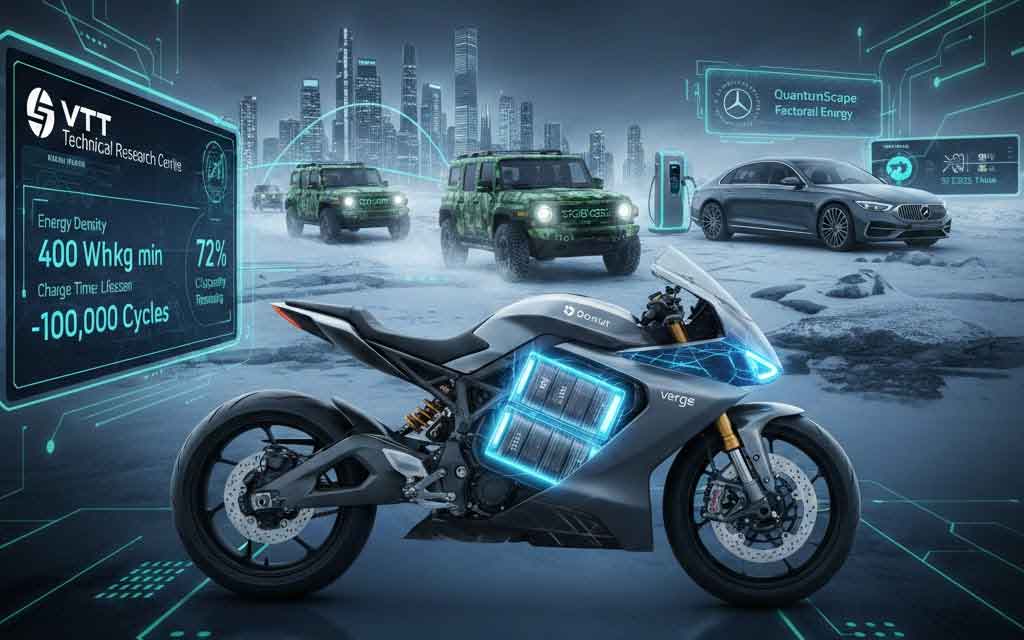
At CES 2026, Finnish startup Donut Lab stole the show by unveiling what it calls the world’s first all-solid-state battery ready for serial production in vehicles. Partnering with electric motorcycle maker Verge Motorcycles, Donut Lab claims its “Donut Battery” is already shipping at gigawatt-hour scale and will power production Verge TS Pro and Ultra models in Q1 2026.
Key specs touted by Donut Lab:
- Energy density: ~400 Wh/kg (nearly double current lithium-ion).
- Charge time: As little as 5 minutes for full charge.
- Lifespan: Over 100,000 cycles.
- Additional perks: Lower production costs, eco-friendlier materials, and integration with their innovative donut-shaped hubless motors.
The battery’s compact, phone-sized cells promise to boost Verge motorcycles from ~217 miles to 370+ miles of range, with ultra-fast charging under 10 minutes. Donut Lab positions this as a game-changer not just for two-wheelers but for broader automotive use.
Skepticism followed quickly. Industry experts questioned the claims, citing trade-offs in stability, degradation, and the lack of detailed manufacturing info or prior independent validation. Donut Lab responded by commissioning Finland’s renowned VTT Technical Research Centre for independent measurements. Results began rolling out in late February 2026, with the first reports released around February 23rd.
If verified, Donut Lab’s breakthrough could disrupt the market—proving solid-state tech is production-viable now, not years away. For American consumers, this means potential faster adoption in premium or niche vehicles, with spillover to cars. Watch for updates on VTT tests and real-world Verge deliveries—they could be the first tangible proof that solid-state is here.
Chinese Advances: Leading the Charge Toward 2026 Mass Production
China dominates global battery production and is accelerating solid-state efforts through state-backed R&D, standards, and aggressive timelines.
Dongfeng Automobile leads with a 350 Wh/kg solid-state battery. In early 2026, Dongfeng dispatched test fleets to extreme cold-weather trials in Mohe (down to -22°F/-30°C), where the packs retained 72% capacity. This overcomes a key lithium-ion weakness in winter.
Dongfeng targets vehicle integration by September 2026, with ranges up to 620 miles (1,000+ km) on a charge. They’ve built a 0.2 GWh pilot line and aim for mass production soon after.
Other Chinese players:
- Ganfeng Lithium (world’s largest lithium metal producer): Started mass-producing semi-solid-state batteries at 400-650 Wh/kg, with all-solid-state samples advancing. Partnerships with Tesla, VW, Hyundai bolster supply chains.
- BYD: Research since 2013; expects limited solid-state production in 2027, scaling by 2030. Focus on sulfide electrolytes for stability and 5C fast charging.
- Others (CATL, SAIC/MG, Chery): Semi-solid-state already in customer vehicles (e.g., MG4 variants in late 2025), with full solid-state pilots in 2026 and broader rollout by 2027-2030.
China’s first national solid-state battery standard launched in mid-2026, standardizing terminology and safety—accelerating deployment. This coordinated push gives Chinese firms an edge in scaling.
For U.S. buyers, Chinese tech often influences global supply chains—cheaper, high-density packs could lower EV prices stateside.
Global Timeline: When Will Solid-State Batteries Hit American Roads?
2026 is the year of proof, not mass adoption. Key milestones:
- 2026: Pilots, independent tests (Donut Lab/VTT), cold-weather validations (Dongfeng), semi-solid-state deliveries (China), U.S. programs (Factorial/Karma).
- 2027-2028: First commercial vehicles—Toyota hybrids/EVs, Factorial/Mercedes tests (745+ mile demos), QuantumScape/VW trials, BYD limited batches, Dongfeng integration.
- 2030+: Mass production for mainstream EVs, $10B+ market potential.
U.S. highlights: Factorial Energy’s quasi-solid-state FEST (500-600+ mile range, 40% lighter) enters production programs with Karma Automotive for 2027 supercars. QuantumScape advances with partners.
Challenges remain: Scaling manufacturing, cost reduction, and supply chain stability. Early solid-state packs will likely debut in premium models before trickling down.
What This Means for American EV Drivers in 2026 and Beyond
For U.S. consumers:
- Range anxiety fades — 500-700+ mile EVs become realistic.
- Charging revolutionized — 5-15 minute stops rival gas pumps.
- Safety boost — Lower fire risks in crashes or extreme weather.
- Cost trajectory — Initial premium pricing, but falling as production scales—potentially matching gas cars by late decade.
American brands like Tesla focus on lithium-ion/LFP optimizations, but partnerships could bring solid-state sooner. Policy shifts (IRA incentives, tariffs) influence adoption.
Investors watch: Donut Lab’s validation, Chinese scaling, U.S. players like Factorial/QuantumScape.
The Bottom Line: 2026 Is the Year Solid-State Batteries Prove Themselves
From Donut Lab’s daring production claims to China’s rapid pilots and cold-weather triumphs, 2026 delivers concrete evidence that solid-state batteries are transitioning from lab dreams to driveway reality. While full mainstream impact hits 2027-2030, this year’s milestones mark the inflection point.
At VFutureMedia, we’re excited about how these battery breakthroughs will power immersive media experiences, autonomous tech, and sustainable transport. Stay tuned for updates on test results, vehicle launches, and what solid-state means for the future of mobility.
The EV revolution just got a massive upgrade—solid-state proof is coming soon.
Ethan Brooks covers the tech that’s reshaping how we move, work, and think — for VFuture Media. He was at CES 2026 in Las Vegas when the world got its first real look at humanoid robots, AI-powered vehicles, and Samsung’s tri-fold phone. He writes about AI, EVs, gadgets, and green tech every week. No hype. No filler. X · Facebook
You made it to the end, which means you actually care about this stuff. So do we. Check out our AI and EV sections for more stories worth your time.

Leave a Comment