
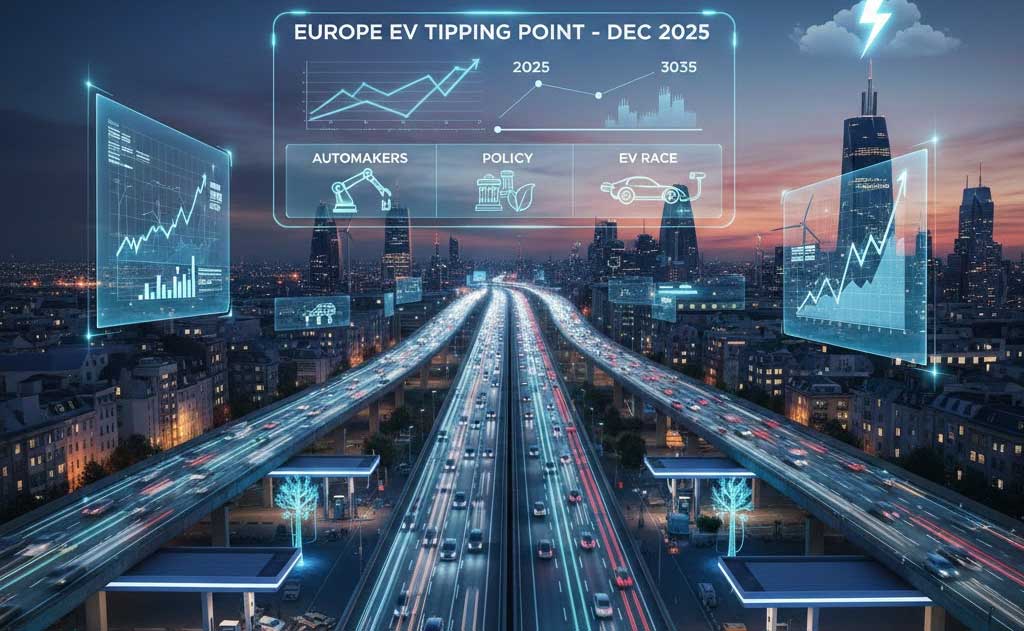
In late January 2026, the European Automobile Manufacturers’ Association (ACEA) released figures that crystallised a long-anticipated shift: for the first time ever, fully electric vehicle (BEV) sales in the European Union surpassed those of pure petrol cars in December 2025. BEVs claimed 22.6% of registrations (217,900 units, up 51% year-on-year), edging out petrol at 22.5% (216,500 units, down 19.2%). When including plug-in hybrids (PHEVs), electrified vehicles dominated with 67% of the market.
Having tracked Europe’s ZEV mandates since the 2019 CO₂ targets, this moment felt inevitable yet startling in its timing—arriving amid proposals to ease 2030–2035 emissions rules and amid intense Chinese competition. For full-year 2025, BEVs held 17.4% share (up from 13.6% in 2024), petrol 26.6%, while hybrids led overall. This Europe EV sales surpass petrol milestone in monthly terms signals the EU EV tipping point 2026 is here, forcing legacy automakers to accelerate or risk irrelevance.
This deep-dive examines the data, drivers, pressures on European brands, Chinese advantages, supply realities, and the concrete actions separating winners from losers through 2035.
The Tipping Point: Europe EV Sales Now Outpace Petrol
The December 2025 crossover was narrow but symbolic. ACEA data showed:
- BEV registrations: 217,900 (+51% YoY)
- Petrol-only: 216,500 (-19.2% YoY)
- PHEV: +36.7% (contributing to electrified total)
- Hybrids (non-plug): +5.8%
Broader Europe (EU + UK + EFTA) saw similar trends, with total registrations up 7.6% to 1.2 million in December and 2.4% to 13.3 million for 2025—highest in five years, though below pre-pandemic peaks.
For deeper official stats, see the ACEA’s full 2025 new car registrations report.
Country-level highlights reveal uneven progress:
- Leaders — Norway (near-100% electrified), Sweden (~63% BEV+PHEV), Netherlands (~59%), Denmark (71%)
- Laggards — Germany (growth but subsidy cuts slowed), Italy, Spain (strong PHEV gains but lower overall)
BEV (Battery Electric Vehicles)
- Full Year 2025: 17.4%
- December 2025: 22.6%
- YoY Change (Dec): +51%
Petrol (ICE)
- Full Year 2025: 26.6%
- December 2025: 22.5%
- YoY Change (Dec): −19.2%
Hybrids (incl. PHEV)
- Full Year 2025: ~44–50% (estimated)
- December 2025: 44%
- YoY Change (Dec): Varies by market
Diesel
- Full Year 2025: 8.9%
- December 2025: Continued decline
This marks the start of sustained momentum toward EU fleet CO₂ targets.
Drivers Behind the Crossover
Several forces converged:
- EU CO₂ fleet targets — 15% reduction 2025–2029 vs. 2021 baseline; 55% by 2030; 100% by 2035. Penalties drive electrification.
- High fuel prices — Persisting from energy shocks, making EVs cheaper to run.
- Subsidy waves — Varied by country; Germany/France incentives boosted late-2025.
- Tesla Model Y dominance — Europe’s top-seller in segments, though Tesla sales fell 38% in 2025.
- Chinese low-cost invasion — BYD, MG (SAIC), XPeng surged; Chinese brands hit ~11% overall Europe share in 2025 (16% electrified).
When I saw the latest ACEA and EAFO numbers, the message to legacy brands was unmistakable: policy + economics + competition = irreversible shift.
For more on global EV trends, see our electric-vehicles section.
Why Legacy Brands Are Under Pressure in 2026
European giants face margin squeeze:
- VW Group — Slow EV uptake despite ID. series; ID.3/4 sales lag expectations.
- Stellantis — Peugeot, Citroën, Fiat hybrids strong but BEV transition uneven.
- Renault — Zoe legacy helps, but mass-market EVs struggle.
- BMW, Mercedes — Premium focus; high prices limit volume.
Dealer resistance (EV service retraining), brand perception lag (EVs seen as clinical), and software glitches erode trust.
Chinese Entrants’ Advantage & Disruption
Chinese brands doubled share in 2025:
- Cost leadership — Vertical integration (BYD batteries, motors).
- Aggressive pricing — Models 20–30% below equivalents.
- Rapid cadence — Frequent launches.
- Market share — ~11% overall, 16% electrified; BYD tripled EU sales.
BYD aims for 1.3M non-China sales in 2026. MG outsold Tesla in some periods.
Explore Chinese innovations in our startups category.
Supply Chain & Manufacturing Reality Check
- Battery localization — EU gigafactories race (Northvolt, ACC); raw materials (lithium, nickel) bottlenecks.
- Tariff risks — EU duties on Chinese imports; potential escalation.
- Localization pressure — BYD, others plan EU plants to evade tariffs.
Delays risk stranding investments.
10 Strategic Moves Automakers Cannot Afford to Delay
Legacy players must act decisively:
- Accelerate affordable EV platforms — Sub-€30k models essential; VW’s entry-level, Renault’s next-gen.
- Fix software quality & OTA experience — Bugs plague; Tesla-like seamless updates needed.
- Restructuring dealer networks — EV-specific training, service for high-voltage.
- Aggressively localize battery & assembly — Europe gigafactories; partnerships (e.g., Mercedes with CATL).
- Rethink brand positioning — Premium + sustainable; emphasize heritage in green narrative.
- Partner or acquire Chinese tech — JV for cost/tech (e.g., Stellantis-Leapmotor).
- Lobby for hybrid-friendly policies — Bridge tech; support flexibilities in CO₂ rules.
- Invest heavily in charging ecosystem — Public/private partnerships; fast-charging networks.
- Prepare for used-EV & battery recycling scale — Second-life, circular economy.
- Double down on AI & connected-car differentiation — Autonomous features, personalization.
- Diversify supply chains — Reduce China dependency for critical minerals.
- Price aggressively with incentives — Lease deals, bundling to close TCO gap.
For green tech strategies, check green-tech.
2027–2035 Scenarios & Market Share Forecasts
Base case: BEV+PHEV >50% by 2030, 80–90% by 2035. Chinese share 20–30% if tariffs ease.
Bullish for Europe: Localization succeeds, demand surges with corporate fleet mandates.
Bearish: Policy backlash, recession; Chinese dominance if locals falter.
Forecasts (BloombergNEF-style): BEV 55%+ by 2030 in optimistic paths.
Investment & Consumer Implications
Investors: Watch localization plays, software leaders. Consumers: Cheaper running costs, but upfront prices key—subsidies matter.
Conclusion: Act Now or Fade
This Europe EV sales surpass petrol moment demands urgency. Winners localize, innovate, and partner strategically.
What’s your view on Europe’s EV future? Share below.
FAQ
- When did EV sales surpass petrol in Europe? Fully electric (BEV) sales overtook petrol in the EU in December 2025 per ACEA.
- Which countries led Europe’s EV tipping point? Norway, Sweden, Netherlands, Denmark with >50–90% electrified shares.
- What should legacy automakers do to survive the EV shift? Accelerate affordable models, localize production, fix software, partner strategically.
- What drove Europe EV adoption in 2026? EU CO₂ targets, fuel prices, subsidies, Chinese competition.
- How much market share do Chinese EV brands have in Europe? ~11% overall in 2025, 16% electrified; growing rapidly.
- What are EU CO₂ fleet targets for 2025–2030? 15% reduction 2025–2029; 55% by 2030 vs. 2021 baseline.
- Why are legacy brands struggling with EV transition? Margin pressure, slow uptake, dealer issues, software problems.
- Will hybrids remain relevant post-2035? Possible flexibilities; PHEVs as bridge in policy debates.
- How do tariffs affect Chinese EVs in Europe? Duties slow imports; prompting local factories.
- What’s the outlook for BEV market share by 2030? Likely 50%+ combined electrified; BEV dominant in optimistic scenarios.
- Which Chinese brands lead in Europe? BYD, MG (SAIC), XPeng, Leapmotor surging.
- How important is charging infrastructure? Critical; investment needed to sustain growth.
- What role do corporate fleets play? Potential mandates could boost demand significantly.
- Are used EVs and recycling ready? Scaling needed for circular economy.
- Why did Tesla sales decline in Europe 2025? Competition from Chinese, legacy brands; Model Y updates insufficient.
- What’s the risk of policy backlash? Loosening rules could slow transition, hurt investments.
- How can consumers benefit from this shift? Lower running costs, incentives; but upfront affordability key.
- Is the EV tipping point irreversible? Yes—momentum from policy, economics, competition.
Stay ahead—explore electric-vehicles and green-tech on vfuturemedia.com for the latest in electrification!


Leave a Comment