
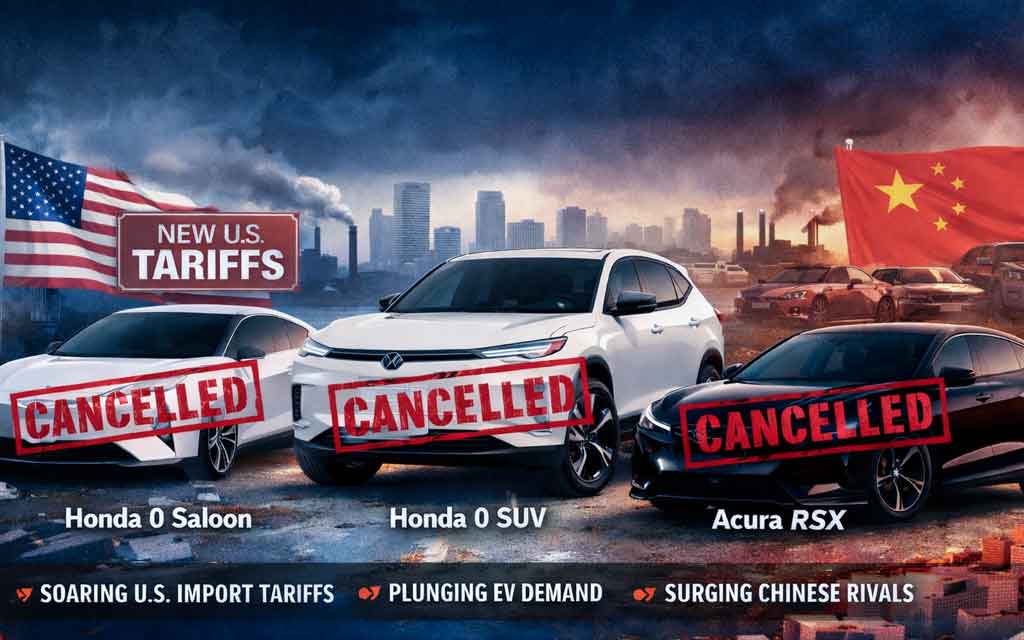
In a major strategic pivot, Honda Motor Co. has officially canceled the development and planned launch of three flagship electric vehicle (EV) models originally slated for the North American market. The decision, announced on March 12, 2026, comes amid a perfect storm of policy shifts, slowing EV demand, and fierce rivalry from Chinese manufacturers—marking a significant setback for the Japanese automaker’s electrification ambitions.
The scrapped models include the futuristic Honda 0 Saloon (sedan), the Honda 0 SUV, and the premium Acura RSX—all part of Honda’s “0 Series” lineup that debuted as near-production prototypes at CES 2025. These were intended to be Honda’s first fully ground-up EVs built in the U.S., with production eyed for facilities in Ohio and elsewhere.
Honda’s official statement highlighted multiple factors driving the cancellation:
- U.S. policy changes, including new import tariffs imposed under the current administration, which have eroded profitability in gasoline and hybrid segments.
- The expiration or reduction of federal EV subsidies and tax credits, contributing to a sharp slowdown in EV adoption in North America.
- Easing of fuel-efficiency and emissions regulations, reducing pressure on automakers to accelerate pure EV transitions.
- Intensified competition from Chinese EV makers, particularly in Asia, where newer players leverage rapid product cycles, software-defined vehicle (SDV) advancements, and aggressive pricing.
Honda emphasized that continuing these programs in the current environment would likely lead to “further losses over the long term.” The company is now redirecting resources toward strengthening its hybrid lineup in the U.S. while seeking to bolster competitiveness in markets like India.
The financial impact is staggering. Honda expects to record expenses and impairments totaling up to ¥2.5 trillion (approximately $15.7–15.8 billion), contributing to its first annual net loss in nearly 70 years as a publicly listed company. The automaker revised its full-year forecast to a loss of ¥420–690 billion, a dramatic reversal from earlier profit projections.
This move isn’t isolated. Honda has also reportedly halted production of the Prologue EV (a GM-platform model) and is reassessing broader EV investments, including potential write-downs in China where it admits struggling to match the pace and value proposition of local rivals like BYD and emerging software-focused brands.
Analysts see this as part of a broader industry reset. EV sales growth has cooled globally in 2025–2026 due to high interest rates, range anxiety, charging infrastructure gaps, and shifting incentives. Several major players—Ford, General Motors, Tesla, Hyundai-Kia, and others—have delayed, canceled, or restructured EV programs in recent months, with total industry writedowns approaching $70 billion.
For Honda, the reversal is particularly poignant. Just a year ago, the company showcased the sleek, wedge-shaped 0 Series as a bold step toward becoming a leader in software-defined, zero-emission mobility. Now, the focus shifts back to hybrids, which continue to see strong demand as a practical bridge technology.
What does this mean for the future of EVs? While pure battery-electric adoption faces headwinds in key markets, the underlying push for electrification—driven by regulations in Europe and China, plus long-term climate goals—remains intact. Honda insists it will continue pursuing EVs selectively, but with greater caution and flexibility.
As one industry observer put it: “Tariffs and Chinese competition aren’t just excuses—they’re real pressures reshaping the global auto landscape faster than anyone anticipated.”
Stay tuned to VFutureMedia for more updates on how legacy automakers are navigating the turbulent transition to electric and software-defined vehicles. The road ahead just got a lot more hybrid.


Leave a Comment