
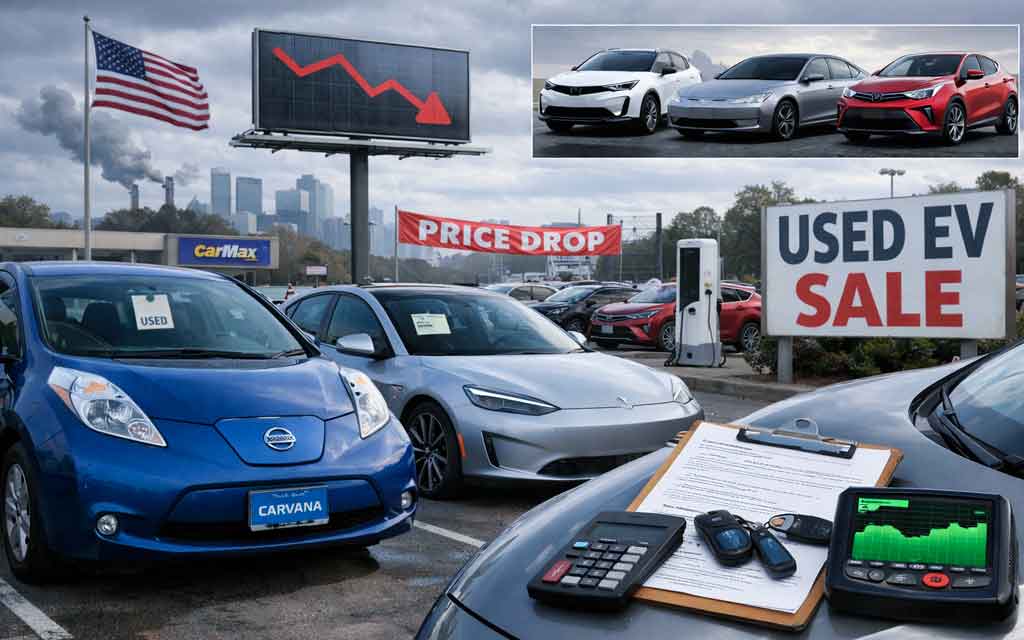
The US electric vehicle (EV) market in February 2026 continues to feel the effects of major policy shifts and economic pressures, creating a challenging environment for new EV buyers while opening doors for savvy shoppers in the used market. With the federal $7,500 EV tax credit expiring at the end of Q3 2025, new EV demand has softened significantly, leading to a noticeable slump in sales. This adjustment period—marked by lower market share, higher effective prices without incentives, and lingering affordability concerns—has reshaped the landscape for American consumers from coast to coast.
According to joint forecasts from J.D. Power and GlobalData, new-vehicle retail sales in February 2026 are projected at around 931,400 units, marking a 4.6% decline from February 2025. EVs are expected to account for just 6.6% of retail sales, down 1.8 percentage points year-over-year. This follows a broader trend: EV share has hovered in the mid-6% range since late 2025, a sharp drop from peaks driven by incentives. Cox Automotive echoes this, projecting total new-vehicle sales at 1.19 million units (down 3.4% year-over-year) and a seasonally adjusted annual rate (SAAR) of 15.6 million—improved from January’s weather-hit pace but still reflecting ongoing headwinds like high new-vehicle prices and economic uncertainty.
The slump stems primarily from the loss of federal tax credits, which had boosted demand in prior years. Without this subsidy, many mass-market buyers face higher upfront costs, pushing some toward hybrids or traditional gas vehicles. Premium segments hold stronger (EVs over 26% of premium sales), but overall retail EV demand remains depressed, especially in non-coastal regions where charging infrastructure lags and range anxiety persists. Automakers have responded with deeper discounts—averaging around $10,000+ on some models—but elevated transaction prices (around $46,500 for EVs) and interest rates continue to pressure volumes.
Despite the new-market slowdown, owner satisfaction tells a different story. The J.D. Power 2026 U.S. Electric Vehicle Experience (EVX) Ownership Study, released in February, shows battery EV (BEV) owner satisfaction at its highest level since the study’s inception in 2021. Premium BEV owners average 786 (up from 756 in 2025), while mass-market BEV owners score 727 (slightly up from 725). Crucially, 96% of current BEV owners say they would consider purchasing or leasing another EV for their next vehicle—even without the expired tax credit. This loyalty highlights real-world benefits like lower operating costs, smooth driving, and advanced features, outweighing initial hurdles for those who make the switch.
For US buyers navigating this slump, the key opportunity lies in the used EV influx. Leases from the 2023-2025 incentive boom are expiring, flooding the market with gently used, low-mileage EVs. Cox Automotive predicts off-lease EV volume will surge, with EV share of lease returns jumping from ~5% in 2025 to 12.5% in 2026 (and higher in 2027). Analysts forecast over 300,000 EVs returning in 2026 alone—creating a buyer’s market with prices dropping significantly. Used EV listing prices have already softened (down ~2.5% in early 2026 per reports), narrowing the gap with gas vehicles to as little as $1,000-2,000 in some cases. Nearly 40% of recent used EV sales fell under $25,000, and models like non-Tesla brands have seen 3-6% price drops post-credit expiration.
This influx could make 2026 one of the best years for affordable EV ownership. Platforms like Carvana, local dealers, and auctions (e.g., Manheim) are seeing increased EV supply, with faster turnover and competitive pricing—especially for 2023-2024 models with remaining battery warranties (typically 8 years/100,000 miles). Tesla models hold value better (up ~4% in some segments), but broader non-Tesla options offer exceptional deals.
Upcoming Models to Watch in 2026
While the slump affects current choices, a robust pipeline promises more affordable and capable options later in the year:
- Acura RSX (second half 2026): Sporty crossover on Honda’s new EV platform, dual-motor AWD, strong performance focus.
- Afeela 1 (late 2026): Sony-Honda sedan with AI-heavy tech, 300+ mile range, starting ~$90,000 (Signature trim).
- Toyota C-HR EV (2026): Compact crossover with up to 287 miles range, appealing to urban buyers.
- Affordable entries like refreshed Chevy Bolt (~$28,000 est.), Nissan Leaf (~$30,000), and Kia EV3 (~$35,000) signal a push toward mass-market accessibility.
These models, combined with improving infrastructure (e.g., more DC fast chargers), could drive a gradual rebound—potentially to ~8% market share by year-end.
Buyer Checklist: Smart EV Purchases in February 2026
To navigate the slump effectively, follow this step-by-step checklist tailored for American buyers:
- Assess Your Needs First — Calculate daily mileage, home charging access, and budget. Use tools like the EPA’s fuel economy site or apps (e.g., PlugShare) to map chargers in your area.
- Compare New vs. Used — Prioritize used for immediate savings. Check sites like Cars.com, Autotrader, or Recurrent for battery health reports on used EVs.
- Hunt Incentives & Deals — Look for manufacturer rebates (often $5,000-$10,000+), state rebates (e.g., California, Colorado), and dealer promotions. Stack with low-interest financing.
- Inspect Battery & Warranty — Verify remaining battery warranty and degradation (aim for <10% loss). Get a pre-purchase inspection focusing on high-voltage components.
- Test Drive & Charge — Experience real-world range in your climate/conditions. Test home charging setup if applicable.
- Factor Total Ownership Costs — EVs save on fuel/maintenance (~$0.03-0.05/mile vs. gas). Use calculators from Edmunds or DOE to compare 5-year costs.
- Consider Hybrids as Bridge — If full EV feels risky, PHEVs/HEVs offer electric benefits with gas backup (13.5% market share in February).
- Time Your Purchase — February-March often sees end-of-quarter deals; watch for tax refund season boosting used inventory.
- Research Reliability & Satisfaction — Reference J.D. Power EVX scores—top models like Tesla Model 3 (804) and Ford Mustang Mach-E (760) lead.
By focusing on used options and upcoming affordable models, buyers can turn the slump into an advantage—securing lower prices and strong long-term value.
The February 2026 EV slump is a transitional phase for the US market, driven by policy changes but buoyed by high owner loyalty and a surging used segment. Smart shoppers who prioritize total cost, real-world fit, and incentives stand to benefit most.
About the Author: Ethan Brooks
The future doesn’t wait — and neither should your feed. If this got you thinking, there’s plenty more where that came from. Browse our latest at VFutureMedia and stick around.
Ethan Brooks covers the tech that’s reshaping how we move, work, and think — for VFuture Media. He was at CES 2026 in Las Vegas when the world got its first real look at humanoid robots, AI-powered vehicles, and Samsung’s tri-fold phone. He writes about AI, EVs, gadgets, and green tech every week. No hype. No filler. X · Facebook



Leave a Comment