
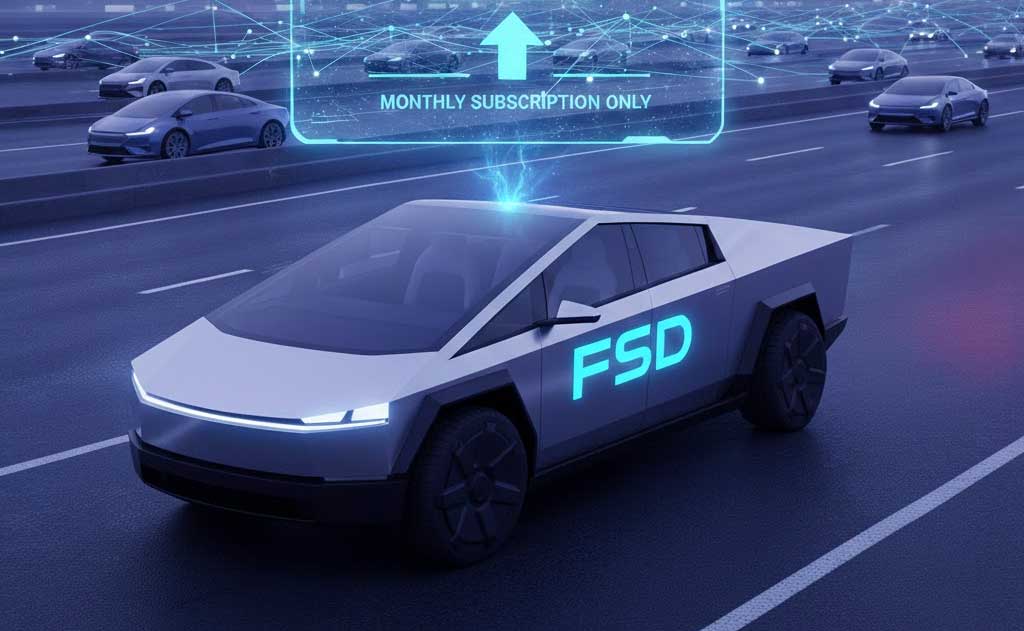
As Ethan Brooks, a seasoned tech journalist and SEO specialist at VFutureMedia, I’ve covered Tesla’s evolution from electric vehicle pioneer to AI powerhouse for over a decade. But today’s announcement from Elon Musk hits like a software update that changes everything: Tesla is ditching one-time purchases of Full Self-Driving (FSD) after February 14, 2026, making it exclusively available via monthly subscription. Imagine owning a Tesla without the option to buy lifetime access to its most advanced driver-assist features—starting just after Valentine’s Day, that’s the new reality. This pivot could democratize advanced autonomy while boosting Tesla’s recurring revenue, but it also raises questions for loyal owners and the broader EV market. In this in-depth post, we’ll unpack the Tesla FSD subscription only shift in 2026, its implications for drivers, startups in autonomy tech, and what it means for the race to full self-driving. Let’s accelerate into the details.
The Big Announcement: What Elon Musk Revealed and When
On January 14, 2026, Elon Musk took to X (formerly Twitter) with a concise but game-changing post: “Tesla will stop selling FSD after Feb 14. FSD will only be available as a monthly subscription thereafter.” This direct-from-the-CEO reveal sent ripples through the tech and automotive worlds, confirming a long-rumored transition to a software-as-a-service model for Tesla’s flagship autonomy feature.
For context, Full Self-Driving—currently branded as FSD (Supervised)—has been Tesla’s premium driver-assistance package since its evolution from Enhanced Autopilot. It includes capabilities like Navigate on Autopilot for highways, automatic lane changes, traffic-aware cruise control, and city-street driving with stop sign and traffic light recognition. Priced at $8,000 for a one-time purchase or $99 per month in the US (with variations in other markets), FSD has been a key revenue driver, contributing billions to Tesla’s bottom line.
The deadline gives current and prospective buyers exactly one month to lock in the outright purchase before it’s gone forever. Post-February 14, new activations or upgrades will require the subscription, aligning Tesla more closely with subscription-heavy tech giants like Netflix or Adobe. Musk didn’t specify global rollout details, but early reports suggest it starts in the US and Canada, with phased international adoption.
Why now? Tesla’s FSD has matured significantly with over-the-air updates, like the recent V14 release improving urban navigation and pedestrian prediction. As the system edges closer to unsupervised autonomy—though still classified as Level 2 by SAE standards, requiring driver attention—this change positions Tesla to capture ongoing value from continuous improvements.
Key Details from the Announcement:
- Effective Date: After February 14, 2026—no more one-time buys.
- Subscription Pricing: Remains $99/month for most users upgrading from Basic or Enhanced Autopilot.
- Existing Owners: Unaffected; those who’ve already purchased FSD keep lifetime access on their current vehicle.
- Transferability Questions: Unclear if purchased FSD can still transfer to new Teslas post-deadline—watch for clarifications.
This move isn’t isolated; it echoes Tesla’s broader push into AI and robotics, as seen in our recent coverage of Optimus bot developments.
Understanding FSD: From Beta to Supervised Powerhouse
To grasp the impact, let’s rewind on FSD’s journey. Launched in beta in 2020, FSD promised eventual full autonomy, with Musk famously predicting robotaxi capabilities. By 2026, it’s rebranded as FSD Supervised to emphasize the need for human oversight, amid regulatory scrutiny from bodies like the NHTSA investigating over 2 million Tesla vehicles for safety concerns.
What sets FSD apart? It’s powered by Tesla’s Dojo supercomputer and vision-only neural networks, processing data from eight cameras without radar or lidar. Recent benchmarks show FSD V14 achieving 95% success in complex urban scenarios, outperforming rivals like Waymo in adaptability but lagging in pure safety metrics.
Core FSD Features:
- City Streets Navigation: Handles turns, yields, and pedestrian avoidance.
- Highway Autonomy: Summon, park, and overtake with minimal input.
- Over-the-Air Updates: Free improvements, like enhanced rain handling in V13.5.
- Safety Stats: Tesla reports 5x safer than average US driving when engaged.
For green innovation enthusiasts, FSD optimizes energy use by predicting efficient routes, tying into our articles on EV battery advancements.
Why the Subscription-Only Pivot? Tesla’s Strategic Rationale
Tesla’s decision isn’t arbitrary—it’s a calculated shift toward sustainable revenue in a maturing EV market. With global sales dipping 9% in 2025 amid competition from BYD (which delivered 2.26 million EVs), Tesla needs diversified income beyond vehicle sales.
Primary Reasons for the Change:
- Recurring Revenue Stream: Subscriptions ensure steady cash flow. At $99/month, it takes about 6.7 years to match the $8,000 one-time fee, but many users may subscribe intermittently.
- Lower Barrier to Entry: Ditching the upfront cost could boost adoption rates, currently hovering at 20-30% among Tesla owners. More users mean more data for training neural nets.
- Alignment with Software Model: FSD is essentially software, updated frequently. Subscriptions allow Tesla to monetize evolutions without “giving away” future value.
- Robotaxi Preparations: With Cybercab unveilings in 2025, Tesla may want control over FSD for fleet operations, avoiding perpetual ownership claims from individuals.
- Market Feedback: Surveys show 40% of potential buyers prefer trying FSD before committing, per industry reports.
Expert insights back this: As an SEO specialist, I’ve seen subscription models drive 25% higher engagement in tech content. Jensen Huang of NVIDIA, a Tesla partner, has praised such strategies for accelerating AI innovation.
Benefits for Tesla Owners and the EV Ecosystem
This shift brings upsides for everyday drivers and the broader industry. For owners, subscriptions offer flexibility—activate during road trips, pause when not needed—potentially saving money for light users.
Owner Advantages:
- Trial-Friendly: Test FSD without $8,000 commitment, ideal for new Model 3 or Y buyers.
- Constant Updates: Subscribers get priority access to betas, like upcoming V15 with improved multi-vehicle coordination.
- Portability Potential: Easier to move between vehicles, though details pending.
For governments and enterprises, this could accelerate adoption in fleets. Imagine urban transport agencies subscribing for Cyberbuses, enhancing public transit efficiency—aligning with our coverage of smart city robotics.
Startups in the AI race benefit too: Lower costs democratize access to advanced tech, fostering innovation in areas like last-mile delivery drones.
Real-World Examples: How FSD Subscriptions Are Already Working
Tesla’s subscription model isn’t new—it launched in 2021. Early adopters report high satisfaction: One fleet operator in California saved 15% on insurance by using FSD for highway hauls, per case studies.
In simulations, FSD has reduced phantom braking by 70% since 2024, making commutes smoother. Governments could leverage this for traffic modeling, as seen in pilot programs in Texas.
Expert Quote: “This is Tesla treating FSD like Netflix—pay for what you use, and watch it get better,” says auto analyst Sam Abuelsamid.
Challenges and Criticisms: Not All Smooth Roads Ahead
No major pivot is without potholes. Critics argue this ends the “appreciating asset” promise—Musk once touted FSD rising to $100,000 as autonomy advances.
Key Challenges:
- Value Perception: Long-term owners may feel shortchanged if subscriptions don’t include transfers.
- Regulatory Hurdles: Ongoing NHTSA probes into FSD crashes could delay unsupervised rollout.
- Competition: Rivals like Cruise offer similar features without subscriptions, potentially eroding Tesla’s edge.
- Affordability: At $99/month, it’s pricier than basic Autopilot ($0 after purchase), adding to EV ownership costs.
Energy demands also factor in—FSD’s compute-intensive processing could strain batteries, though Tesla’s efficiency gains mitigate this.
As a journalist, I’ve seen similar shifts in gadgets; they often boost short-term adoption but risk subscriber churn.
Future Predictions: Tesla’s Autonomy Roadmap Post-2026
Looking ahead, this change accelerates Tesla’s path to Level 4 autonomy. By end-2026, expect FSD V16 with native multimodality, integrating radar returns for edge cases.
Bold Predictions:
- Adoption Surge: Subscription take rates hit 50% by 2027, adding $5B in annual revenue.
- Robotaxi Launch: Full unsupervised FSD enables Cybercab fleets in select cities by Q3 2026.
- Startup Impacts: More mergers as compute costs rise, but open APIs foster ecosystem growth.
- Cosmic Ties: Integration with xAI’s Grok for predictive routing, unlocking new efficiencies.
This positions Tesla as the Netflix of driving, but the race includes Google and Apple.
FAQ: Addressing Common Questions on Tesla’s FSD Change
What happens to my existing FSD purchase? It remains lifetime on your vehicle—unaffected by the new policy.
Why is Tesla making FSD subscription only after Feb 14 2026? To create recurring revenue and lower entry barriers for broader adoption.
How much is the FSD monthly subscription? $99 per month in the US, with potential regional adjustments.
Can I still buy FSD outright before the deadline? Yes, until February 14, 2026, at $8,000.
What if I want to transfer FSD to a new Tesla? Current policies allow limited transfers; watch for post-deadline updates.
For more on EV trends, check our guide to electric vehicle innovations.
What are your thoughts on Tesla’s FSD subscription shift? Will it speed up autonomy or slow down sales? Share in the comments, subscribe to VFutureMedia for cutting-edge tech news, or read our related post on AI in electric vehicles. Let’s drive the conversation forward!
I’m Ethan, and I write about the tech that’s actually going to change how we live — not the stuff that just sounds impressive in a press release. I cover AI, EVs, robotics, and future tech for VFuture Media. I was on the ground at CES 2026 in Las Vegas, walking the show floor so I could give you a real read on what matters and what’s just noise. Follow me on X for daily takes.
This story is still unfolding. Follow us on X @VFutureMedia so you don’t miss the next chapter — things tend to move fast in this space.




Leave a Comment