
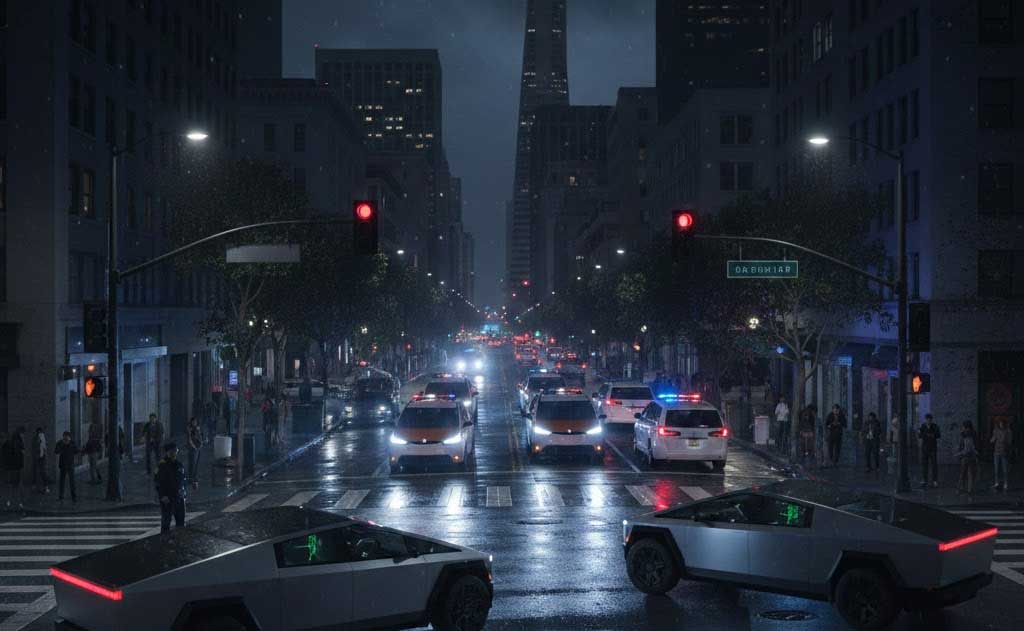
December 22, 2025 – In a real-world test of autonomous vehicle reliability, Tesla’s Robotaxi fleet continued operating smoothly during a massive power outage that struck San Francisco on December 20, while rival Waymo suspended services and saw vehicles stall across the city. Tesla CEO Elon Musk highlighted the contrast on X, stating: “Tesla Robotaxis were unaffected by the SF power outage.”
This incident underscores the growing resilience of vision-based autonomous systems in unpredictable scenarios, offering a glimpse into the future of urban mobility where AVs must handle infrastructure failures without disruption.
The Outage: Chaos on San Francisco Streets
The blackout began Saturday morning, triggered by a fire at a Pacific Gas & Electric (PG&E) substation in the South of Market area around 2:15 p.m. It rapidly expanded, affecting approximately 130,000 customers—roughly one-third of the city—including neighborhoods like the Richmond, Sunset, Presidio, Golden Gate Park, and parts of downtown.
Traffic lights went dark, leading to gridlock and manual direction by emergency personnel. Public transit disruptions included Muni line shutdowns and BART station closures. By Sunday morning, power was restored to about 110,000 customers, with full restoration expected later in the day.
Social media videos captured the chaos: Multiple Waymo vehicles stalled at intersections, hazard lights flashing, blocking lanes and forcing human drivers to navigate around them. Waymo, Alphabet’s driverless ride-hail leader, temporarily suspended operations in the Bay Area, citing the widespread outage and safety priorities.
A Waymo spokesperson explained: “We have temporarily suspended our ride-hailing services… due to the widespread power outage.” Services resumed Sunday evening after coordination with city officials.
Tesla’s FSD Shines: Vision-Based Training Pays Off
In stark contrast, Tesla vehicles equipped with Full Self-Driving (FSD)—including those in the Robotaxi testing fleet—navigated the darkened streets without issue. Videos shared online showed Teslas smoothly handling intersections with non-functioning traffic lights, treating them as all-way stops or proceeding cautiously based on real-time vision.
Elon Musk’s post quickly went viral, emphasizing Tesla’s approach: Trained on billions of real-world miles, including diverse scenarios like power outages, FSD relies primarily on cameras and neural networks rather than heavy dependence on external signals or infrastructure data.
Experts note key differences:
- Waymo’s system integrates lidar, radar, and high-definition maps, potentially relying on live traffic signal data or cellular connectivity for optimal performance. Dark signals or connectivity dips may trigger conservative safety protocols, leading to stops.
- Tesla’s vision-only strategy mimics human driving: Observing the environment directly, inferring rules from context (e.g., treating blank lights as stops), and adapting fluidly.
Bryan Reimer, MIT researcher on automated systems, commented on similar incidents: Power outages are predictable challenges, highlighting the need for robust backups—but Tesla’s data-driven training appears to provide an edge here.
Implications for the Autonomous Future
This event arrives as robotaxi competition heats up:
- Waymo leads in fully driverless miles in the U.S., operating unsupervised in San Francisco and expanding elsewhere.
- Tesla is ramping up Robotaxi testing, with unsupervised FSD deployments in select areas and plans for broader rollout in 2026.
The outage exposes vulnerabilities: As AV fleets grow, cities must consider how vehicles behave during grid failures, natural disasters, or cyber events. Critics of rapid AV expansion point to blocked routes in emergencies, while proponents argue real-world incidents like this accelerate improvements.
For Tesla, it’s a marketing win and validation of its end-to-end neural net approach, which scales with fleet data. Supporters on social media hailed it as proof that “Tesla FSD handles edge cases better.”
Broader Context: AV Resilience in a Changing World
With climate-driven extreme weather increasing outage risks, autonomous vehicle makers are prioritizing robustness. Tesla’s over-the-air updates allow rapid fleet-wide improvements post-incident.
As urban areas integrate more AVs, incidents like this will inform regulations—from California’s CPUC oversight to national NHTSA guidelines.
The San Francisco blackout serves as an unintended stress test, revealing strengths in Tesla’s system while prompting industry-wide reflection on infrastructure dependencies.
For the latest on autonomous vehicles, Robotaxi developments, EV infrastructure resilience, and future mobility trends, visit vfuturemedia
I’m Ethan, and I write about the tech that’s actually going to change how we live — not the stuff that just sounds impressive in a press release. I cover AI, EVs, robotics, and future tech for VFuture Media. I was on the ground at CES 2026 in Las Vegas, walking the show floor so I could give you a real read on what matters and what’s just noise. Follow me on X for daily takes.


Leave a Comment