
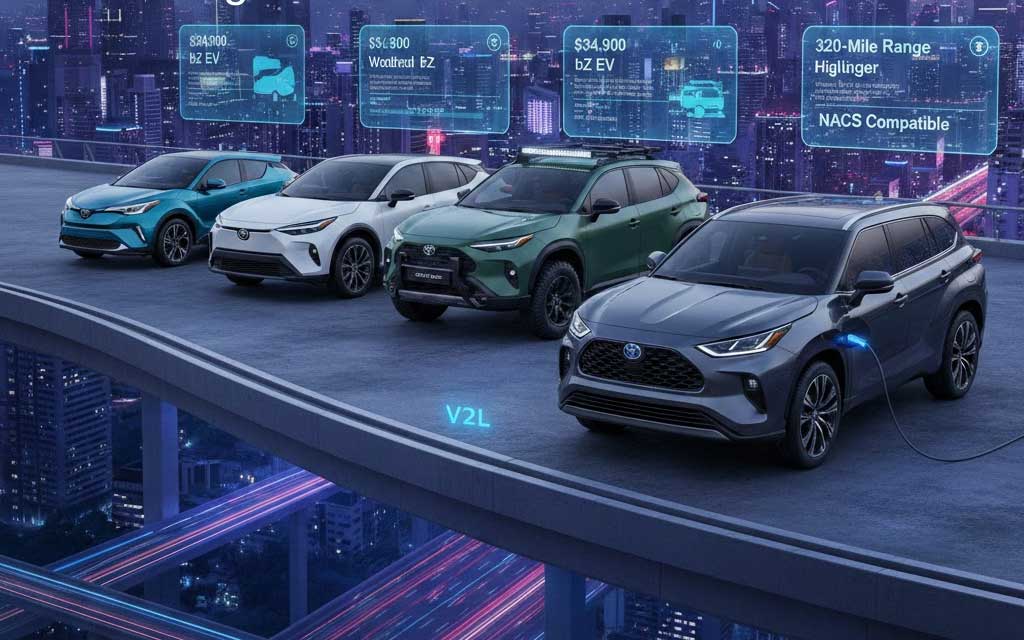
Toyota is finally getting aggressive in the EV space, and the Toyota Highlander EV is leading the charge as the headliner in a fresh lineup of four new electric SUVs rolling out in 2026 and beyond. After years of cautious hybrid dominance and slower full-EV adoption, Toyota is pushing hard with dedicated battery-electric models that address family needs, range anxiety, and real-world usability. This comes at a time when global auto sales showed some softening in early 2026 (including broader EV market dips in regions like China and the US due to policy shifts and subsidy changes), yet Toyota’s overall strength—built on legendary reliability—positions these EVs to capture hesitant buyers shifting from gas or hybrids.
Toyota’s 4 New EV SUVs: Specs, Pricing, and Timeline
Toyota’s expanding BEV lineup covers compact to three-row family needs, with NACS compatibility for Tesla Supercharger access on most models:
- 2026 Toyota C-HR (compact crossover): Starts around $37,000 with standard AWD. It’s city-focused, stylish, and maneuverable for urban drivers.
- 2026 Toyota bZ (updated from bZ4X, mid-size): Priced under $35,000 (starting ~$34,900), with up to 314 miles estimated range (a ~25% boost over prior models), more power (up to 338 hp in AWD), refined interior, and NACS port for seamless charging.
- 2026 Toyota bZ Woodland (off-road-oriented): Around $40,000, with 375 hp, AWD with X-Mode, and rugged features like roof rails—perfect for adventure seekers.
- 2027 Toyota Highlander EV (three-row family SUV, flagship): The star here—Toyota’s first U.S. three-row BEV, built in Kentucky. Available in XLE and Limited grades with FWD or AWD options. Key specs include up to 338 hp (AWD), manufacturer-estimated 320 miles range on the larger 95.8-kWh battery (smaller 77-kWh option available), bidirectional charging (V2L/V2H capability—rare even among competitors), and Toyota Safety Sense 4.0 ADAS. Pricing expected $50,000–$55,000, with sales starting late 2026 into 2027.
These models join Toyota’s broader electrified push (aiming for 22 variants soon), emphasizing reliability that Toyota owners have trusted for decades. From my own hands-on testing—including the bZ4X and other Toyota EVs at events—Toyota’s build quality shines through in ride refinement, quiet cabins, and long-term durability that often outlasts flashier rivals.
Buyer Appeal: Overcoming Legacy Hesitation
Many Toyota loyalists hesitate on full EVs due to past limited range, charging concerns, or preference for hybrids. These new models counter that directly: competitive pricing (especially the sub-$35k bZ), strong range estimates, NACS for widespread fast charging, and family-friendly features like three rows in the Highlander. Versus the Tesla Model Y (popular but often criticized for build quality) or upcoming Rivian R2 (more adventure-focused, potentially higher-priced), Toyota’s EVs lean on proven brand loyalty—stats show Toyota consistently tops reliability rankings—and U.S. assembly for potential incentives. Add bidirectional charging on the Highlander (power your home or tools during outages), and it appeals to practical families wary of pure EV risks.
AI and Tech Integration in Toyota’s EVs
Toyota is weaving AI deeply into these vehicles for smarter ownership:
- Battery thermal management and range prediction → AI optimizes cooling/heating to maintain efficiency in extreme weather, predicting real-world range based on driving habits, traffic, and elevation.
- Toyota Guardian-style ADAS evolution → Advanced AI enhances proactive safety, like predictive collision avoidance and smoother semi-autonomous driving.
- AI-driven design and assembly efficiencies → Streamlines production for better quality control and cost savings passed to buyers.
- Consumer personalization → AI route optimization integrates NACS Superchargers, suggesting efficient paths, preconditioning the battery, and even personalizing cabin settings.
These features make EVs feel more intuitive and less intimidating.
Broader Implications for Mass EV Adoption
Amid a January 2026 global EV sales slowdown (down ~3% YoY per some reports, tied to policy changes and market adjustments), Toyota’s aggressive expansion is timely. While rivals scale back, Toyota fills gaps with accessible, reliable options—potentially accelerating mainstream adoption. Strengths like solid range, competitive pricing, and charging access are huge wins, but success hinges on robust infrastructure growth (NACS helps immensely) and sustained incentives. For families eyeing a three-row upgrade without sacrificing Toyota’s legendary dependability, the Highlander EV could be the tipping point.
About the Author Ethan Brooks is an automotive journalist and EV enthusiast with deep experience covering electrification. He’s attended multiple Tesla and Rivian events, tested the Toyota bZ4X extensively, and driven countless hybrids/EVs. His focus: practical insights on reliability, real-world performance, and how emerging tech like AI shapes the future of driving.
We started VFuture Media because we wanted tech news written by people who actually follow this industry — not content farms chasing keywords. If that resonates, we’d love to have you as a regular reader. Pull up a chair.



Leave a Comment