
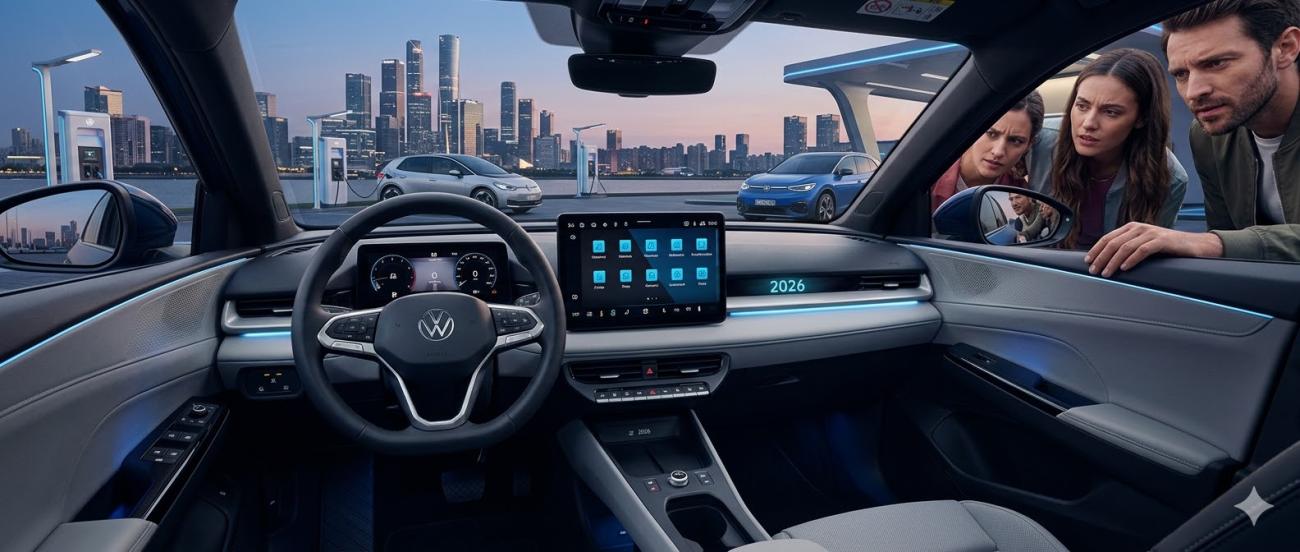
As a tech journalist covering the electric vehicle space for VFutureMedia.com, I’ve seen Volkswagen’s EV journey evolve from bold promises to real-world challenges. The early ID. models, particularly the ID.3 and ID.4, faced significant backlash over their touchscreen-heavy interfaces—drivers complained about distracting haptic sliders, accidental touches, and a lack of tactile feedback during critical tasks like adjusting climate controls or volume. Volkswagen’s design team openly admitted this was a misstep, with Chief Designer Andreas Mindt stating that future models would prioritize “clear physical buttons” to provide “stability and trust.”
Fast-forward to January 2026, and the near-production reveal of the ID. Polo interior marks a decisive turning point. This sub-€25,000 (~$29,500) electric supermini isn’t just another EV—it’s Volkswagen’s strategic response to years of criticism, a deliberate pivot toward user-centric design, and a direct challenge to the affordable segment dominated by Chinese competitors. By blending physical controls, high-quality sustainable materials, and clever nostalgic touches, the new ID. Polo interior could genuinely win back skeptical buyers who felt alienated by the brand’s earlier digital experiments.
The Touchscreen Backlash: Why Volkswagen Had to Change Course
Volkswagen’s shift to touchscreen-dominated cabins began with the goal of creating sleek, futuristic interiors. However, real-world feedback quickly exposed the flaws. Capacitive sliders for temperature and volume were prone to misfires, requiring drivers to take their eyes off the road—sometimes for seconds at a time. Independent studies, including those from traffic safety organizations, highlighted how touchscreen interactions can increase distraction risks compared to physical switches.
Customer surveys and online forums amplified the frustration. Owners of early ID. models described the experience as “frustrating” and “unsafe,” particularly for everyday tasks. By mid-2025, Volkswagen leadership acknowledged the issue publicly. Design boss Andreas Mindt emphasized in interviews that “it’s a car, not a phone,” promising a return to tactile controls starting with entry-level models like the ID. Polo (previously known as the ID.2all concept).
This redesign aligns with broader industry trends and regulatory pressures. Starting in 2026, Euro NCAP safety ratings penalize vehicles relying excessively on touchscreens for essential functions, requiring dedicated physical controls for items like hazard lights to maintain five-star ratings. Volkswagen’s proactive move positions the ID. Polo not just as a compliant vehicle but as a leader in intuitive, driver-focused EV design.
For more on EV safety standards, read our guide: Euro NCAP 2026 Changes: What They Mean for Electric Vehicles.
Breaking Down the New ID. Polo Interior: Physical Buttons Take Center Stage
The ID. Polo’s cockpit represents a complete rethink of Volkswagen’s interior philosophy. Key highlights include:
- Dedicated physical buttons for HVAC essentials: A neat row below the 13-inch infotainment touchscreen handles temperature, fan speed, and hazard lights—no more fumbling with sliders.
- Rotary volume knob on the center console: This doubles for track and station selection, offering precise, tactile feedback that’s easy to use without looking away.
- Redesigned multifunction steering wheel: Clear, grouped hard buttons replace capacitive surfaces for cruise control, media, and phone functions, eliminating the “guessing game” of earlier designs.
- 10.25-inch digital driver display: Mounted traditionally on the dashboard (unlike awkward previous placements), it delivers high-resolution, clear information with tidy menu structures.
- Sustainable, premium materials: Fabric covers the dashboard, doors, and console, creating a warm, inviting “Pure Positive” atmosphere with recycled content that feels upscale for the price point.
These changes prioritize safety, usability, and emotional connection. Mindt describes the interior as “an affordable friend for everyday life,” with physical buttons providing immediate trust and confidence.
A standout feature is the retro display mode: Press a button, and the digital instruments switch to 1980s Golf-inspired analog dials and cassette-deck graphics—a charming nod to Volkswagen heritage that adds personality without overwhelming the modern tech.
This holistic approach stems directly from customer input, making the ID. Polo feel welcoming from the first sit-in. It’s a compact car with a “big heart,” blending nostalgia, practicality, and forward-thinking efficiency.
For deeper insights into Volkswagen’s design shift, check our related article: From ID. Buzz to ID. Polo: Volkswagen’s Pure Positive Design Era.
Affordable Accessibility: Pricing, Specs, and Real-World Appeal
The ID. Polo targets mass-market buyers with a starting price under €25,000 in Europe (base models may arrive slightly later in 2026 after higher-spec launches). Built on the upgraded MEB+ platform with front-wheel drive, it delivers:
- Battery options: 37 kWh LFP for entry-level models (~200-250 miles WLTP range) and 52 kWh NMC cell-to-pack for higher trims (up to 450 km/280 miles WLTP).
- Power variants: 85 kW (116 PS), 99 kW (135 PS), and 155 kW (211 PS) at launch, with a GTI version (166 kW/226 PS) following later in 2026.
- Charging: Up to 130 kW DC fast charging on larger-battery models, plus efficient energy use for real-world urban and highway driving.
- Dimensions and practicality: At 4,053 mm long with a 2,600 mm wheelbase, it offers surprising interior space for five passengers and 435 liters of cargo—more versatile than many rivals.
This combination makes the ID. Polo a practical daily driver: efficient for city commutes, capable on longer trips, and affordable enough to compete in the sub-€30,000 segment without subsidies.
Facing the Chinese Competition: Strengths and Strategic Advantages
The affordable EV market in Europe is increasingly dominated by Chinese brands. BYD (with models like the Dolphin starting around €26,000-€30,000) and MG (MG4 from ~€27,000) lead with aggressive pricing, long ranges, and tech-heavy features. These vehicles often undercut European rivals while offering competitive specs, thanks to vertical integration in batteries and supply chains.
Volkswagen counters with several key advantages:
- European build quality and brand trust: Assembled in Spain (Martorell plant), the ID. Polo benefits from Volkswagen’s reputation for reliability, safety, and resale value—factors many buyers still prioritize over pure price.
- User-focused interior: While Chinese models lean heavily on large touchscreens and software gimmicks, the ID. Polo’s physical buttons address a real pain point that many rivals still ignore. This could sway buyers frustrated with digital overload.
- Heritage and familiarity: The Polo name carries decades of goodwill as a reliable supermini. Adding electric power while keeping the intuitive feel of traditional VWs creates emotional appeal.
- Regulatory alignment: Compliance with 2026 Euro NCAP rules (and potential future global standards) gives it an edge in safety-conscious markets.
Chinese brands excel in value and rapid innovation, but Volkswagen’s focus on tactile usability, sustainable materials, and brand loyalty could carve out a loyal niche. The ID. Polo isn’t trying to win a specs war—it’s winning the usability war.
Future Outlook: Volkswagen’s 2026 EV Offensive
The ID. Polo launches in spring 2026 as the first of six new Volkswagen EVs that year, including the ID. Cross SUV. If the interior redesign resonates, it could restore confidence in the brand’s electric strategy and help reclaim share in the compact segment.
This model feels like Volkswagen finally hitting its stride: respecting heritage, listening to customers, and delivering an EV that’s practical, affordable, and enjoyable.
Insert infographic here: ID. Polo vs. key competitors (BYD Dolphin, MG4, Renault 5) — price, range, and interior control comparison.
FAQ: ID. Polo Interior and Affordable EV Questions
Why is Volkswagen bringing back physical buttons in the ID. Polo? Customer backlash against distracting touch controls in earlier ID. models prompted the change. Physical buttons offer safer, more intuitive operation, aligning with Euro NCAP 2026 safety requirements.
What’s the expected starting price of the ID. Polo? Under €25,000 (~$29,500) in Europe, positioning it as one of the most accessible mainstream EVs, though base variants may launch after higher-spec models.
How does the ID. Polo compare to Chinese rivals like BYD Dolphin and MG4? It emphasizes European build quality, familiar controls, and VW heritage over pure tech specs. Physical buttons and premium-feeling materials could attract buyers tired of touchscreen-heavy designs.
Will the ID. Polo be available outside Europe? Currently focused on Europe with no U.S. plans confirmed. Global interest remains high for affordable EVs.
What’s next for Volkswagen EVs in 2026? The ID. Polo kicks off six new models, including SUVs and performance variants. The interior philosophy will roll out across the lineup.
What do you think—will the return of physical buttons and retro flair convince you to consider a Volkswagen EV again? Share your thoughts in the comments, share this post with fellow EV enthusiasts, and subscribe to VFutureMedia.com for the latest updates on electric mobility, green innovation, and future tech!
— Ethan Brooks, Tech Journalist at VFutureMedia

| Ethan Brooks covers the tech that’s reshaping how we move, work, and think — for VFuture Media. He was at CES 2026 in Las Vegas when the world got its first real look at humanoid robots, AI-powered vehicles, and Samsung’s tri-fold phone. He writes about AI, EVs, gadgets, and green tech every week. No hype. No filler. X · Facebook |




Leave a Comment