
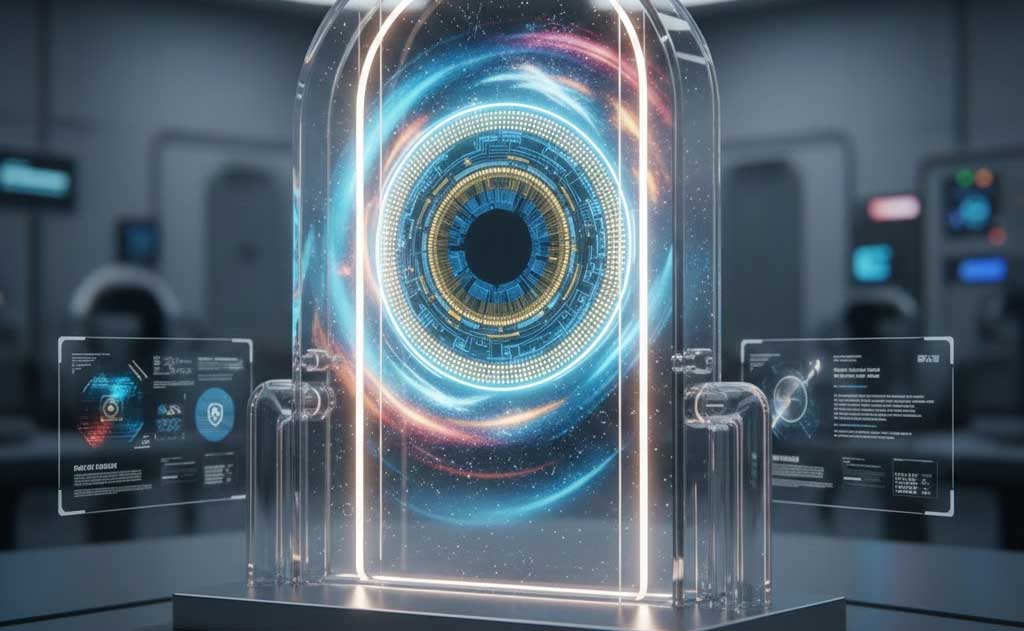
As Ethan Brooks, lead tech journalist at VFutureMedia specializing in quantum computing and emerging technologies, I’ve been tracking Google’s Quantum AI efforts closely. Here in January 2026, the conversation around their Willow processor remains electric. Launched in late 2024, Willow didn’t just push hardware boundaries—it ignited one of the most intriguing scientific debates of our time: Could this quantum chip be evidence that computations tap into parallel universes?
The core claim? Willow solved a benchmark task in under five minutes that would take today’s fastest classical supercomputers an astonishing 10 septillion years—that’s 10 followed by 24 zeros, a timescale vastly exceeding the universe’s age. Hartmut Neven, founder and lead of Google Quantum AI, highlighted how this performance “lends credence to the notion that quantum computation occurs in many parallel universes,” aligning with the many-worlds interpretation of quantum mechanics.
But is this proof of a multiverse, or simply the result of brilliant quantum engineering? Let’s break it down with the latest 2026 insights.
What Makes Willow a Game-Changer?
Willow is a 105-qubit superconducting quantum processor that achieved a critical milestone: scalable error correction. Qubits are notoriously fragile—tiny disturbances cause errors—but Willow demonstrated that adding more qubits actually reduces error rates exponentially. This “below-threshold” breakthrough, pursued for nearly 30 years, is now reality.
In October 2025, Google took it further with the Quantum Echoes algorithm. This out-of-order time correlator (OTOC) protocol ran on Willow, delivering verifiable quantum advantage. It simulated complex physics processes 13,000 times faster than the best classical algorithms on top supercomputers like Frontier. The task took Willow just over two hours versus years on classical systems.
These results aren’t hype—they’re published in top journals like Nature and represent repeatable, beyond-classical computation.
The Multiverse Debate: What Hartmut Neven Really Said
The multiverse angle comes from the many-worlds interpretation (MWI), proposed by Hugh Everett and championed by physicist David Deutsch. In MWI, every quantum possibility branches into parallel realities. A quantum computer, using superposition, effectively explores vast numbers of paths simultaneously—as if “borrowing” power from those branches.
Neven has been careful but provocative. In his original 2024 announcement and follow-up interviews, he noted Willow’s mind-boggling speed “suggests we should take this idea seriously.” He referenced how the computation touches 2 to the power of 105 combinations in one cycle, prompting questions: Where do these possibilities “happen”?
Critics counter that no direct evidence proves parallel universes. Standard quantum effects—superposition, entanglement, and interference—fully explain the performance without invoking extra realities. Interpretations like Copenhagen (wave function collapse) or others suffice.
As of 2026, the debate is spirited but philosophical. Willow proves quantum advantage is real and scaling; the multiverse remains an intriguing lens, not settled science.
Real-World Benefits Emerging in 2026
Willow’s breakthroughs point to practical impacts sooner than expected:
- Drug Discovery & Chemistry — Simulating molecular structures at quantum scales could accelerate new medicines and materials design.
- Materials Science — Modeling superconductors or advanced batteries for better energy storage.
- Physics Insights — Quantum Echoes probes information scrambling, with potential ties to black hole physics and quantum chaos.
- Optimization & AI — Tackling problems too complex for classical systems, enhancing machine learning.
Google’s roadmap suggests quantum-enhanced sensing by 2029, with fault-tolerant systems following. In 2026, we’re seeing the shift from benchmarks to verifiable, science-relevant tasks.
Key Challenges Still Ahead
Despite progress, hurdles remain:
- Noise & Scalability — Qubits need near-absolute zero; scaling to millions for full utility is ongoing.
- Energy & Infrastructure — Cryogenic cooling demands massive power, tying into broader tech energy debates.
- Security Implications — Quantum speed threatens current encryption—post-quantum cryptography is essential now.
- Verification & Access — Ensuring results are independently verifiable, as with Quantum Echoes, builds trust.
These challenges make quantum tech mature faster than skeptics predicted.
Expert Perspectives on the Frontier
From Neven himself: Willow’s feats make you question the “where” of quantum possibilities, with many-worlds as a compelling framework—though he stresses it’s suggestive, not proof.
The scientific community agrees on one thing: Willow settles quantum advantage debates. Classical computers can’t compete on these tasks anymore.
Looking Ahead: 2026 and Beyond
This year is pivotal. With Willow’s momentum, expect:
- More verifiable algorithms for real scientific problems.
- Industry partnerships accelerating applications in medicine and materials.
- Intensified global competition pushing timelines forward.
Quantum isn’t just faster computing—it’s a new way to explore nature’s rules. Whether it hints at multiverses or reveals deeper quantum truths, machines like Willow are reshaping reality’s possibilities.
FAQ: Your Top Questions Answered
Does Google’s Willow prove we live in a multiverse? No definitive proof, but its extreme performance aligns suggestively with many-worlds theory. Most physicists attribute it to standard quantum superposition.
How fast is Willow really? It completed benchmarks in minutes/hours that would take supercomputers septillions of years or thousands of times longer, with 13,000× speedups on physics simulations.
What practical uses are coming soon? Near-term: advanced simulations for drugs, materials, and physics. Google targets sensing advantages within years.
Is quantum computing ready for everyday use? Not yet—still noisy and specialized—but 2026 shows rapid progress toward practical tools.
What blows your mind most about Willow—the speed, the error breakthrough, or the multiverse idea? Share your thoughts in the comments below. If you’re as excited about quantum’s future as we are at VFutureMedia, subscribe for more updates on AI, robotics, and next-gen tech. Let’s keep exploring the quantum frontier together!
If you found this useful, the best thing you can do is share it with someone who’d actually appreciate it. And if you want more like it, we’re here every week.


Leave a Comment