

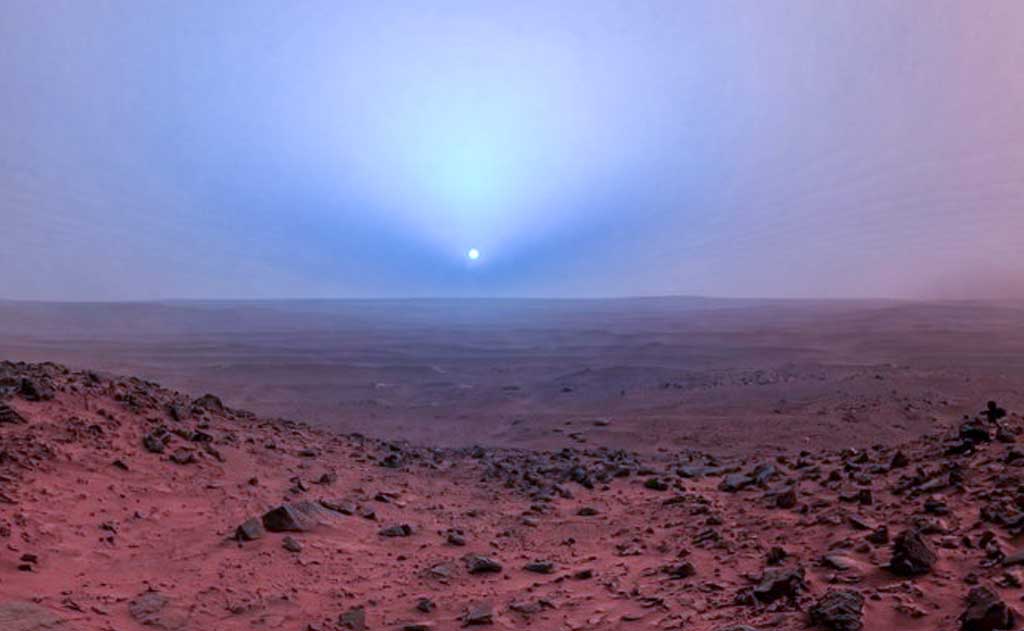
NASA’s Curiosity rover continues to mesmerize space enthusiasts worldwide with its latest images of Martian sunsets. These stunning twilight views, captured in recent weeks and shared in early 2026, reveal a dramatically different sunset experience compared to Earth: a compact, distant Sun surrounded by a distinctive bluish glow, created by fine dust particles scattering sunlight in Mars’ thin atmosphere.
As part of its ongoing twilight observation campaign, Curiosity has also documented beautiful crepuscular rays — dramatic beams of sunlight slicing through high-altitude clouds during dusk. These images not only showcase the eerie beauty of another world but also provide valuable scientific data about Mars’ atmospheric behavior, dust distribution, and seasonal cloud patterns.
The Unique Science of Martian Sunsets
On Earth, sunsets glow in warm oranges, reds, and pinks because blue light scatters widely in our thicker atmosphere, leaving longer red wavelengths to dominate the view near the horizon. Mars flips this effect entirely.
- The Martian atmosphere is extremely thin (about 1% of Earth’s density) and filled with ultra-fine dust rich in iron oxides.
- These dust particles preferentially scatter red and yellow light, while blue light travels more directly through the sky.
- As a result, the area around the setting Sun takes on a glowing blue halo, often described as steely blue or azure, while the rest of the sky remains hazy and reddish-brown.
The Sun itself appears noticeably smaller from Mars due to the planet’s greater average distance from the Sun (about 228 million km vs. Earth’s 150 million km). Combined with the dust scattering, these factors create one of the most alien and hauntingly beautiful sunset scenes in the solar system.
Crepuscular Rays: Sunbeams Through Martian Clouds
Curiosity has also imaged crepuscular rays (sometimes called “God rays” or “Jacob’s ladder”) during twilight. These occur when sunlight streams through gaps in clouds or haze, scattering off ice crystals or dust particles and forming visible beams that appear to converge toward the Sun.
Recent captures show these rays piercing through thin, high-altitude water-ice clouds during Martian dusk — a phenomenon Curiosity first clearly documented several years ago and continues to monitor. These observations help scientists understand:
- Cloud formation and dissipation on Mars
- Seasonal cycles of atmospheric water vapor
- How dust storms influence twilight visibility and sky color
- Potential implications for future human missions (e.g., how dust and clouds affect solar power generation)
Why Curiosity Keeps Studying Martian Twilight
Now well over a decade into its mission (landing in August 2012), the rover is exploring the lower slopes of Mount Sharp inside Gale Crater. While its primary science focuses on ancient habitability — searching for signs of past water and organic molecules — twilight imaging serves dual purposes:
- Purely scientific: Tracking atmospheric opacity, dust loading, and cloud properties over time.
- Public inspiration: Delivering jaw-dropping views that connect people emotionally to Mars exploration.
These sunset photos remind us that even on a cold, dusty world billions of kilometers away, the simple act of a star setting behind the horizon can still feel poetic and profound.
Looking Ahead: Mars Exploration in 2026 and Beyond
Curiosity’s twilight campaign adds to the growing library of Mars atmospheric data, complementing observations from orbiters like MAVEN and the upcoming Mars Sample Return mission. As NASA and international partners prepare for human missions in the 2030s, understanding Mars’ skies — from dust storms to twilight clouds — will be critical for planning safe landings, habitats, and energy systems.
For now, these latest images stand as a quiet reminder of the Red Planet’s quiet, otherworldly beauty.
Stay tuned for the latest updates on Mars missions, rover discoveries, space science breakthroughs, and futuristic exploration tech at www.vfuturemedia.com — your source for forward-looking stories from the final frontier.
Note: All descriptions are based on NASA’s publicly released Curiosity rover data and imagery as of February 2026. Martian sunset appearance varies with dust levels, season, and rover location.


Leave a Comment