
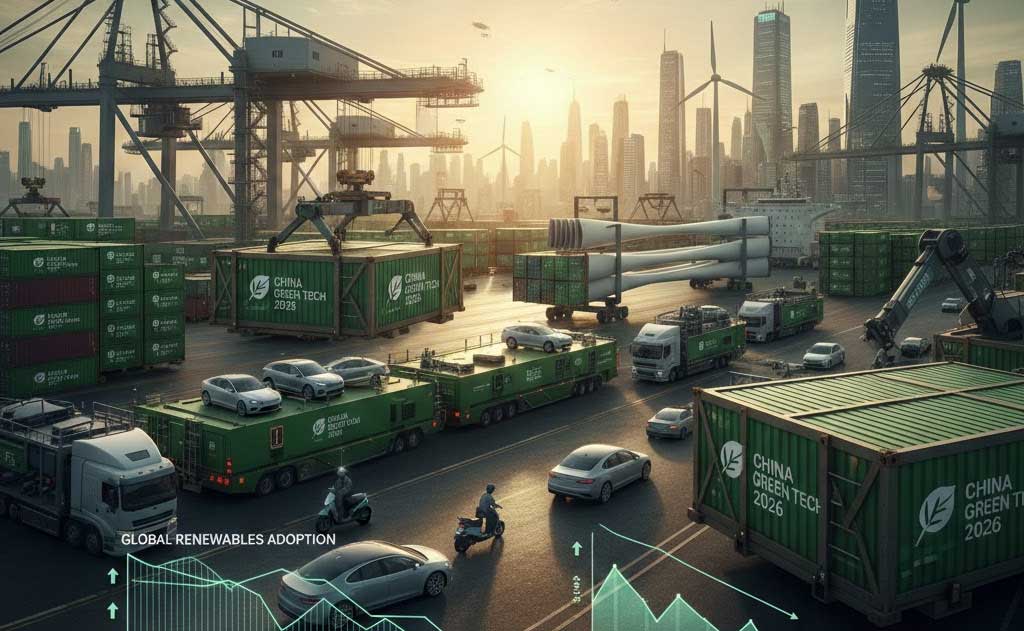
As we step into 2026, the world is witnessing an unprecedented wave of clean energy transformation—and China is at the epicenter. With record-breaking exports of solar panels, batteries, and electric vehicles (EVs), Chinese manufacturers are flooding global markets with affordable, high-quality green tech. This “tsunami” isn’t just boosting China’s economy; it’s accelerating renewable energy adoption and EV transitions worldwide, especially in developing nations that might otherwise remain locked into fossil fuels.
Despite U.S. policy rollbacks and escalating tariffs in some markets, China’s dominance continues to drive down costs, enabling a faster, more inclusive global energy shift. In this deep dive, we explore the latest data, the role of China’s upcoming 15th Five-Year Plan (2026-2030), and how this export surge is reshaping the planet’s clean energy future.
Record Exports: Batteries, EVs, and Solar Leading the Charge
China’s clean energy exports have shattered records in recent years. In August 2025 alone, the country hit $20 billion in monthly clean tech shipments—a new high—driven by surging demand for EVs (up 26% year-on-year in the first eight months) and batteries (up 23%). Batteries have become the top earner, accounting for roughly 37% of clean energy export revenues in 2025, followed closely by EVs.
Key highlights from 2025 data (with momentum carrying into 2026):
- Batteries and storage systems: Nearly $66 billion in sales for the year, making them China’s most lucrative clean tech export.
- EVs: Around $54 billion exported, with steady annual growth since 2019.
- Solar PV components: While value dipped due to price drops, capacity exports set records—46 GW of panels shipped in August 2025 alone, exceeding Australia’s entire installed solar capacity.
Since 2018, China has shipped nearly $1 trillion worth of batteries, solar components, EVs, and wind systems globally. Prices for solar panels have plummeted over 80% in the last decade, making renewables more accessible than ever and fueling explosive demand in emerging markets.
This export boom is no accident—it’s tied to massive domestic manufacturing scale, supply chain control, and aggressive innovation from giants like BYD, CATL, and LONGi.
The 15th Five-Year Plan: Doubling Down on Green Dominance (2026-2030)
China’s 15th Five-Year Plan (officially rolling out in early 2026) cements green tech as a national priority. Recommendations from late 2025 emphasize accelerating the “new energy system,” building green production and lifestyles, and achieving carbon peaking by 2030 as scheduled.
Key targets include:
- Non-fossil fuels (renewables, nuclear, hydro) reaching ~25% of primary energy consumption by 2030.
- Wind and solar capacity exceeding 1,200 GW (a goal already met early in some projections).
- Focus on innovation-driven growth, technological self-reliance, and sustainable development.
This plan positions green exports as a dual engine: economic growth and global decarbonization. By prioritizing renewables at home, China creates surplus capacity for export—driving down global costs and enabling faster transitions elsewhere.
Leapfrogging Fossil Fuels: How China Helps Developing Nations Go Green
The real game-changer is China’s impact on the Global South. Affordable Chinese tech allows countries to skip traditional fossil fuel infrastructure and leap straight to renewables and EVs—a phenomenon experts call “green leapfrogging.”
Examples already emerging in 2025-2026:
- Pakistan has abandoned natural gas as a strategic fuel after massive purchases of Chinese solar panels and batteries.
- Ethiopia effectively banned fossil-fuel car imports, sparking a surge in EV sales powered by Chinese models.
- ASEAN (e.g., Indonesia) saw Chinese EV exports surge 75% in early 2025, making Indonesia the 9th-largest EV market globally.
- Africa experienced explosive growth: Chinese EV exports nearly tripled (+287%), with Nigeria seeing a six-fold increase.
Over half of China’s EV export growth in 2025 came from non-OECD (developing) countries. Exports to Africa, Latin America, the Middle East, and Southeast Asia are booming, with Chinese firms like BYD leading the charge—aiming for up to 1.6 million overseas vehicle sales in 2026.
These technologies displace millions of tons of CO2 annually. Chinese exports in 2024 alone were projected to avoid 220 million tons of overseas emissions per year once installed—equivalent to 1% of global CO2 reductions.
BYD’s Global Rise: From Chinese Champion to World Leader
No story captures this trend better than BYD, which overtook Tesla as the world’s top EV seller in 2025, with millions of units shipped globally. BYD’s affordable models, advanced batteries (like the durable Blade), and rapid overseas expansion are accelerating adoption in price-sensitive markets.
Despite tariffs (up to 100% in the U.S. and 17-38% in the EU), Chinese EVs remain competitive through local production, hybrids (often exempt from some duties), and sheer value. BYD plans new factories in Hungary, Brazil, and beyond, turning exports into localized manufacturing.
Navigating Headwinds: Tariffs, Overcapacity, and U.S. Rollbacks
Challenges exist. U.S. policy shifts (ending subsidies, imposing tariffs) and EU mechanisms like the Carbon Border Adjustment (effective 2026) aim to protect domestic industries. Overcapacity in China has led to price wars and losses for some producers.
Yet the export shift to developing markets proves resilient—tariffs in developed regions simply redirect flows elsewhere. China’s strategy of subsidizing production (not just exports) keeps prices low, speeding global adoption regardless of barriers.
The Bigger Picture: A Faster, More Inclusive Energy Transition
China’s green tech tsunami is a double-edged sword: it creates trade tensions but delivers undeniable climate wins. By making solar, batteries, and EVs cheaper and more available, China is helping the world decarbonize faster—especially where it matters most.
As the 15th Five-Year Plan takes effect in 2026, expect this momentum to intensify. The result? A greener planet, powered in no small part by Chinese innovation.
Ethan Brooks covers the tech that’s reshaping how we move, work, and think — for VFuture Media. He was at CES 2026 in Las Vegas when the world got its first real look at humanoid robots, AI-powered vehicles, and Samsung’s tri-fold phone. He writes about AI, EVs, gadgets, and green tech every week. No hype. No filler. X · Facebook
Stay tuned to vfuturemedia for ongoing coverage of the global energy transition, EV breakthroughs, and renewable revolutions. The future is electric—and it’s arriving faster than ever.



Leave a Comment