
By Ethan Brooks U.S.-Based Technology and Automotive Journalist Published: April 9, 2026 For VFutureMedia.com
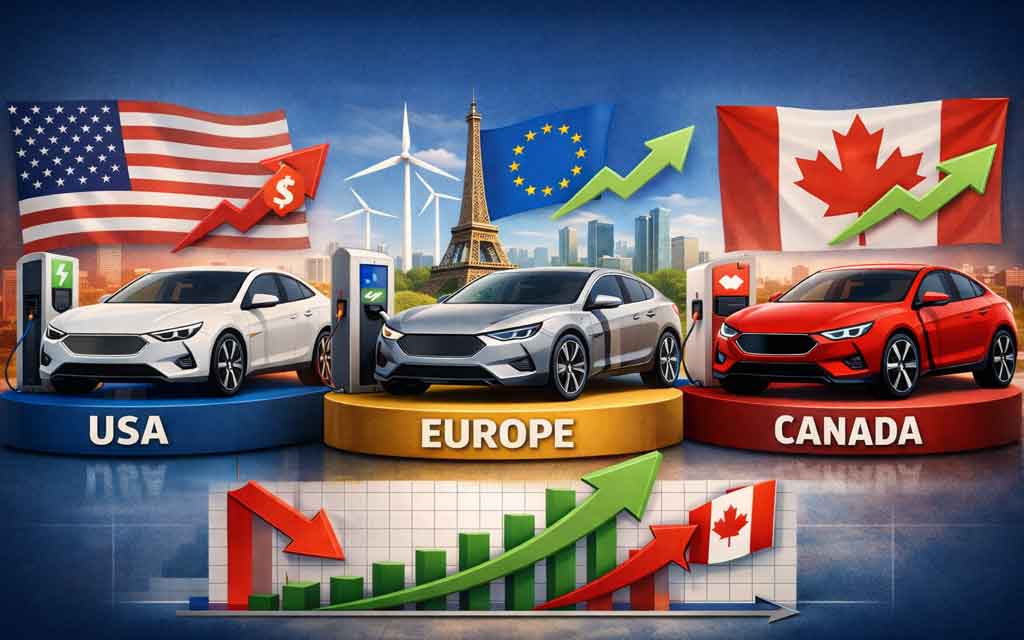
As gas prices hover above $4 per gallon in many parts of the United States and new EV incentives face headwinds, North America and Europe are charting noticeably different paths in the electric mobility transition. While the U.S. leans on market-driven innovation and used-vehicle momentum, Canada is investing heavily in practical infrastructure, and Europe continues to post steady gains in battery-electric vehicle (BEV) market share despite modest overall auto sales growth.
This divergence in policy, infrastructure, and consumer response is shaping how quickly — and affordably — EVs reach mainstream adoption in 2026.
United States: Market Forces and Used EV Resilience Take Center Stage
In the U.S., the expiration of the broad federal $7,500 EV tax credit has contributed to softer new EV sales in Q1 2026 (down roughly 28% year-over-year in some estimates). Yet rising fuel costs are creating a counter-effect in the used market.
Used electric vehicle sales rose nearly 30% in Q1 2026 according to CarGurus data, while Cox Automotive reported a more conservative 12–17% increase. Average used EV prices have dropped to around $28,000, making them competitive with — or cheaper than — many used gas vehicles while delivering significantly lower operating costs as gasoline exceeds $4 per gallon.
At the 2026 New York International Auto Show, automakers emphasized accessibility:
- Kia EV3: North American debut of the compact electric crossover with up to 320 miles of estimated range on higher trims. Expected starting price in the mid-$30,000s, with U.S. sales targeted for late 2026.
- Subaru Getaway: First three-row all-electric SUV from Subaru, offering up to 420 horsepower, seating for seven, and more than 300 miles of range. Jointly developed with Toyota, it arrives late 2026.
- Hyundai Boulder Concept: A rugged body-on-frame off-road SUV study signaling future ambitions in adventure-oriented vehicles.
Google’s enhanced EV route planner in Android Auto and fleet expansions (e.g., DoorDash) are also helping reduce practical barriers.
A March 2026 Pew Research Center survey found 44% of Americans would seriously consider a hybrid as their next vehicle, compared to 32% for a pure EV — highlighting hybrids as a popular bridge technology amid policy uncertainty.
Canada: Focused Infrastructure Buildout and Trade Openness
Canada is taking a more hands-on approach to accessibility. On April 8, 2026, the federal government announced $10.6 million for 14 EV charging infrastructure projects that will add more than 1,600 new chargers nationwide. The funding, unveiled at the EV & Charging Expo in Toronto, prioritizes smaller and mid-sized communities where adoption has lagged.
This investment builds on Canada’s updated Auto Strategy and complements efforts to make EVs practical for families and businesses. Canada has also opened its market to more Chinese EVs under a January 2026 trade agreement, allowing up to 49,000 units annually at a reduced 6.1% tariff. While cheaper imports may take time to arrive in volume, the move aims to improve affordability and stimulate competition.
Consumer incentives have been reinstated in some forms, and public events continue to boost awareness and test-drive opportunities.
Europe: Steady Electrification Gains Through Policy and Market Share Growth
Europe’s approach remains technology-neutral but aggressive on decarbonization. In January–February 2026, new car registrations across the EU showed modest overall movement (down 1.2% year-to-date in some reports), yet battery-electric vehicles (BEVs) captured an 18.8% market share — up from 15.2% a year earlier. Plug-in hybrids (PHEVs) also gained ground, while traditional petrol and diesel combined fell to around 30–31%.
New models entering key markets — including the Denza Z9 GT, Geely E5, and DS N°7 — are helping sustain momentum. Europe continues refining the EU AI Act and supporting large-scale AI and green tech infrastructure (e.g., renewable-powered data centers in Finland, France, and Sweden), which indirectly benefits EV ecosystems through smarter energy management and autonomous tech.
Unlike the U.S., Europe maintains a more consistent policy framework favoring electrification, though challenges such as overcapacity and potential trade tensions persist.
Key Divergences and What They Mean for Consumers and Industry
United States
- Policy Focus: Market-driven; tax credit expired
- EV Market: New sales softer; used market strong
- Infrastructure: Private sector + some public support
- Consumer Preference: Hybrids lead (44% vs 32% EV)
- Trade Approach: Restrictive on some imports
🇨🇦 Canada
- Policy Focus: Infrastructure + targeted incentives
- EV Market: Growing with infrastructure support
- Infrastructure: $10.6M investment for 1,600+ new chargers
- Consumer Preference: Affordability + accessibility focused
- Trade Approach: More open to Chinese EVs
🇪🇺 Europe
- Policy Focus: Technology-neutral decarbonization
- EV Market: BEV ~18.8–19% YTD (strong growth)
- Infrastructure: Steady expansion + grid modernization
- Consumer Preference: BEVs and PHEVs gaining steadily
- Trade Approach: Balanced but protective
Implications:
- U.S. buyers may find the best near-term value in certified pre-owned EVs or hybrids, especially with gas prices elevated.
- Canadian drivers benefit from improving charging access in underserved areas and potentially more affordable import options.
- European consumers continue to see broader model availability and policy support driving higher BEV adoption rates.
The Road Ahead in 2026
The divergence highlights a core truth: no single strategy fits all markets. The U.S. is testing whether innovation, falling used prices, and fuel costs can sustain momentum without broad subsidies. Canada is betting on practical infrastructure and openness. Europe is leveraging consistent policy to build market share.
Record Q1 2026 AI funding — with OpenAI, Anthropic, xAI, and Waymo raising massive rounds — promises to accelerate smarter vehicles, better energy optimization, and autonomous features across all regions.
For VFutureMedia readers navigating 2026 mobility choices, the message is clear: evaluate total cost of ownership, local charging availability, and your driving patterns. Hybrids may offer the easiest transition for many, while dedicated EV owners stand to gain the most from lower operating costs as infrastructure improves.
What region’s approach do you think will prove most effective? Share your thoughts in the comments.
Ethan Brooks is an independent U.S.-based journalist with over a decade covering automotive technology, sustainable mobility, and emerging tech trends. This analysis is based on publicly reported data as of April 9, 2026, and is for informational purposes only.
Related Reading on VFutureMedia.com:
- New York Auto Show 2026: Affordable EVs Take Center Stage
- Q1 2026 Record AI Funding and Its Impact on Mobility
- Rising Gas Prices Push Americans Toward EVs and Hybrids
Sources: ACEA, Crunchbase, Pew Research Center, Cox Automotive, CarGurus, Natural Resources Canada, Forbes, Automotive News, and official automaker statements.


Leave a Comment