
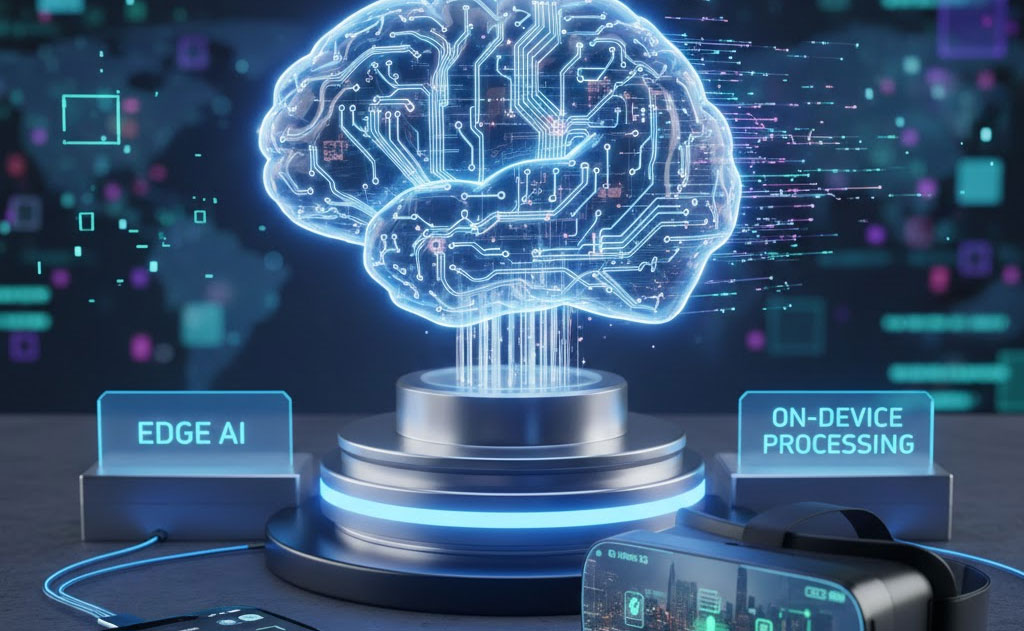
As privacy concerns dominate technology discussions in late 2025, edge AI 2026 is emerging as the defining trend in intelligent computing. On-device AI trends are accelerating, shifting processing power from distant cloud servers to the devices in our pockets, homes, and workplaces. This paradigm—known as edge AI or on-device processing—keeps sensitive data local, reducing latency, enhancing security, and delivering seamless experiences without constant internet dependency. Leading the charge are Apple Intelligence updates, alongside innovations from Google, Qualcomm, and Microsoft, all prioritizing privacy-first architectures.
By 2026, analysts predict that over 70% of AI inferences will occur on-device, driven by advancements in neural processing units (NPUs), efficient model compression, and federated learning. Viral demonstrations of real-time translation, photo editing, and personal assistants running entirely locally have fueled excitement. This comprehensive guide explores edge AI 2026 developments, key on-device AI trends, major platform updates including Apple Intelligence, benefits for privacy and performance, real-world applications, and the challenges ahead. Whether you’re a tech enthusiast or privacy advocate, understanding this shift is crucial for the intelligent future.
What Is Edge AI and On-Device Processing?
Edge AI 2026 refers to artificial intelligence models that run directly on endpoint devices—smartphones, laptops, wearables, IoT sensors, and even vehicles—rather than relying on cloud servers. This contrasts with traditional cloud AI, where data travels to remote data centers for processing.
Core components include:
- Specialized hardware like NPUs and TPUs optimized for AI workloads.
- Quantized and pruned models that maintain accuracy while fitting within device constraints.
- Hybrid approaches that intelligently route tasks between edge and cloud when needed.
The result? Faster responses, lower bandwidth usage, and most importantly, data that never leaves the device. As regulations like GDPR and emerging privacy laws tighten, on-device AI trends position edge processing as the compliant, user-centric standard.
Key On-Device AI Trends Shaping 2026
On-device AI trends for 2026 emphasize efficiency, personalization, and security:
- Model Miniaturization: Techniques like distillation and quantization enable large language models (LLMs) to run on consumer hardware with minimal performance loss.
- Multimodal Capabilities: Devices handling text, voice, image, and video inputs simultaneously—all processed locally.
- Federated Learning: Models improve collectively without sharing raw user data.
- Contextual Awareness: Real-time adaptation based on device sensors (location, activity, biometrics) while preserving privacy.
- Open-Source Acceleration: Frameworks like TensorFlow Lite and ONNX Runtime democratizing edge deployment.
These edge AI 2026 trends are fueled by hardware leaps, with next-generation chips delivering 10x efficiency gains over 2024 baselines.
Platform Leaders: Apple Intelligence Updates and Competitors
Apple Intelligence updates exemplify the privacy-first ethos. Introduced in 2024-2025, Apple Intelligence processes most tasks on-device using the A-series and M-series Neural Engines. By 2026, expect deeper integration:
- Enhanced Private Cloud Compute for complex queries that still avoid third-party servers.
- Advanced on-device generation for writing tools, image creation (Image Playground), and personalized Siri responses.
- Expanded multimodal features, such as live visual intelligence and contextual understanding across apps.
Apple’s closed ecosystem ensures end-to-end encryption and zero data sharing, setting the benchmark for on-device AI trends.
Competitors are matching pace:
- Google’s Gemini Nano powers Android features like real-time call screening and summarization—all local.
- Qualcomm’s Snapdragon platforms with Hexagon NPUs enable Windows on Arm devices to run Copilot+ experiences offline.
- Microsoft’s Phi-series small language models optimize for PC and mobile edge deployment.
Cross-platform consistency means users benefit regardless of device, accelerating edge AI 2026 adoption.
Privacy and Security Benefits of Edge AI
The primary driver behind edge AI 2026 is privacy. On-device processing eliminates risks associated with data transmission:
- No cloud uploads mean reduced exposure to breaches or surveillance.
- Features like differential privacy and secure enclaves add layers of protection.
- Users gain transparency—knowing exactly where their data resides.
In an era of increasing data scandals, on-device AI trends restore trust. Enterprises also benefit, complying with regulations while deploying sensitive AI in healthcare, finance, and government.
Performance and User Experience Advantages
Beyond privacy, edge AI delivers tangible improvements:
- Sub-second latency for voice assistants and AR overlays.
- Offline functionality in remote or low-connectivity areas.
- Reduced battery drain through optimized hardware acceleration.
- Personalized experiences that adapt without phoning home.
These on-device AI trends create fluid, intuitive interactions that feel truly intelligent.
Real-World Applications of Edge AI in 2026
Edge AI 2026 transforms industries:
- Healthcare: Wearables detecting anomalies locally, preserving patient confidentiality.
- Automotive: In-vehicle vision systems processing road data without cloud dependency.
- Smart Homes: Cameras and sensors identifying activity patterns on-device.
- Productivity: Real-time translation, meeting transcription, and content generation offline.
- Retail and Manufacturing: IoT edge devices predicting maintenance or optimizing inventory locally.
From personalized fitness coaching to secure enterprise collaboration, on-device AI trends enable innovation grounded in user control.
Challenges and Limitations
Despite momentum, hurdles remain for edge AI 2026:
- Hardware constraints limit model size and complexity compared to cloud giants.
- Initial development costs for optimized models.
- Balancing performance across diverse device tiers.
- Ensuring equitable access so premium features aren’t locked behind flagship hardware.
Ongoing research in efficient architectures and collaborative training promises solutions.
The Future Outlook: A Privacy-First Intelligent World
Looking ahead, edge AI 2026 lays the foundation for ubiquitous intelligence. Hybrid systems will seamlessly blend on-device speed with optional cloud depth, always prioritizing privacy. As Apple Intelligence updates and ecosystem rivals mature, everyday computing becomes proactive, secure, and deeply personal.
Conclusion: Embracing On-Device Intelligence
Edge AI 2026 and rising on-device AI trends mark a pivotal shift toward privacy-first computing. With Apple Intelligence updates leading by example, this technology empowers users, enhances security, and unlocks seamless experiences. The future of AI isn’t in distant servers—it’s right in your hand, processing intelligently and privately. At VFutureMedia, we’re excited to track this evolution as edge AI redefines what’s possible.
I’m Ethan, and I write about the tech that’s actually going to change how we live — not the stuff that just sounds impressive in a press release. I cover AI, EVs, robotics, and future tech for VFuture Media. I was on the ground at CES 2026 in Las Vegas, walking the show floor so I could give you a real read on what matters and what’s just noise. Follow me on X for daily takes.
We’ll be watching how this develops over the next few weeks. Bookmark this page — we update our coverage as the story moves. And if you spotted something we missed, tell us in the comments.




Leave a Comment