
Published on December 20, 2025 | By VFuture Media Team
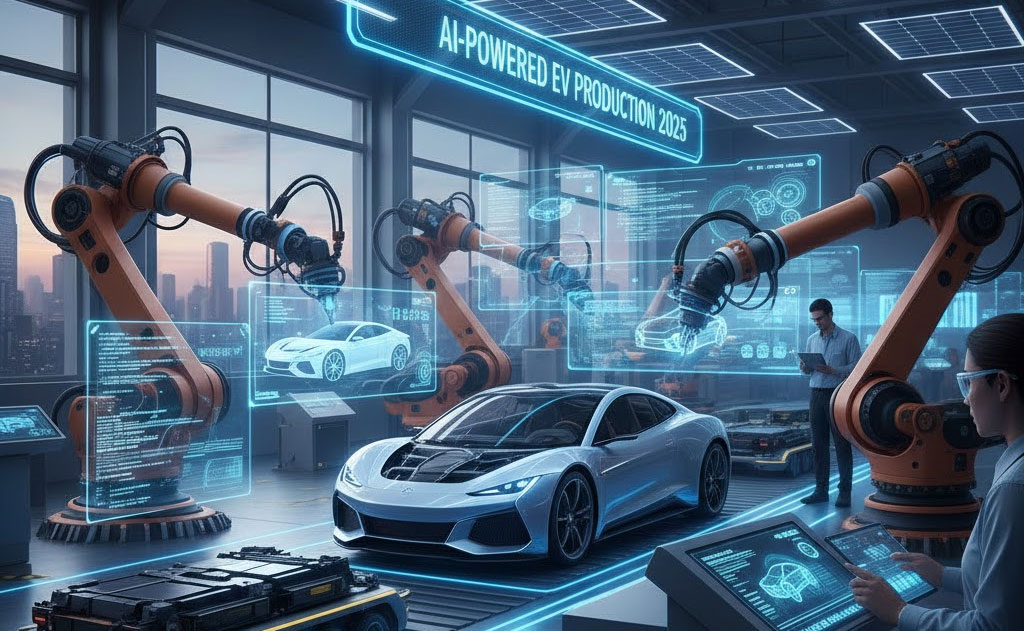
Imagine a factory where robots anticipate defects before they happen, batteries design themselves for maximum safety and range, and vehicles drive autonomously straight off the assembly line. This isn’t science fiction—it’s the promise of artificial intelligence reshaping electric vehicle (EV) manufacturing in 2025. From Xpeng’s “bulletproof” AI batteries to Rivian’s in-house AI chips powering future robotaxis, AI is accelerating the EV revolution like never before.
Yet, beneath the excitement lies a harsh reality: 80-95% of AI projects fail to deliver meaningful returns, often stalling in pilot stages or crumbling under real-world demands. As EV makers pour billions into AI, understanding both the triumphs and pitfalls is crucial. Let’s explore the cutting-edge innovations, why so many initiatives falter, and actionable strategies to turn AI into a competitive edge.
Revolutionary AI Innovations Driving EV Manufacturing Forward
2025 has seen AI deeply embedded in every stage of EV production and performance:
- Battery Technology Breakthroughs: AI is tackling the heart of EVs—batteries. Xpeng’s 2025 G6 SUV features 5C “AI batteries” that charge from 10-80% in just 12 minutes and withstand extreme conditions, earning the “bulletproof” moniker. Researchers at the University of Arizona use machine learning to predict and prevent thermal runaway, reducing fire risks. Meanwhile, platforms like TCS’s quantum-AI hybrids accelerate material discovery, aiming for denser, safer cells.
- Autonomous Driving and ADAS: Companies are betting big on AI for self-driving tech. Rivian unveiled its in-house AI chip and lidar sensors in December 2025, targeting Level 4 autonomy for 2026 models like the R2 SUV. Tesla’s patent surge shifts toward AI hardware/software for Full Self-Driving, while partnerships (e.g., Honda with Helm.AI) push conditional automation.
- Smart Manufacturing and Efficiency: AI optimizes assembly lines with predictive maintenance, reducing downtime. Tesla’s Dojo supercomputer and BYD’s vertical integration use AI for precision battery assembly. Edge AI enables real-time quality control, cutting defects and waste—vital as global EV sales push toward 17 million units.
These advancements aren’t just incremental; they’re enabling safer, longer-range EVs while slashing production costs.
The Stark Truth: Why 80-95% of AI Projects in EV Manufacturing Fail
Despite the hype, failure rates remain alarmingly high. MIT’s 2025 report pegs generative AI pilots at 95% failure for revenue impact, while RAND estimates 80% overall—double non-AI projects.
Common culprits in the EV sector:
- Poor Data Quality and Access: Fragmented, siloed, or biased data leads to unreliable models. Manufacturing sensors often miss readings or lack context, dooming predictive tools.
- Misaligned Goals and Overambition: Projects chase flashy tech without clear ROI, like overly complex autonomy pilots ignoring regulatory hurdles (e.g., Tesla’s past recalls).
- Organizational and Leadership Gaps: Lack of buy-in from operations teams, skill shortages, and failing to scale from POC to production.
- Integration Challenges: Internal builds fail more often than vendor partnerships, per MIT.
In EVs, these issues amplify: High-stakes safety demands flawless execution, yet rushed implementations risk costly setbacks.
Strategies for Cost-Effective AI Success in EV Manufacturing
The good news? Failures are avoidable. Successful players like Tesla, BYD, and Rivian focus on pragmatic approaches:
| Strategy | Key Benefits | Real-World Example |
|---|---|---|
| Prioritize High-Quality Data | Builds trustworthy models; reduces bias | Invest in clean, contextual sensor data |
| Start Small with Clear ROI | Phased pilots deliver quick wins | Focus on predictive maintenance first |
| Partner with Vendors | Higher success (2x internal builds) | Collaborate on proven AI tools |
| Foster Organizational Buy-In | Bridges dev-deployment gap | Train teams; align with business KPIs |
| Leverage Incentives & Learn from Failures | Offsets costs; informs future projects | Claim R&D tax credits on trials |
- Phased Deployment: Begin with targeted use cases like battery optimization or quality control for measurable gains.
- Human-Centric Design: Ensure AI augments, not replaces, workers—building trust and adoption.
- Robust Governance: Stress-test models, monitor post-deployment, and iterate.
As Rivian’s December 2025 AI announcements show, strategic focus yields breakthroughs without excessive risk.
The Road Ahead: AI as EV’s Ultimate Accelerator
2025 proves AI’s transformative power in EVs—from safer batteries to autonomous fleets—but only for those navigating pitfalls wisely. With global EV adoption surging, manufacturers embracing disciplined AI strategies will lead the pack, delivering affordable, intelligent vehicles that redefine mobility.
At VFuture Media, we’re watching this convergence closely. AI isn’t just innovating EVs—it’s electrifying the future.
Sources: MIT NANDA Report 2025, RAND Corporation, Electrek, TechCrunch, IDTechEx, and industry announcements as of December 20, 2025.
I’m Ethan, and I write about the tech that’s actually going to change how we live — not the stuff that just sounds impressive in a press release. I cover AI, EVs, robotics, and future tech for VFuture Media. I was on the ground at CES 2026 in Las Vegas, walking the show floor so I could give you a real read on what matters and what’s just noise. Follow me on X for daily takes.
The future doesn’t wait — and neither should your feed. If this got you thinking, there’s plenty more where that came from. Browse our latest at VFutureMedia and stick around.



Leave a Comment