
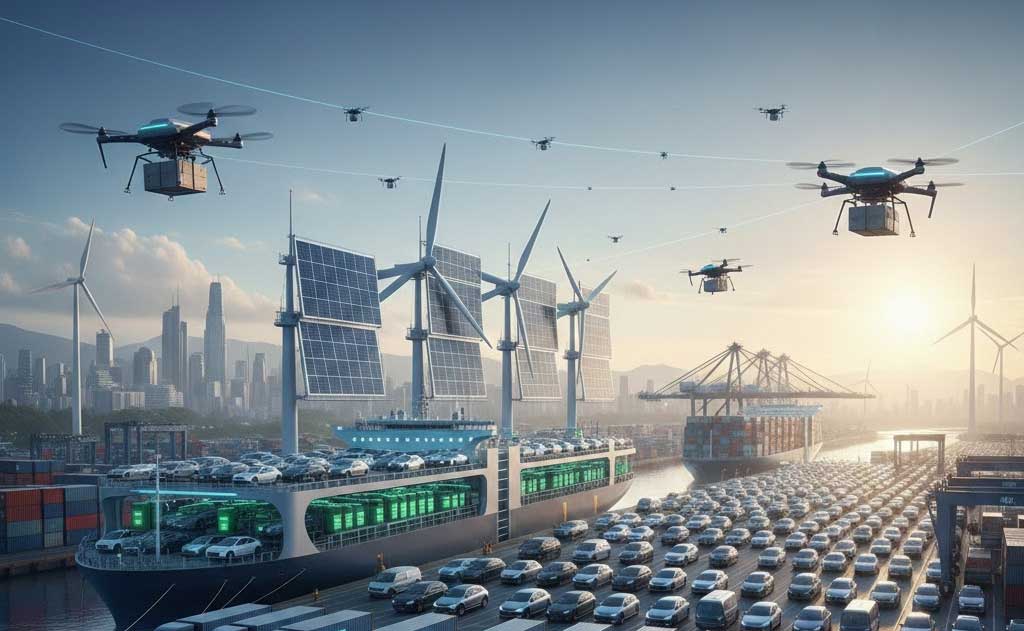
Happy New Year from vFutureMedia—it’s January 3, 2026, and if you’re watching the energy transition, China’s role is impossible to ignore. While trade tensions and policy shifts grab headlines in the West, China’s clean tech exports are hitting record highs, quietly (and not so quietly) speeding up renewable energy and electric vehicle adoption worldwide—especially in developing nations. This isn’t just about market share; it’s reshaping how the Global South powers its future.
Record-Breaking Exports Fuel the Global Shift
China’s dominance in clean energy manufacturing has turned into a massive export machine. In the first 10 months of 2025 alone, the country shipped out over $180 billion worth of clean technologies, including more than $66 billion in batteries and around $55 billion in EVs. August 2025 set a new monthly record at $20 billion, driven by surging EV exports (up 26% year-on-year in the first eight months) and battery shipments (up 23%).
Even with falling prices—solar panels have dropped over 80% in the last decade—these exports are booming because demand is exploding. In August 2025, China exported 46 GW of solar PV modules in a single month—more than Australia’s entire installed solar capacity. EVs and batteries now often outvalue solar in export dollars, highlighting the shift toward electrification.
The real story? Over half the growth in EV exports this year came from outside traditional OECD markets. ASEAN countries saw a 75% surge, led by Indonesia where Chinese EVs helped push battery electric vehicle sales to 14% of new cars in August 2025 (up from 9% the year before). Africa experienced explosive growth too, with exports nearly tripling from a low base. These affordable, high-quality products are making renewables and EVs viable in places where they were once out of reach.
Helping Developing Nations Leapfrog Fossil Fuels
For many emerging economies in Asia, Africa, and Latin America, China’s exports are transformative. Cheap solar panels, batteries, and EVs lower the barriers to clean energy, displacing fossil fuels and cutting millions of tons of CO₂ over project lifetimes. Falling costs mean renewables are now the cheapest path to new power generation in regions home to two-thirds of the world’s population—accelerating adoption by at least a decade.
This isn’t dominance for its own sake; it’s enabling faster decarbonization globally. Chinese tech is helping countries build resilient grids, expand access to electricity, and meet climate goals without massive upfront costs. It’s a practical, market-driven boost to the energy transition, even as some Western markets face headwinds.
The 15th Five-Year Plan: Doubling Down on Innovation
Looking ahead, China’s upcoming 15th Five-Year Plan (2026-2030)—set to be formally adopted in March 2026—will supercharge this trajectory. The plan emphasizes technological self-reliance and breakthroughs in frontier fields like artificial intelligence (AI), quantum computing, biotechnology, humanoid robotics, 6G communications, hydrogen, and fusion energy.
Green tech remains central: expanding renewables, electric vehicles, energy storage, and ecological transformation. By integrating innovation into industrial applications and promoting sustainability, China aims to maintain leadership in clean energy supply chains while opening doors for international cooperation in climate finance and environmental technologies.
This forward-looking strategy ensures continued export growth and domestic scaling, positioning China to drive even more global progress in the late 2020s.
Why This Matters in 2026 and Beyond
In a year of geopolitical rivalry and policy debates, China’s clean tech exports offer a positive, results-oriented counterpoint. They’re not waiting for subsidies or perfect conditions—they’re delivering affordable solutions that help the world move faster toward net zero. From record shipments to emerging market booms, this momentum is set to continue accelerating in 2026.
At vFutureMediaIf you found this useful, the best thing you can do is share it with someone who’d actually appreciate it. And if you want more like it, we’re here every week., we’re keeping a close eye on these shifts—how they reshape energy security, climate action, and global markets. China’s boom isn’t just an economic story; it’s a key driver of the sustainable future we’re all heading toward.
I’m Ethan, and I write about the tech that’s actually going to change how we live — not the stuff that just sounds impressive in a press release. I cover AI, EVs, robotics, and future tech for VFuture Media. I was on the ground at CES 2026 in Las Vegas, walking the show floor so I could give you a real read on what matters and what’s just noise. Follow me on X for daily takes.
What do you think—will these exports bridge the gap for developing nations, or spark more trade friction? Share your take in the comments!




Leave a Comment