
By VFuture Media Staff
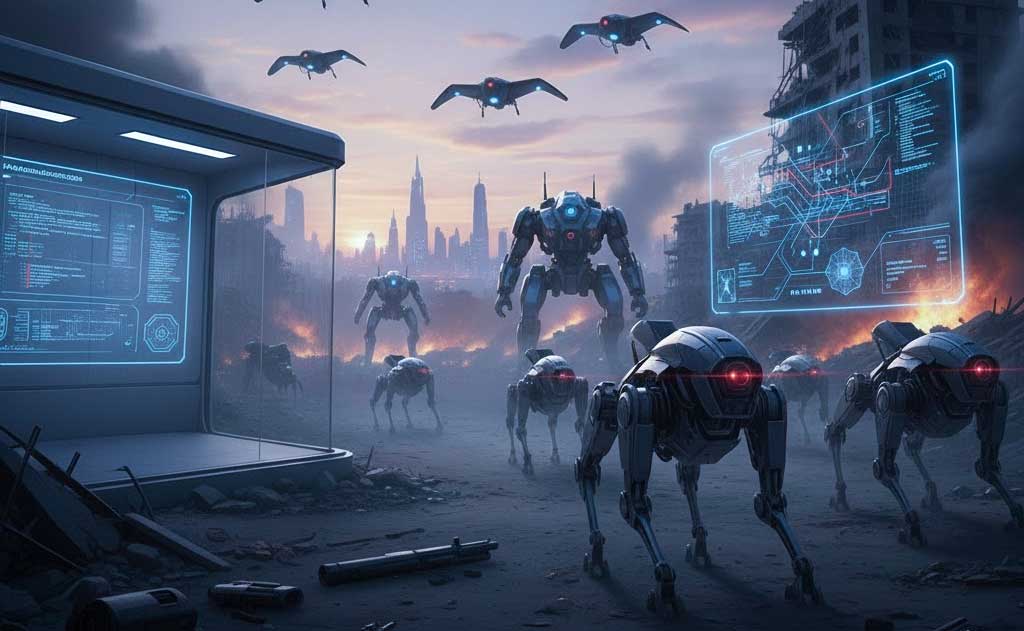
The dawn of 2026 marks a profound evolution in the nature of conflict. Artificial intelligence is no longer a distant enhancer but a core driver reshaping battlefields worldwide. From swarms of autonomous drones overwhelming defenses to AI-enabled targeting systems deciding strikes in real-time, the integration of AI is accelerating decision cycles, amplifying lethality, and challenging long-held norms of warfare. Lessons from ongoing conflicts, particularly in Ukraine, have propelled a global arms race in autonomous technologies, while January’s developments highlight surging deployments of expendable systems and renewed international pleas to regulate “killer robots.”
This in-depth exploration uncovers the thrilling yet unsettling narrative of AI’s military ascent: dominant drone swarms in modern wars, ambitious initiatives like the U.S. Replicator program, intensifying ethical debates at the UN, and broader applications enhancing intelligence and logistics. As speed and scale become decisive factors, the human element hangs in the balance—will innovation outpace our ability to govern it responsibly?
Autonomous Drones and Swarms: Redefining Dominance on the Battlefield
Imagine hundreds of drones descending like a storm, coordinating without human input, evading jammers, and striking with relentless precision. This is no longer speculation—it’s the reality emerging in 2026.
In conflicts like Ukraine, AI-powered drones have become the primary agents of destruction, accounting for an estimated 70-80% of battlefield casualties. Both Ukrainian and Russian forces have refined AI targeting systems, pushing strike accuracy to around 80% through machine learning that locks onto targets even amid electronic warfare interference. Semi-autonomous features allow drones to navigate, identify, and engage independently after initial human lock-on, making them resilient to jamming.
Swarms represent the next leap: Coordinated groups of drones that communicate, adapt, and overwhelm. Ukraine has pioneered combat use of AI-guided swarms, with tests scaling to dozens and plans for hundreds, enabling mass strikes resistant to traditional defenses. Russia follows suit, fielding systems with visual recognition for drone-to-drone coordination.
The U.S. Replicator initiative, launched to counter China’s numerical advantages, aims to field thousands of attritable (expendable) AI-enabled vehicles across domains. Though initial phases delivered hundreds rather than thousands due to technical and production hurdles, 2026 sees accelerated progress with integrations into operational plans, including counter-drone capabilities. These low-cost, autonomous platforms—drones, surface vessels, and more—prioritize mass, speed, and deception over exquisite systems.
Hypotheses from experts favor militaries mastering resilient networks, deception tactics, and overwhelming volume. Swarms could saturate defenses, rendering expensive assets vulnerable while minimizing risks to human forces. The narrative is one of asymmetric disruption: Cheap, smart drones leveling the playing field against superior numbers.
Ethical Tensions and Urgent Calls for Regulation: The “Oppenheimer Moment” of AI Warfare
Amid this technological surge, a profound ethical reckoning unfolds. Lethal Autonomous Weapons Systems (LAWS)—often dubbed “killer robots”—spark intense debates over delegating life-and-death decisions to machines.
Risks are stark: Inadvertent escalation from misidentification, biases in algorithms leading to disproportionate harm, proliferation of cheap systems to non-state actors, and erosion of human accountability. An “Oppenheimer moment” looms, as experts warn AI could make mass killing mechanized and detached, crossing moral lines where machines target humans without oversight.
The United Nations is at the forefront, with Secretary-General António Guterres and the ICRC repeatedly calling for a legally binding treaty by 2026 to prohibit fully autonomous systems lacking meaningful human control and regulate others. Momentum builds, with over 100 countries supporting prohibitions on unpredictable LAWS, emphasizing humanitarian law, ethics, and security. Yet major powers like the U.S., China, and Russia advance “intelligentized” capabilities, prioritizing strategic edges while advocating responsible use—often through non-binding guidelines.
The tension is palpable: Innovation races ahead, but unchecked autonomy risks instability, proliferation, and dehumanized warfare. Advocates argue for preserving human judgment in lethal decisions, ensuring compliance with principles like distinction and proportionality.
Broader Military Applications: From Intelligence to Human-Machine Teaming
AI’s influence extends far beyond lethality, transforming the entire military ecosystem.
In intelligence, AI sifts vast data for patterns, predictive analytics forecast movements, and decision-support tools accelerate command cycles. Predictive maintenance optimizes assets, while logistics benefit from optimized routing and resource allocation.
Human-machine teaming emerges as a balanced approach: Defensive systems lead, with autonomy in surveillance or jamming, always under human oversight for ethical strikes. Interoperability poses challenges in coalitions, requiring shared standards for data and frameworks.
Low-tech counters—jamming, deception, and creativity—remain vital against AI’s vulnerabilities like fragility to adversarial inputs or environmental factors.
The story here is holistic transformation: AI enhances efficiency and precision across operations, rewarding speed and scale while demanding robust safeguards.
The Future of AI-Enabled Conflict: Balancing Deterrence and Restraint
As 2026 unfolds, the world tests whether ethical norms and regulations can temper relentless innovation amid escalating arms races. Balanced adoption—prioritizing human control, transparency, and accountability—could deter aggression and stabilize crises. Unchecked, however, it risks flash escalations, proliferation, and a dehumanized era of warfare.
The narrative arc is suspenseful: Will global cooperation forge binding rules in time, or will strategic imperatives prevail? Responsible development, international dialogue, and ethical integration offer a path forward, ensuring AI serves as a force multiplier for humanity, not its replacement.
At VFutureMedia, we track these pivotal shifts in real-time. The battlefields of tomorrow are being forged today—stay informed on military AI’s evolving frontier.
I’m Ethan, and I write about the tech that’s actually going to change how we live — not the stuff that just sounds impressive in a press release. I cover AI, EVs, robotics, and future tech for VFuture Media. I was on the ground at CES 2026 in Las Vegas, walking the show floor so I could give you a real read on what matters and what’s just noise. Follow me on X for daily takes.
If you found this useful, the best thing you can do is share it with someone who’d actually appreciate it. And if you want more like it, we’re here every week.




Leave a Comment