
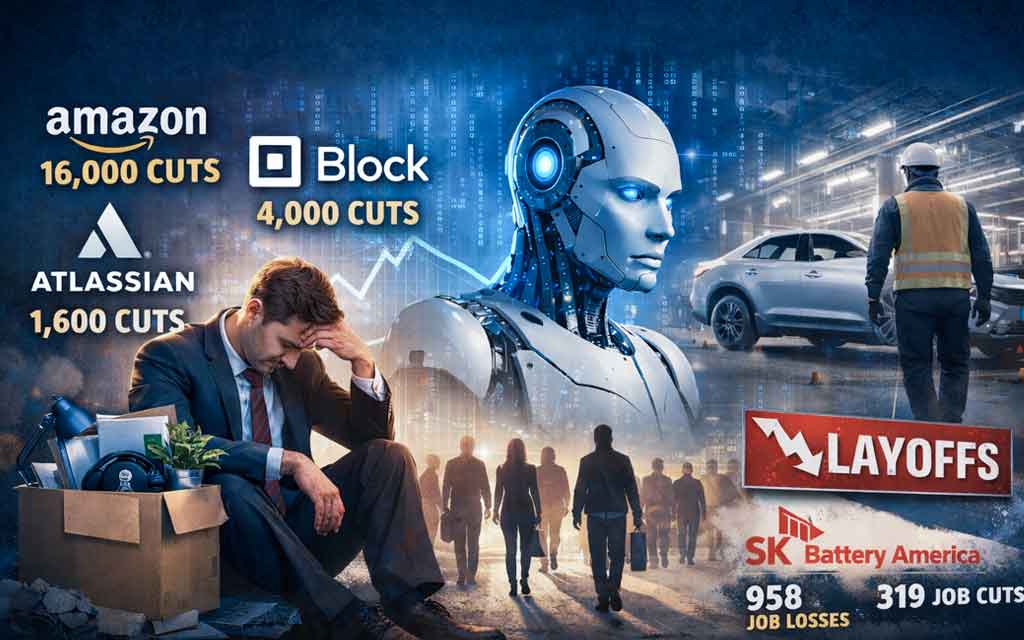
The tech layoffs 2026 wave continues to intensify in March, with U.S. companies announcing massive workforce reductions driven by aggressive efficiency measures and the rapid integration of artificial intelligence. As of mid-March 2026, tech sector cuts have exceeded 45,000 jobs year-to-date globally, with a significant portion in the U.S. (over 30,000 according to analyses from RationalFX and trackers like Layoffs.fyi). This surge reflects a broader corporate push to streamline operations, reallocate resources toward AI investments, and adapt to shifting market demands amid economic pressures.
Amazon leads with 16,000+ cuts announced earlier this year as part of restructuring to fund AI infrastructure. Fintech giant Block slashed nearly 4,000 roles (about 40% of its workforce), explicitly citing AI’s growing capabilities to handle tasks previously done by humans. Atlassian followed suit this week, laying off roughly 1,600 employees (10% of its global headcount) to self-fund AI and enterprise sales expansion.
These moves aren’t isolated to tech; spillover effects are hitting the auto and EV sectors hard. SK Battery America laid off 958 workers at its Georgia plant due to cooling EV demand and shifting automaker priorities, while Lucid Motors cut 319 positions (12% of its U.S. workforce) to boost efficiency amid ongoing losses.
This layoffs March 2026 trend signals a pivotal moment: companies are using cost savings from reductions to accelerate AI adoption, but at the expense of immediate job security for thousands.
Top Layoff Announcements This Week
The past week has seen several high-profile announcements underscoring the momentum:
- Atlassian: On March 11, the productivity software leader revealed plans to cut about 1,600 jobs (10% of its workforce). CEO Mike Cannon-Brookes described the move as a necessary restructuring to thrive in the “AI-first” era, with funds redirected toward AI development and enterprise growth. The company emphasized retaining strong performers, recent graduates, and those with transferable skills, while phasing out its CTO role.
- Block (formerly Square): Earlier in March (building on February announcements), the fintech firm confirmed massive reductions of over 4,000 employees. CEO Jack Dorsey highlighted AI tools’ ability to perform a wider range of tasks as the primary driver, not financial distress. Shares surged post-announcement, reflecting investor approval of the efficiency pivot.
- SK Battery America: A March 6 WARN notice detailed 958 layoffs at its Commerce, Georgia facility, reducing the workforce to around 1,600. The South Korean battery maker cited slowed EV market growth, uncertain consumer demand, and automakers’ changing electrification plans—exacerbated by federal incentive uncertainties.
- Lucid Motors: The luxury EV maker notified California authorities of 319 cuts (effective April), targeting engineering, software, hardware, and non-manufacturing roles. This 12% reduction aims to improve profitability as the company ramps up production for new models amid persistent financial challenges.
Other notable mentions include ongoing ripple effects from earlier cuts at Amazon (16,000 corporate roles in January) and Pinterest/Autodesk (AI-focused reallocations in January, with hundreds affected in the Bay Area).
These announcements contribute to the YTD total surpassing 45,000 tech layoffs (per RationalFX data as of early March), with AI and automation explicitly linked to about 20% (over 9,200) of global cuts.
How AI is Fueling Job Cuts
AI job cuts USA are no longer speculative—they’re explicit in corporate communications. Companies are openly attributing reductions to AI’s transformative potential, viewing it as a tool to automate routine tasks, enhance productivity, and redirect talent toward high-value innovation.
Block’s Dorsey framed the 4,000+ cuts as a strategic bet on AI’s expanding role in payments, operations, and customer service. Atlassian’s pivot explicitly funds AI teams and enterprise sales, while Pinterest (less than 15% cuts in January) and Autodesk (about 7%) redirected resources to AI-focused roles and cloud/AI platforms.
Broader data supports this: RationalFX estimates 9,238 layoffs (20% of the 45,363 global total) tied to AI implementation and restructuring. Challenger, Gray & Christmas reports tech sector cuts at 33,330 through February, up 51% YoY. Even as some CEOs downplay mass white-collar displacement, real-world examples show AI agents handling support, coding, data analysis, and more—freeing budgets for AI infrastructure investments projected in the trillions globally.
This isn’t just cost-cutting; it’s a reimagining of workflows. However, experts note potential “AI hangovers,” with some firms quietly rehiring for roles automation couldn’t fully replace, highlighting the need for balanced human-AI integration.
Impact on Auto and EV Sectors
The efficiency drive spills over into auto and EV sectors, where softening demand meets high capital costs. SK Battery America’s 958 cuts reflect broader EV market headwinds: delayed consumer adoption, incentive rollbacks, and automakers scaling back aggressive electrification timelines (e.g., Ford’s adjustments).
Lucid’s 319 layoffs target engineering and support functions to preserve manufacturing momentum for models like the Gravity SUV. These reductions highlight vulnerabilities in the supply chain—battery producers and startups face pressure from inventory buildup and uncertain orders.
Corporate America overall is streamlining: tech efficiency gains indirectly affect suppliers, as reduced R&D spending or slower production ramps lead to downstream cuts. This creates a feedback loop where AI-driven optimizations in one sector ripple into others, amplifying economic signals of caution.
What Comes Next for US Workers
The layoffs March 2026 wave raises critical questions about workforce shifts and economic implications. For startups, tighter funding and AI focus could mean leaner teams from the outset, prioritizing versatile talent over headcount growth. Established firms may see short-term boosts in profitability and stock performance (as seen with Block and Atlassian), but long-term success hinges on effective AI upskilling.
Workers face uncertainty: entry-level and mid-tier roles in operations, support, and routine engineering are most vulnerable, while demand grows for AI specialists, data scientists, and those with hybrid skills. Surveys indicate many companies regret hasty cuts, with rehiring predicted in some cases as AI limitations become clear.
Broader economic signals point to a transitional period—strong corporate revenues contrast with job insecurity, potentially pressuring consumer spending and innovation pace. Policymakers may push reskilling programs, while individuals should focus on adaptability: continuous learning in AI tools, transferable skills, and networking.
This surge isn’t the end of tech jobs but a reconfiguration. Those who pivot toward AI-augmented roles could thrive in the emerging landscape.
Concerned about AI’s impact on your team? Get tailored future-of-work strategies from VFuture Media at Contact




Leave a Comment