
By Ethan Brooks, April 29, 2026
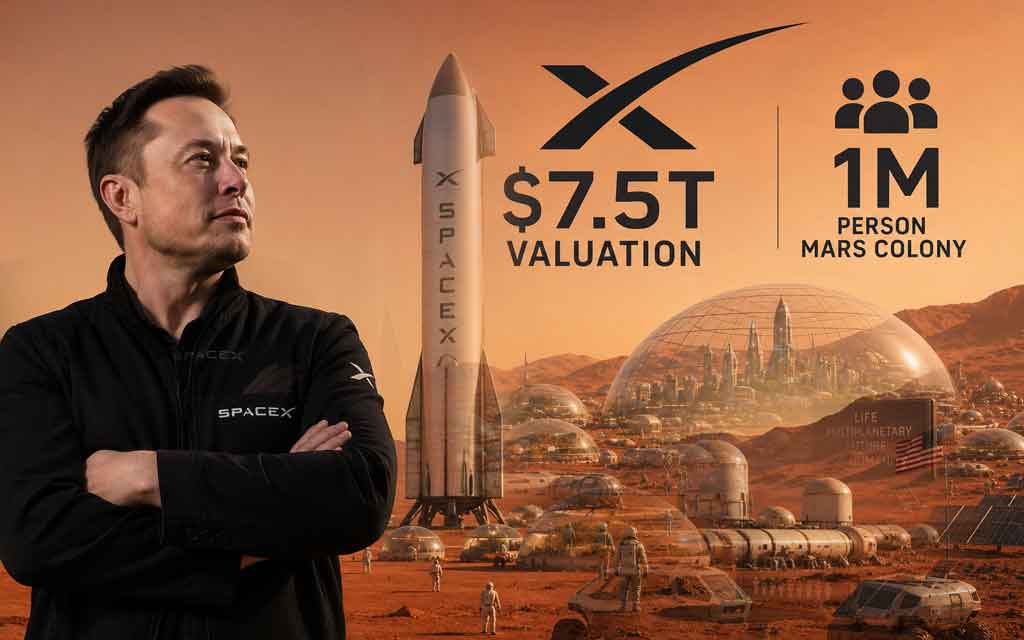
In a move that perfectly encapsulates the audacious spirit of private space exploration, SpaceX has linked Elon Musk’s compensation directly to humanity’s most ambitious goals: colonizing Mars and achieving unprecedented corporate scale. According to details revealed in a confidential SEC filing reviewed by Reuters, the SpaceX board approved in January 2026 a performance-based pay package that could award Musk 200 million super-voting restricted shares — but only if the company hits a staggering $7.5 trillion market valuation and successfully establishes a permanent human colony on Mars with at least one million residents.
This isn’t just another executive bonus. It represents one of the most visionary — and potentially controversial — compensation structures ever designed in corporate America. A separate award of up to 60.4 million restricted shares is tied to additional valuation milestones plus the operation of space-based data centers capable of delivering at least 100 terawatts of computing capacity. For context, that’s the power output equivalent of 100,000 one-gigawatt nuclear reactors running simultaneously in orbit.
Musk, who already draws a nominal annual salary of just $54,080 from SpaceX, receives nothing from these awards unless every target is met. There is no fixed deadline — the incentives remain in place as long as he continues serving as CEO. The shares are Class B super-voting stock, carrying 10 votes per share, ensuring Musk and key insiders maintain overwhelming control even after SpaceX goes public.
Why This Package Matters Now: The IPO Context
SpaceX is barreling toward what could be the largest IPO in history. The company has confidentially filed with the SEC and is targeting a public debut as soon as June 2026, with an initial valuation estimated between $1.75 trillion and over $2 trillion. This would dwarf previous record-setters like Saudi Aramco and make SpaceX one of the most valuable companies on Earth from day one.
The pay package disclosure comes as part of the IPO preparations. By tying Musk’s rewards so explicitly to long-term, multi-decade goals, the board is signaling to future public investors that SpaceX will not be distracted by short-term quarterly pressures. Instead, the company remains laser-focused on becoming a multiplanetary civilization.
SpaceX’s own website has long outlined the requirements for a self-sustaining Mars colony: “upwards of one million people and millions of tons of cargo.” Achieving this would require thousands of Starship launches, in-orbit refueling infrastructure, reliable life support systems, radiation shielding, and eventually Martian manufacturing and agriculture. The pay package turns that roadmap into a personal incentive for the company’s founder.
Breaking Down the Two Major Awards
- The Mars Milestone Package (200 million super-voting shares)
- Requires $7.5 trillion company valuation
- Permanent human settlement on Mars with ≥ 1 million inhabitants
- Vests in tranches as valuation increases
- The Orbital Compute Package (up to 60.4 million shares)
- Additional valuation targets
- Non-Earth-based data centers delivering 100 terawatts of compute power annually
- Designed to support the explosion in AI training and inference that traditional Earth-based power grids cannot sustain
These goals are not guaranteed. The filing itself acknowledges significant technological and economic risks, including the unproven commercial viability of orbital data centers. Yet that hasn’t stopped analysts from speculating on the pathway forward.
Path to $7.5 Trillion: What It Would Take
Current private valuations for SpaceX hover around $1.25–$2 trillion post its merger with elements of xAI. Reaching $7.5 trillion would require roughly 4–6x growth from IPO levels. Analysts point to several revenue streams that could make this possible:
- Starlink Expansion: Global broadband could generate hundreds of billions in annual revenue as constellations grow to tens of thousands of satellites.
- Starship Commercial Operations: Point-to-point Earth transport, lunar missions for NASA and private clients, and eventual Mars cargo runs.
- Orbital Data Centers & AI Infrastructure: Powering next-generation AI with solar energy in space could create an entirely new multi-trillion-dollar industry.
- Human Spaceflight & Tourism: Regular flights to orbit, the Moon, and Mars.
- Defense & Government Contracts: Expanded work with the U.S. Space Force and international partners.
If achieved, a $7.5 trillion SpaceX would rank among the most valuable companies in history, rivaling or surpassing today’s biggest tech giants combined.
Implications for American Leadership in Space
This compensation plan reinforces America’s dominance in commercial space. While China and other nations pursue their own lunar and Martian ambitions, SpaceX’s private-sector approach — backed by visionary incentives — continues to outpace traditional government programs in speed and innovation.
For U.S. investors, the IPO represents a rare chance to own a piece of humanity’s future. However, it also comes with risks. Musk’s divided attention across Tesla, xAI, and now public SpaceX has raised questions in some quarters. The super-voting structure means public shareholders will have limited say, a trade-off many seem willing to accept in exchange for Musk’s proven track record of delivering the “impossible.”
Critics argue the Mars timeline remains highly speculative — current projections suggest the first uncrewed Mars missions in the late 2020s, crewed landings in the 2030s, and a self-sustaining colony potentially decades beyond that. Reaching one million residents could take 50–100 years or more. Supporters counter that bold incentives are exactly what’s needed to compress those timelines.
Broader Tech & Economic Ripple Effects
The package also highlights the growing convergence of space technology and artificial intelligence. Orbital data centers could solve Earth’s energy constraints for AI training, potentially accelerating breakthroughs in everything from climate modeling to drug discovery.
Economically, a successful SpaceX at this scale would create tens of thousands of high-paying American jobs in engineering, manufacturing, and mission operations. It could also spur a new wave of space-focused startups and supply chain companies across the United States.
Historical Perspective: Musk’s Previous Pay Packages
This isn’t Musk’s first performance-heavy deal. At Tesla, his 2018 compensation package (later re-approved by shareholders) was tied to market cap and operational milestones. It made him one of the world’s wealthiest individuals when targets were hit. The SpaceX version goes further, incorporating civilizational goals rather than purely financial ones.
What Happens Next?
SpaceX’s full S-1 prospectus is expected in the coming weeks as it moves toward the June IPO window. Investors will scrutinize governance, risks, and Musk’s role closely. Meanwhile, engineering teams continue pushing Starship through rapid test flights, Starlink deployments accelerate, and early Mars architecture planning intensifies.
Whether or not Musk ultimately receives the full award, the mere existence of this package sends a powerful message: SpaceX is playing the long game. In an era when many companies chase quarterly earnings, one of America’s most valuable private firms is incentivizing its leader to make humanity multiplanetary.
For everyday Americans, this could mean cheaper global internet, new career opportunities in the space economy, and — someday — the chance for their descendants to call another planet home.
The Bottom Line SpaceX’s board has placed one of the biggest bets in corporate history on Elon Musk’s ability to deliver. At $7.5 trillion and one million Martians, the reward matches the ambition. The coming years will test whether this vision is genius, hubris, or something in between.
What do you think — realistic timeline or science fiction? Will you invest in the SpaceX IPO? Share your thoughts in the comments below and subscribe to vfuturemedia for ongoing coverage of space, AI, EVs, and future tech.
Related Reads:
- SpaceX Links Elon Musk Pay to $7.5T Valuation & Mars Colony (2026)
- Elon Musk Warns AI ‘Could Kill Us All’ in OpenAI Trial
- Elon Musk vs OpenAI: $134B Lawsuit Trial Begins April 27, 2026
By Ethan Brooks at vfuturemedia – Your source for American innovation and future mobility news.




Leave a Comment