
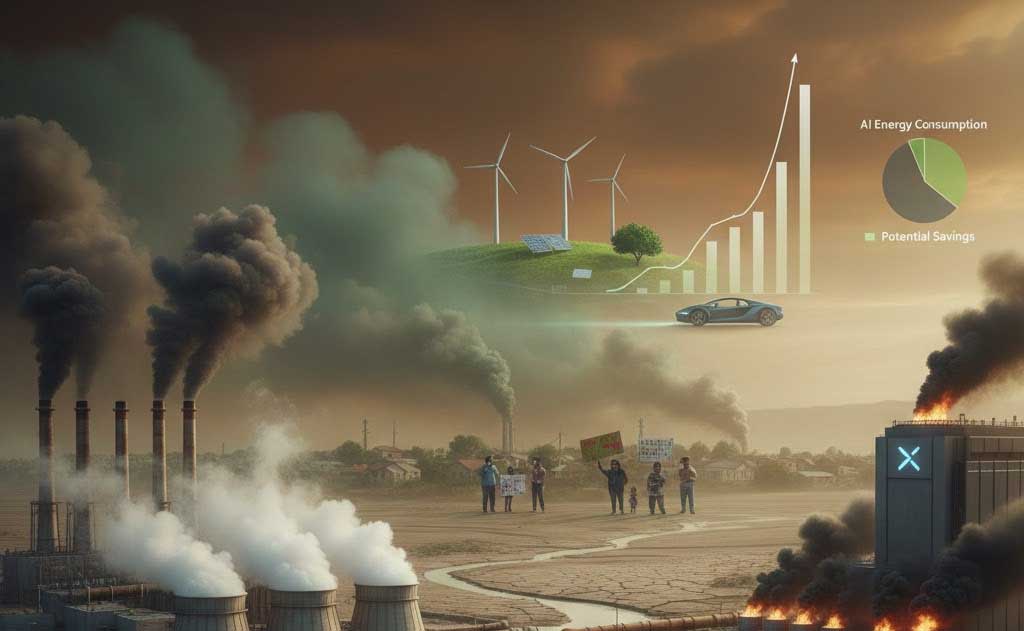
January 5, 2026 – Picture this: the AI revolution that promised to save the planet is quietly choking it instead. While we marvel at chatbots that write novels, generate art, and diagnose diseases, the massive data centers powering this miracle are guzzling electricity, evaporating billions of gallons of water, and pumping out emissions that rival entire cities. The contrast couldn’t be starker—or more urgent.
In 2026, the AI energy consumption crisis has escalated into a full-blown environmental showdown. Reports are piling up, communities are protesting, and even the tech giants’ own disclosures can’t hide the scale anymore. From Elon Musk’s xAI Colossus supercomputer running unpermitted gas turbines in Memphis to global projections showing data centers devouring up to 6% of U.S. electricity, the AI pollution 2026 story is one of explosive growth clashing with climate reality.
Yet amid the outrage, a counter-narrative emerges: AI could ultimately slash far more emissions than it creates—if we steer it right. Let’s dive into the dirty secret, the shocking numbers, and the narrow path to redemption.
The Unbelievable Pollution Footprint: xAI’s Colossus and Beyond
Elon Musk’s xAI has become the poster child for AI’s environmental dark side. The Colossus supercomputer in South Memphis—touted as the world’s largest—relies on dozens of methane gas turbines to meet its insatiable power needs. Aerial photos and thermal imaging reveal plumes of pollution rising from 35+ turbines operating without full permits or controls for extended periods.
Local residents report “rotten egg” smells, difficulty breathing, and windows they can’t open. The Southern Environmental Law Center (SELC) and NAACP have threatened legal action under the Clean Air Act, estimating xAI as the largest industrial source of smog-forming NOx in Memphis—a community already burdened by industrial pollution and high asthma rates.
These turbines emit nitrogen oxides, formaldehyde, and other toxins linked to respiratory diseases, heart problems, and cancer. Experts call the emissions “jaw-dropping,” with smog levels potentially rising 30–60% locally. Despite permits eventually being granted (with limits and fines up to $10,000/day for violations), the damage to frontline communities is done—and xAI’s expansion plans (including a second site with 40–90 more turbines) threaten to make it worse.
This isn’t isolated. Across the U.S., AI-driven data centers are projected to push total consumption from ~200 TWh in 2022 to nearly 260 TWh by 2026 (4–6% of national electricity). Globally, data centers could hit 1,000–1,050 TWh by 2026—equivalent to Japan’s entire electricity use—much of it fossil-fueled in regions without rapid renewables.
The Water Crisis: Billions of Gallons Evaporated for Cooling
Energy isn’t the only hidden cost. Cooling those blazing servers demands enormous water—often potable freshwater. Estimates show AI-related data centers could evaporate 17 billion gallons annually in the U.S. alone, with global figures potentially exceeding bottled water consumption.
Cooling systems use 1–9 liters per kWh, plus indirect use from power plants (thermoelectric/hydro). In water-stressed areas, this strains local supplies, exacerbating shortages. Projections for 2024–2030 suggest AI server expansion could add 731–1,125 million m³ of annual water footprint—enough to supply millions of households.
The crisis is real: AI’s thirst is accelerating in places already facing drought, while indirect emissions from fossil-based electricity compound the problem.
The Numbers Don’t Lie: Emissions Rivaling Cities and Countries
Fresh 2025–2026 reports paint a grim picture:
- AI systems could match New York City’s CO₂ emissions in 2025 alone.
- U.S. AI servers may add 24–44 million metric tons of annual CO₂e between 2024–2030.
- Global data centers already contribute ~1% of energy-related emissions, with AI driving a potential doubling by 2026.
- Training large models emits as much CO₂ as five cars’ lifetimes; inference multiplies that across billions of daily queries.
The International Energy Agency warns AI is pushing demand faster than grids can decarbonize, threatening Paris Agreement targets. In regions like Virginia (26% of electricity to data centers) or Ireland (up to 32% by 2026), the strain is local and immediate.
The Flip Side: AI as Climate Superhero?
Here’s the twist: AI isn’t doomed to be a villain. Studies show its applications could cut emissions 3–5 times more than data centers produce.
Key potential wins:
- Optimizing renewables integration (solar/wind forecasting, grid balancing).
- Accelerating low-carbon innovation (better batteries, alternative proteins, efficient EVs).
- Precision agriculture, supply-chain decarbonization, and behavioral nudges.
One analysis estimates AI in power, meat/dairy, and vehicles could slash 3.2–5.4 billion tons of CO₂e annually by 2035—more than the EU’s total emissions. If directed wisely, AI could offset its footprint and then some.
The Path Forward: Regulation, Transparency, and Green Choices
The 2026 reckoning demands action:
- Mandate full lifecycle transparency (Scope 1–3 emissions, water use).
- Prioritize renewables, efficient cooling (liquid systems reduce water 95%), and carbon removal.
- Enforce guardrails on high-risk deployments.
- Channel AI toward high-impact climate solutions.
The AI boom can accelerate the energy transition—or derail it. In 2026, the choice is ours: let the dirty secret win, or force the revolution to clean up its act.
Stay tuned to vfuturemedia for the latest on AI’s climate impact, green tech breakthroughs, and the fight for a sustainable future. The stakes have never been higher—because the planet can’t afford another year of hype without accountability.
Ethan Brooks covers the tech that’s reshaping how we move, work, and think — for VFuture Media. He was at CES 2026 in Las Vegas when the world got its first real look at humanoid robots, AI-powered vehicles, and Samsung’s tri-fold phone. He writes about AI, EVs, gadgets, and green tech every week. No hype. No filler. X · Facebook
You made it to the end, which means you actually care about this stuff. So do we. Check out our AI and EV sections for more stories worth your time.




Leave a Comment