
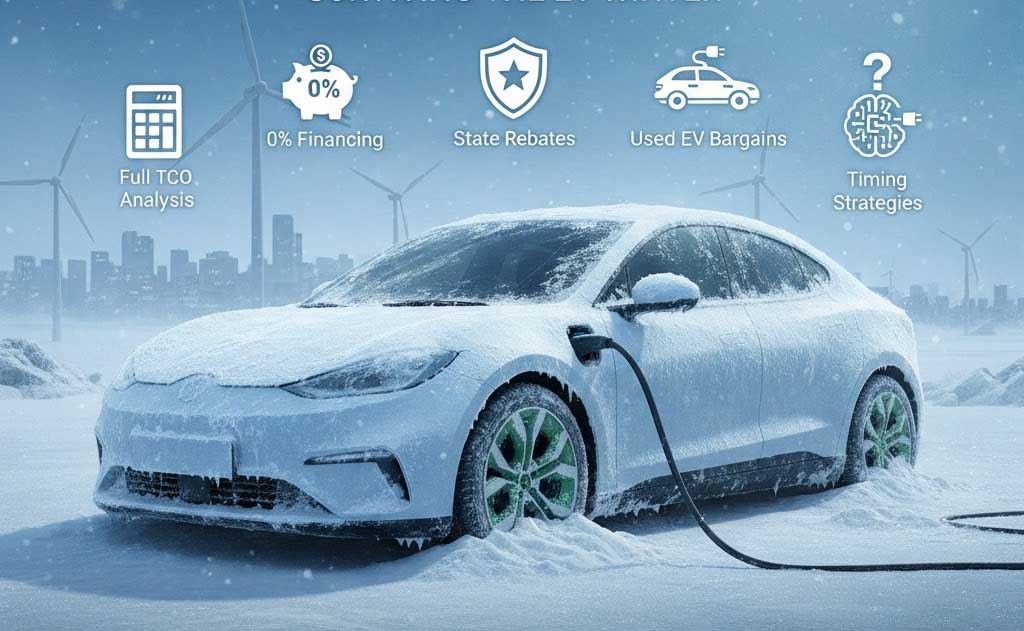
Picture this: It’s late September 2025. A young couple in Austin rushes to their local Tesla store, credit app in hand, determined to snag a Model Y before the $7,500 federal tax credit vanishes at midnight on the 30th. They drive off grinning, feeling like they’ve beaten the system. Fast-forward to January 2026: that same Model Y now sits on their driveway, resale value down 25% from the incentive rush, monthly payments still stinging at 6.9% APR on their remaining loan, and the news cycle screaming “EV winter.” They’re not alone — thousands of early movers now face the harsh morning-after reality.
I’ve seen two major EV slowdowns in my career: the 2019 subsidy cliff in Europe and the 2022–2023 post-pandemic inventory glut. The 2026 version feels different — sharper, more policy-driven, but also more survivable for those who adapt quickly. The “EV winter” label is everywhere: Cox Automotive projects total U.S. new-vehicle sales dipping to 15.8 million (down 2.4% from 2025), with EV share pressured toward 8% or lower after a Q4 2025 collapse. Edmunds sees ~6% share, BloombergNEF warns of choppy U.S. growth amid global slowdown to ~12%, and pessimistic scenarios peg passenger EV volume contraction at 15–20%.
Is this the end of electrification? Hardly. It’s a brutal correction — painful for legacy laggards and incentive-addicted startups, but a buying opportunity for savvy consumers and a proving ground for resilient brands. Last month I spoke with three fleet managers who are quietly doubling down on EVs for cost-per-mile savings, two Tesla loyalists who timed their purchases perfectly, and one legacy buyer regretting a premium non-Tesla pickup he rushed into without state rebates. Their stories reveal the real playbook for navigating 2026.
This isn’t just another forecast roundup. It’s a myth-busting survival guide: the numbers behind the winter talk, who gets hit hardest (and why some skate through), seven costly mistakes buyers are making right now, a practical checklist for winning in the downturn, and bold predictions for when (and how) the thaw arrives.
Is the ‘EV Winter’ Real? The Brutal Numbers for 2026
Let’s start with the cold facts. Cox Automotive’s January 2026 outlook pegs total U.S. new-vehicle sales at 15.8 million — down 2.4% from 2025’s stronger-than-expected 16.2 million pace. Retail sales fall 1.5%, fleet sales drop 6.1%, and EV/plug-in hybrid leasing penetration slips to 21% from higher 2025 levels. EV-specific softness is tied directly to the loss of the $7,500 federal clean vehicle credit, which buyers rushed to capture in Q3 2025 before its effective phase-down or repeal.
Edmunds forecasts EV share around 6% — down from recent highs near 7–8%. BloombergNEF sees global EV growth cooling to ~12% in 2026, with the U.S. particularly choppy due to policy uncertainty. In pessimistic scenarios — full repeal without offsetting state support — passenger EV volume could contract 15–20%, especially outside mandate-heavy states like California.
2026 EV Forecast Snapshot
- Cox Automotive — Total sales 15.8M (–2.4% YoY); EV softness, leasing to 21%
- Edmunds — EV share ~6%; policy/economic drag
- BloombergNEF — Global slowdown to 12% growth; U.S. choppy/contraction risk
- Pessimistic range — 15–20% passenger EV volume drop if federal support vanishes fully
Cox Automotive’s January 2026 U.S. vehicle sales forecast lays out the detailed breakdowns.
For ongoing market tracking, check our electric-vehicles section.
Why the Tax Credit Repeal Hit So Hard — And Why Q4 2025 Crashed
The federal $7,500 credit wasn’t just money off the hood — it was psychological rocket fuel. Q3 2025 saw record EV volume as buyers front-loaded purchases to beat the deadline. Then came the cliff: Q4 registrations collapsed 36–46% quarter-over-quarter in many reports, the steepest drop since early pandemic chaos.
The hangover is brutal. Affordability — already strained by high interest rates (auto loans averaging 7–8%) and slower job/wage growth — took a direct hit. A $50,000 EV that felt like $42,500 suddenly costs full freight. Resale values for 2025 incentive buyers are down 20–30% in some segments, fueling “buyer’s remorse” stories flooding forums.
‘EV Winter’ Defined: Who Gets Frostbite — And Who Skates Through
The term “EV winter” captures real pain: legacy OEMs scaling back ambitious EV targets, niche startups facing funding droughts, incentive-dependent models gathering dust on lots. Margin pressure is intense — some players are burning cash to move metal.
But it’s uneven. Tesla’s vertical integration, pricing power, and Supercharger moat let it weather the storm better than most. Scaled OEMs with hybrid bridges (Ford, GM) pivot faster. California buyers lean on state rebates; fleet operators quietly lock in cost-per-mile wins.
Contrarian take: the winter is overstated for resilient segments and deadly for others. Tesla loyalists who bought pre-rush are laughing; legacy buyers who chased premium non-Tesla models without rebates are freezing.
Myth-Busting: 5 Big Misconceptions About the 2026 Downturn
- “EVs are dead” — Wrong. Global growth continues ~12%; U.S. contraction is policy shock, not tech rejection.
- “Prices will crash 30% overnight” — Unlikely. Used EV supply surges, but new models hold firmer.
- “Only Tesla survives” — Partially true. Scaled players with incentives and hybrids thrive; startups with strong balance sheets endure.
- “Charging infrastructure stalls” — Federal slowdown hurts, but private/utility buildout accelerates in key markets.
- “2026 is the bottom” — Possible, but recovery ties to new affordable launches and rate cuts.
7 Costly Mistakes Buyers Are Making Right Now (With Real Stories)
- Panic-selling used EVs at the bottom — One Denver teacher sold her 2024 Model 3 at 28% loss fearing further drops. Wait — off-lease flood peaks mid-2026; values stabilize.
- Overpaying premium non-Tesla models without incentives — A Chicago exec bought a $90k luxury EV expecting resale strength. Now underwater; incentives masked true TCO.
- Ignoring total cost of ownership — Focus on sticker price only; one Atlanta family skipped home charger, paying 30% more in public charging.
- Buying non-Tesla without state rebates — Texas buyer chose premium crossover sans credits; California counterpart saved $7k+ via CVRP successor.
- Waiting too long for “mythical” price drops — Early 2026 inventory overhang helps, but best deals (0% financing) vanish fast.
- Skipping used market entirely — Off-lease returns create bargains; one Florida retiree saved $18k on low-mile 2024 EV.
- Rushing without comparing financing — 0% deals save thousands; one buyer took 5.9% standard rate, losing $4k+ over term.
Smart Survival Playbook: How Savvy Buyers Are Winning in 2026
Checklist for Buyers
- Run full TCO calculator — Include electricity vs. gas, maintenance, insurance, resale.
- Leverage 0% financing — Tesla Model Y Standard, Chevy Equinox EV, Kia EV9 — up to 72 months in many regions.
- Stack state/utility rebates — California, Colorado, others fill federal gap.
- Hunt used/off-lease — 2026 surge creates bargains; check Recurrent reports.
- Prioritize resilient brands — Tesla ecosystem, GM/Ford incentives, Hyundai/Kia value.
- Install home charger — AI-optimized scheduling cuts bills 20–40%.
- Consider lease/fleet tactics — Lower upfront, capture incentives.
- Time purchase — End-month deals, rate-cut anticipation.
Buyer Timing Guide
- Buy now — If 0% financing/state rebates available and you need vehicle.
- Wait 3–6 months — Used surge peaks, potential rate relief.
- Wait 12+ months — New affordable models (Bolt refresh, R2) arrive.
Resilient Brands & Models: Who Thrives in the Cold
Tesla — Pricing power, scale, network. Model Y 0% deals keep momentum.
GM — Equinox EV push, Bolt revival target mainstream.
Ford — Lightning/Mach-E incentives, hybrid bridge.
Hyundai/Kia — Value pricing, aggressive financing.
Rivian — R2 launch could reset affordability.
Used market — Off-lease flood creates entry point.
State Incentives & Workarounds: Federal Gap Fillers
California CVRP successors, Colorado rebates, utility programs — key offsets. Mandate states (Section 177) sustain demand.
AI & Smart Charging Edge: The Hidden Cost Cutter
AI apps predict low-rate windows, enable demand-response earnings, V2G potential. One fleet manager I spoke with cut costs 35% via optimized scheduling.
See AI gadgets surge in Canada 2026 and Elon Musk reveals x’s AI future 2026.
Buyer Psychology & Timing: Fear vs. Opportunity
Panic drives mistakes; patience wins. Early movers regret; informed adapters thrive.
Future Outlook 2027–2035: Thaw, Bifurcation, Trillion-Scale Buildout
Recovery via new models/infrastructure; mandate states accelerate; national bifurcation; grid/charging investment reaches trillions.
Investment & Consumer Angles
Resilient stocks (Tesla, battery plays), buyer shift to TCO focus.
FAQ
Is 2026 really an EV winter or just a correction?
Correction — policy shock creates pain, but resilient factors position recovery.
Should I buy an EV now or wait until 2027?
Depends — grab 0% financing/state rebates now; wait for used surge/new models if flexible.
What are the best 0% financing EVs in January 2026?
Tesla Model Y Standard, Chevy Equinox/Silverado EV, Kia EV9/EV6, Hyundai Ioniq 5 — check regional offers.
How much could EV sales drop in 2026?
Cox sees overall market dip; EV softness could mean 15–20% passenger contraction in pessimistic views.
Why did Q4 2025 EV sales crash?
Post-incentive rush hangover — buyers pulled forward demand before credit phase-down.
Are used EVs a good buy in 2026?
Yes — off-lease surge creates bargains; check battery health via Recurrent.
Which states still offer strong EV rebates?
California, Colorado, others — fill federal gap effectively.
Is Tesla the only safe bet in EV winter?
Strongest — pricing power, ecosystem; scaled OEMs (GM/Ford) also resilient.
How does AI smart charging help during slowdown?
Cuts electricity costs 20–40%, enables V2G earnings, improves TCO.
What new affordable models arrive in 2026?
Refreshed Chevy Bolt, Rivian R2, updated Nissan Leaf target mainstream buyers.
Will resale values crash further?
Used supply peaks mid-2026; stabilize after initial dip.
Should I avoid non-Tesla EVs without state rebates?
Risky — higher effective cost; prioritize incentive-eligible or used.
How might policy preemption affect state programs?
Legal battles likely; mandates endure in key states.
What is the long-term EV outlook post-2026?
Gradual recovery, bifurcation, trillion-scale infrastructure.
Why is the used EV market key in 2026?
Off-lease returns create affordable entry point amid new-vehicle headwinds.
Ready to navigate the EV winter? Dive deeper at Electric-vehicles/ or explore smart charging tech at Ai/.
I’m Ethan, and I write about the tech that’s actually going to change how we live — not the stuff that just sounds impressive in a press release. I cover AI, EVs, robotics, and future tech for VFuture Media. I was on the ground at CES 2026 in Las Vegas, walking the show floor so I could give you a real read on what matters and what’s just noise. Follow me on X for daily takes.
If you found this useful, the best thing you can do is share it with someone who’d actually appreciate it. And if you want more like it, we’re here every week.



Leave a Comment