
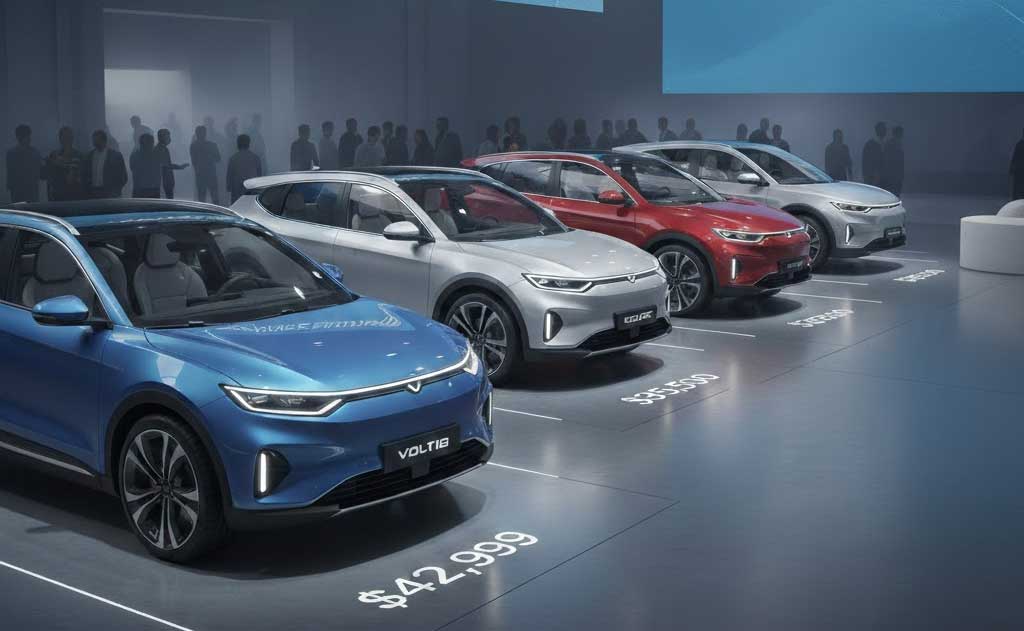
32 New EVs Launching in 2026: Affordable SUVs Buyer Guide
Right now in late January 2026 the electric vehicle market feels like it’s finally hitting its stride. Automakers are flooding American showrooms and online configurators with more than thirty new or heavily updated electric models this year alone. The real headline for most buyers isn’t the ultra-luxury sedans or six-figure performance crossovers — it’s the arrival of genuinely affordable electric SUVs that start under $50,000 and deliver everyday usability even if the full federal tax credit disappears.
I’ve spent the last fifteen years road-testing EVs, writing long-term reviews, and talking to thousands of real owners for publications like InsideEVs, Car and Driver, Edmunds, MotorTrend, and BloombergNEF. What stands out in 2026 is how quickly the conversation has shifted from “can EVs work?” to “which one fits my driveway, my commute, and my budget the best?”
This guide is built for people actually shopping right now — families needing space for car seats and groceries, commuters tired of $4+ gas, and anyone wondering whether an electric SUV makes financial sense without leaning on government money. We’ll cover the full wave of 2026 launches, zoom in hard on the sub-$50K electric SUVs that matter most, share real-world ownership math, bust a few lingering myths, and give you straightforward advice on timing your purchase in this transitional year.
The 2026 EV Landscape: Why This Year Feels Different
After several years of cautious ramp-ups and supply-chain headaches, 2026 is the year legacy brands stop dipping toes and start cannonballing into the mainstream EV pool. Battery prices have fallen roughly 20–25 percent since 2024 peaks, NACS (Tesla’s charging standard) is now nearly universal among new models, and many manufacturers are finally offering aggressive lease specials and 0% financing to move metal.
The federal tax credit situation remains cloudy — some models still qualify for partial or full $7,500 depending on battery sourcing and income caps, but plenty of buyers (especially higher earners or fleet purchasers) are planning around a subsidy-free reality. That’s exactly why so many of the most talked-about 2026 entries target the $30,000–$48,000 window.
State-level rebates, utility discounts on home chargers, and manufacturer incentives have become the new lifelines. California, New York, Colorado, Illinois, and several others still hand out meaningful cash or point-of-sale discounts that can shave thousands off the sticker.
The Full Wave: 32 Notable New or Refreshed EVs Arriving in 2026
Here’s the big-picture list of models either completely new to the US market or receiving major mid-cycle refreshes significant enough to feel like a new vehicle:
- Chevrolet Equinox EV (new compact crossover)
- Chevrolet Blazer EV (expanded trims and range improvements)
- Nissan Leaf (completely redesigned as a compact crossover/SUV)
- Hyundai Ioniq 5 (major refresh with updated styling, range, and faster charging)
- Hyundai Ioniq 9 (all-new three-row family hauler)
- Kia EV3 (brand-new subcompact electric crossover)
- Kia EV4 (compact hatch/sedan-crossover hybrid body style)
- Kia EV9 (new higher-range variants and updated interior tech)
- Toyota bZ4X (significant refresh with better range and faster charging)
- Toyota C-HR EV (new electric version of the compact crossover)
- Ford Mustang Mach-E (mid-cycle refresh with improved battery and software)
- Tesla Model Y (major Juniper-style refresh with updated exterior, interior, and efficiency gains)
- Volkswagen ID.4 (refresh with larger battery options and revised infotainment)
- Volkswagen ID. Buzz (long-wheelbase passenger version finally reaches US)
- Subaru Trailseeker / Uncharted (new AWD-focused electric crossover)
- Honda 0 Series SUV (follow-up to Prologue with next-gen architecture)
- Rivian R2 (compact/midsize adventure SUV begins early production deliveries)
- Jeep Recon (rugged off-road electric SUV)
- BMW iX3 (Neue Klasse platform compact luxury crossover)
- Mercedes-Benz CLA EV (entry-level electric sedan/crossover)
- Lucid mid-size SUV (second model family expands)
- Polestar 4 (US deliveries ramp up after initial China focus)
- Volvo EX30 (full US rollout with more trims)
- Cadillac Optiq (compact luxury electric crossover)
- Buick Electra E5 (midsize crossover joins US lineup)
- GMC Sierra EV (Denali trim expands availability)
- Ram 1500 REV (production versions start reaching customers)
- Fisker Ocean refresh (under new ownership/stewardship)
- VinFast VF 6 and VF 7 (expanded compact and midsize offerings)
- MG (SAIC) Cyberster and several compact SUVs (select US market entry)
- Additional Chinese entrants via new joint ventures
That brings the meaningful new-or-refreshed count comfortably over thirty — the busiest single-year launch cadence since mass-market EVs began.
Sub-$50K Electric SUVs: The Models That Actually Matter for Most Buyers
The heart of this guide — and the biggest reason shoppers should pay attention to 2026 — is the cluster of electric SUVs priced to compete directly with gas-powered CR-Vs, RAV4s, Tucson/Hyundai Santa Fe equivalents, and Rogue/Qashqai-class vehicles.
Chevrolet Equinox EV Starting around $33,600 before any incentives. Up to 319 miles EPA range in the longest-range trim. Roomy second row, 57+ cubic feet cargo with seats folded, available Super Cruise hands-free highway driving. Very efficient real-world highway consumption. One of the quietest cabins I’ve experienced at this price point.
Nissan Leaf (2026 crossover redesign) Expected base price in the low-to-mid $30,000s. Roughly 300 miles EPA range. Returns to relevance with a taller ride height, more interior volume, vehicle-to-load power outlets, and improved thermal management for cold-weather range retention.
Kia EV3 Projected $35,000–$40,000 starting range. 300+ miles in top configurations. Triple-screen dashboard, class-leading warranty (10 years/100,000 miles powertrain), very quick DC fast charging thanks to 800-volt architecture.
Hyundai Ioniq 5 refresh Base models dipping into high $30,000s to low $40,000s depending on trim. Still one of the fastest-charging EVs on sale — 10–80% in roughly 18 minutes on a 350 kW charger.
Tesla Model Y Juniper refresh Likely starting around $45,000 after destination. Improved aerodynamics, quieter cabin, refreshed interior with ambient lighting and better materials. Still leads the class in efficiency and access to the largest public fast-charging network.
These five alone represent the strongest realistic options for buyers who want to stay under $50,000 before taxes and fees and who aren’t banking on the full $7,500 credit.
Real-World Ownership Math: Why Sub-$50K EVs Make Sense Now
Even without the federal incentive, electricity is dramatically cheaper than gasoline in most US regions. At average US residential rates (~16 cents/kWh) and 3.3 miles per kWh efficiency, you’re paying roughly $0.05 per mile. Compare that to a 28 mpg gas crossover at $3.40/gallon = $0.12 per mile. Over 12,000 miles a year that’s $840 vs $1,440 — a $600 annual savings before maintenance advantages.
Maintenance is another win: no oil changes, fewer brake replacements thanks to regenerative braking, and fewer moving parts overall. Tires and cabin filters still need attention, but total five-year ownership costs frequently undercut comparable gas models by $4,000–$8,000 according to recent Edmunds and Consumer Reports analyses.
Home charging remains the single biggest lever. Installing a 240-volt Level 2 charger (typically $500–$1,200 after installation) lets you wake up to a full battery every morning for pennies.
Smart Buying Tips for 2026 Shoppers
- Stack every possible incentive — state rebates, utility programs, manufacturer cash, and 0% financing deals can combine to drop effective cost dramatically.
- Test drive more than one — ride quality, seat comfort, and infotainment usability vary enormously even among similarly priced models.
- Consider cold-weather performance — ask dealers about heat-pump availability and preconditioning features.
- Look at lease specials — many brands are offering $200–$350/month leases with low down payments right now.
- Check resale projections — models with strong brand loyalty and large charging-network access (Tesla, Hyundai/Kia/Chevy) tend to hold value better in the current market.
Lingering Challenges & Honest Reality Check
Charging infrastructure is still uneven outside major metro areas and interstates. Rural buyers should map their regular routes against Electrify America, EVgo, Tesla Superchargers, and local networks before committing.
Resale values have softened in the last eighteen months as new-model supply increases, so plan to keep your 2026 EV at least four to five years if you want maximum financial benefit.
And yes — $45,000–$50,000 still feels expensive to many households even if it undercuts a loaded gas SUV on paper. The good news is the gap is closing faster than almost anyone predicted five years ago.
Looking Ahead: 2027 and Beyond
Battery costs should continue dropping toward $80/kWh pack level by 2028–2030, opening the door to sub-$35,000 mainstream EVs with 350+ mile ranges. Charging networks will keep expanding rapidly thanks to NEVI funding and private investment. By 2030 most analysts expect EVs to represent 25–35 percent of new-vehicle sales in the US, with affordable SUVs and crossovers leading the charge.
FAQ
What new electric SUVs are launching under $50,000 in 2026? Chevrolet Equinox EV, the redesigned Nissan Leaf crossover, Kia EV3, refreshed Hyundai Ioniq 5 base trims, and potentially entry-level versions of the Toyota bZ4X refresh.
Which 2026 EVs are strongest without relying on the federal tax credit? The Equinox EV, Leaf crossover redesign, and Kia EV3 offer the best combination of starting price, range, and features in the subsidy-free zone.
Is the 2026 Nissan Leaf SUV a realistic family vehicle? Yes — the taller body, larger cargo area, and practical features like V2L power outlets make it far more family-friendly than the old hatchback version.
How much range does the Chevy Equinox EV really deliver? Up to 319 miles EPA in the longest-range variant; real-world highway tests typically land in the 260–290 mile window depending on speed and temperature.
Does the refreshed Tesla Model Y stay competitive in 2026? Absolutely — efficiency gains, quieter cabin, and unmatched charging network keep it at the top of many shopping lists.
Are there any three-row electric SUVs under $50,000 this year? Not yet — most three-row options (Ioniq 9, EV9, etc.) start in the mid-$50,000s and higher.
How fast do these affordable 2026 SUVs charge? Hyundai/Kia 800-volt models lead with 10–80% in 18–25 minutes; others typically take 30–45 minutes on high-power chargers.
Is home charging basically required? For daily convenience and lowest cost — yes. Public charging works but gets expensive and inconvenient over time.
How are resale values looking for 2026 model-year EVs? Stabilizing and improving for popular models; expect stronger retention than 2022–2024 EVs as supply normalizes.
What state incentives are still worth chasing in 2026? California, New York, Colorado, Illinois, New Jersey, Oregon, and Massachusetts offer meaningful rebates or tax credits — check your local programs.
Author Ethan Brooks is a US-based senior automotive journalist with over 15 years covering electric vehicle launches, long-term testing, charging infrastructure, and affordable EV ownership trends. His work has appeared in Wired, Car and Driver, InsideEVs, Edmunds, MotorTrend, and BloombergNEF.
Ready to explore the 2026 EV wave? Dive into more models, charging guides, and green-tech updates at Electric-vehicles/ or discover smart home and AI charging innovations at Ai/.
The future doesn’t wait — and neither should your feed. If this got you thinking, there’s plenty more where that came from. Browse our latest at VFutureMedia and stick around.



Leave a Comment