
By Ethan Brooks, Senior Journalist at VFutureMedia
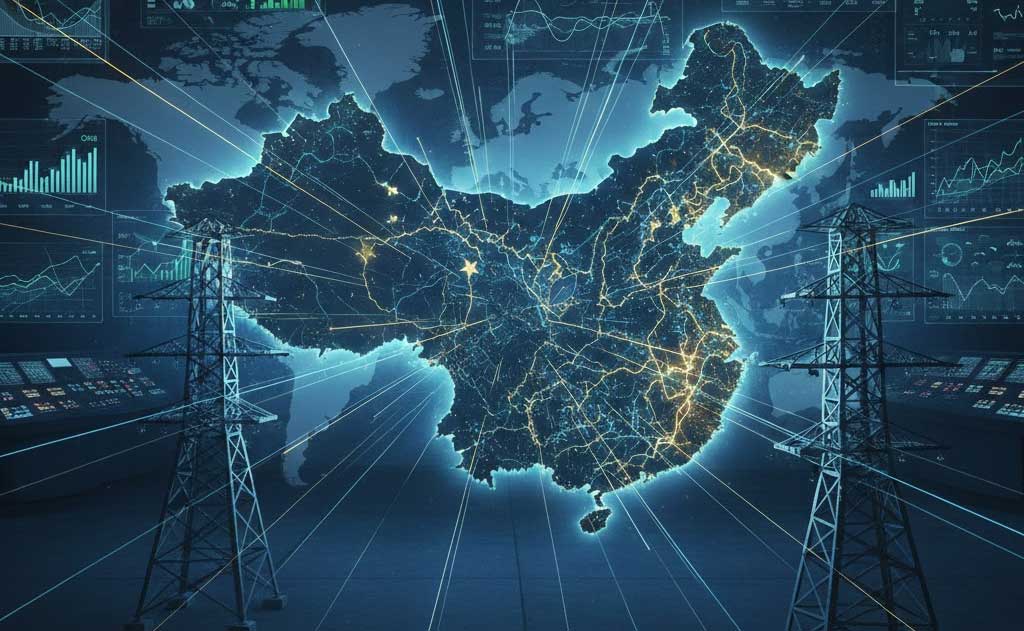
China’s energy grid stands as one of the most monumental engineering and industrial achievements of the modern era. In 2025, the country solidified its position as the undisputed leader in global electricity generation, accounting for approximately 33.2% of the world’s total output—more than double the United States’ share of around 14.2%. This means China alone generates roughly one-third of all electricity produced worldwide, leaving the rest of the planet combined to account for about 52.6%. This staggering dominance underscores China’s role as an absolute powerhouse in global power systems.
The figures, highlighted in recent analyses and echoed by figures like Elon Musk on social platforms, reflect not just sheer volume but the relentless pace of expansion. China’s electricity consumption surpassed 10 trillion kWh (10,368.2 TWh) for the first time in 2025, up 5% year-over-year, driven by surging demand in services, residential sectors, and industrial electrification. This scale has profound implications for energy transitions, geopolitics, supply chains, and the fight against climate change.
The Numbers Behind China’s Electricity Supremacy
Recent data from sources like the National Energy Administration (NEA), Ember, IEA, and industry reports confirm China’s outsized role:
- Total global electricity generation in recent years has hovered around 30,000–32,000 TWh annually, with growth accelerating due to electrification trends.
- China’s 2025 generation aligns with its consumption milestone of over 10,000 TWh, representing a massive share when compared to global totals.
- The U.S., the second-largest producer, generates roughly half or less of China’s output in absolute terms, with shares consistently in the low teens percentage-wise.
- Other major players like India (around 7–8% historically) and the EU combined fall far behind.
This 33.2% figure positions China as generating more electricity than the next several largest economies put together in many metrics. As noted in discussions around Musk’s comments, China’s system is “insanely large and highly increasing,” fueled by rapid industrialization, urbanization, and aggressive deployment of both fossil and renewable infrastructure.
Rapid Growth and the Renewable Surge
China’s grid expansion has been extraordinary. Electricity demand has doubled since 2015 (from around 5 trillion kWh), reflecting economic transformation and electrification across sectors. Key drivers include:
- Industrial electrification — Manufacturing of solar panels, batteries, EVs, and related tech consumes vast amounts.
- Residential and services boom — Rising air conditioning use, EV charging, data centers, and digital infrastructure.
- Renewable additions — In 2025, non-fossil fuel capacity exceeded 60% of total installed power, with wind and solar installations continuing at record pace (e.g., wind + solar nearing 2 TW combined in some estimates).
Renewable generation from sources like wind, solar, hydro, and others reached about 4 trillion kWh in 2025—exceeding the entire EU’s power consumption. Solar and wind alone have seen explosive growth, with shares in China’s mix rising sharply (e.g., solar at record highs in monthly data).
Despite heavy reliance on coal (still ~55–60% of the mix in recent years), thermal power generation declined for the first time in a decade in 2025, as renewables met or exceeded demand growth. This shift is structural: new coal plants often serve as backup/flexibility rather than primary generation, with utilization rates hitting record lows.
For context on global trends, renewables (including hydro) overtook coal in share during parts of 2025 in some metrics, driven largely by China’s contributions (e.g., 55% of global solar growth in early periods).
Implications for Global Energy, EVs, and Climate
China’s scale has ripple effects worldwide:
- Supply Chain Dominance — The country produces the majority of solar panels, batteries, and wind components, accelerating global clean energy deployment while raising concerns about dependency.
- Electrification Leadership — High electricity penetration in final energy (higher than the U.S. or EU in some metrics) supports massive EV adoption, data centers, and industrial shifts—key for mobility futures.
- Climate Impact — While coal remains dominant, renewables growth curbs emissions growth. China’s actions influence global CO2 trajectories, with power sector emissions plateauing in forecasts partly due to its renewable push.
- Geopolitical Power — Control over such a large share of generation capacity shapes energy security, trade, and international climate negotiations.
In the EV space—relevant to VFutureMedia’s focus—China’s grid scale enables the world’s largest EV market and export surge, powering manufacturing and charging infrastructure at unprecedented levels.
Challenges and the Path Ahead
Despite dominance, challenges persist: grid integration of variable renewables, regional imbalances, curtailment risks, and balancing coal phase-down with reliability. Policy continues to prioritize renewables, with targets aligning to carbon neutrality by 2060.
China’s grid is a blueprint for what massive, rapid scaling looks like—combining state-driven investment with technological leaps. As the world electrifies, few nations match this pace or ambition.
For more on related topics, check our posts: Chinese EV Battery Innovations and Global Renewable Trends 2026.
As we move into 2026, China’s energy story remains central to understanding the future of power, mobility, and sustainability
I’m Ethan, and I write about the tech that’s actually going to change how we live — not the stuff that just sounds impressive in a press release. I cover AI, EVs, robotics, and future tech for VFuture Media. I was on the ground at CES 2026 in Las Vegas, walking the show floor so I could give you a real read on what matters and what’s just noise. Follow me on X for daily takes.
We started VFuture Media because we wanted tech news written by people who actually follow this industry — not content farms chasing keywords. If that resonates, we’d love to have you as a regular reader. Pull up a chair.



Leave a Comment