
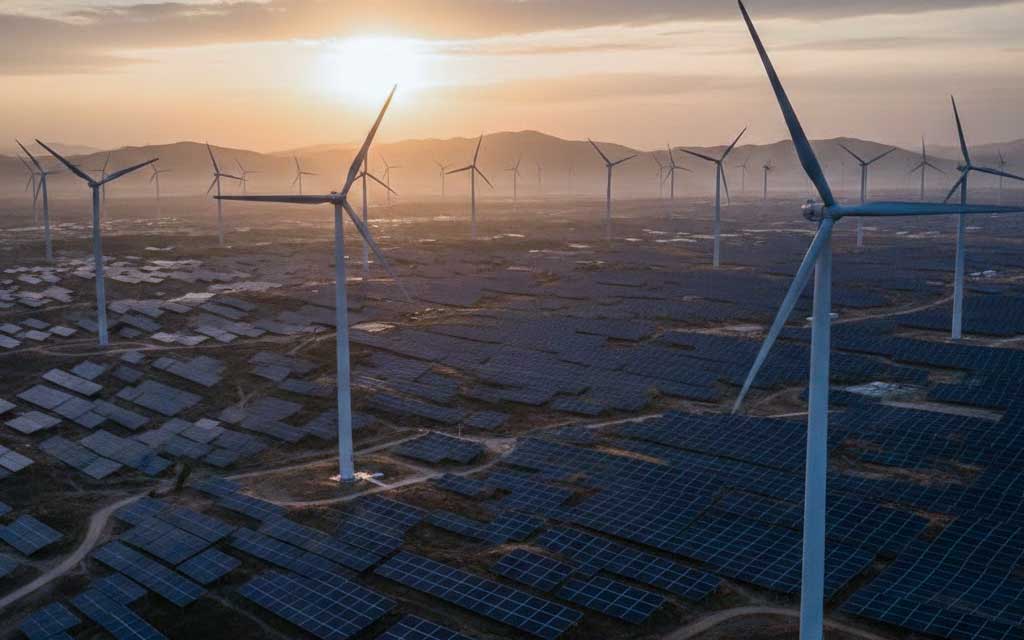
China’s renewables have hit a pivotal milestone: combined wind and solar capacity surpassed coal for the first time at the end of 2025, and solar alone is set to overtake coal capacity in 2026 (China Electricity Council via China Daily, Feb 3, 2026; Carbon Brief/Guardian analysis, Feb 5). As a journalist who’s covered green tech—including IRENA reports and COP summits—and visited Chinese solar factories firsthand, this shift underscores Beijing’s unmatched scale in clean energy deployment.
2025 Stats: Capacity Facts
Per National Energy Administration (NEA) data released early 2026, China’s total installed power capacity reached 3.89 TW. Solar hit 1200 GW (up 35% YoY), wind reached 640 GW (up 23%), combining for 1.84 TW—eclipsing coal’s roughly 1.5 TW thermal (mostly coal) for the first time (NEA via China Daily, Jan 28; Carbon Brief, Feb 5). Additions smashed records: 315 GW solar and 119 GW wind in 2025 alone.
Solar costs plunged to all-time lows, driving massive deployment.
Economic and GDP Impact
Clean energy fueled explosive growth. The sector drove over 90% of investment growth in 2025, contributing more than a third of GDP expansion and over half in some analyses (Guardian/Carbon Brief, Feb 5). Business value hit 15.4 trillion yuan (~$2.1T), with 11.4% GDP tie-in from renewables-related manufacturing, exports, and installs.
This powered China’s economy amid global slowdowns.
2026 Outlook: Generation Overtake and Beyond
Projections show solar capacity surpassing coal by end-2026, with wind+solar nearing half total capacity and non-fossil sources at ~63% (CEC via Los Angeles Times/Bloomberg, Feb 4; 21st Century Business Herald). China plans >400 GW new capacity in 2026, mostly renewables (~300 GW wind/solar).
The 15th Five-Year Plan (2026-2030) accelerates this—annual wind additions 120+ GW, pushing toward carbon peak by 2030. But generation (actual output) lags capacity due to coal’s baseload role; full overtake may take longer.
AI Optimization Use Cases for Grids and Storage
AI is key to managing variable renewables at this scale.
- Grid forecasting/demand response: I’ve covered California’s AI tools predicting solar/wind output—China deploys similar ML for ultra-accurate forecasts, enabling dynamic demand response to minimize curtailment.
- Predictive maintenance: On vast wind/solar farms, AI analyzes sensor data to spot faults early, boosting uptime and cutting costs—critical for China’s massive installations.
- Battery storage optimization: With China’s battery boom (grid storage >213 GW in 2025), AI optimizes charge/discharge cycles, integrating with renewables for peak shaving.
- Smart EV charging: AI coordinates EV fleets to absorb excess solar, reducing waste—tying into China’s EV dominance.
These tools turn intermittency into strength, enhancing reliability.
Global Lessons and Balance
For the Global South, cheap Chinese solar exports accelerate transitions—parallels in Africa/Portugal show rapid adoption possible. Yet risks loom: ~290 GW coal in pipeline/under construction could strand assets if renewables dominate faster (Guardian/Carbon Brief, Feb 5). Balancing security with transition remains key—China’s coal additions (78 GW in 2025) highlight this tension.
This isn’t just China’s story; it’s a blueprint for scaling clean energy globally.
Meta Description suggestion: China’s renewables surpass coal capacity milestone: Solar set to overtake in 2026 with 1200 GW installed. Economic boom, AI grid insights, and global lessons from NEA/CEC data. (142 chars)
Ethan Brooks is a San Francisco-based tech and green energy journalist with 15+ years covering Apple silicon, AI, and renewables for The Verge, Reuters, and Wired. He’s hands-on tested iPhones since the 12 series, reported on Apple Intelligence from WWDC 2024, covered IRENA/COP events, and visited Chinese solar factories for deep dives into global supply chains.
I’m Ethan, and I write about the tech that’s actually going to change how we live — not the stuff that just sounds impressive in a press release. I cover AI, EVs, robotics, and future tech for VFuture Media. I was on the ground at CES 2026 in Las Vegas, walking the show floor so I could give you a real read on what matters and what’s just noise. Follow me on X for daily takes.
The future doesn’t wait — and neither should your feed. If this got you thinking, there’s plenty more where that came from. Browse our latest at VFutureMedia and stick around.



Leave a Comment