
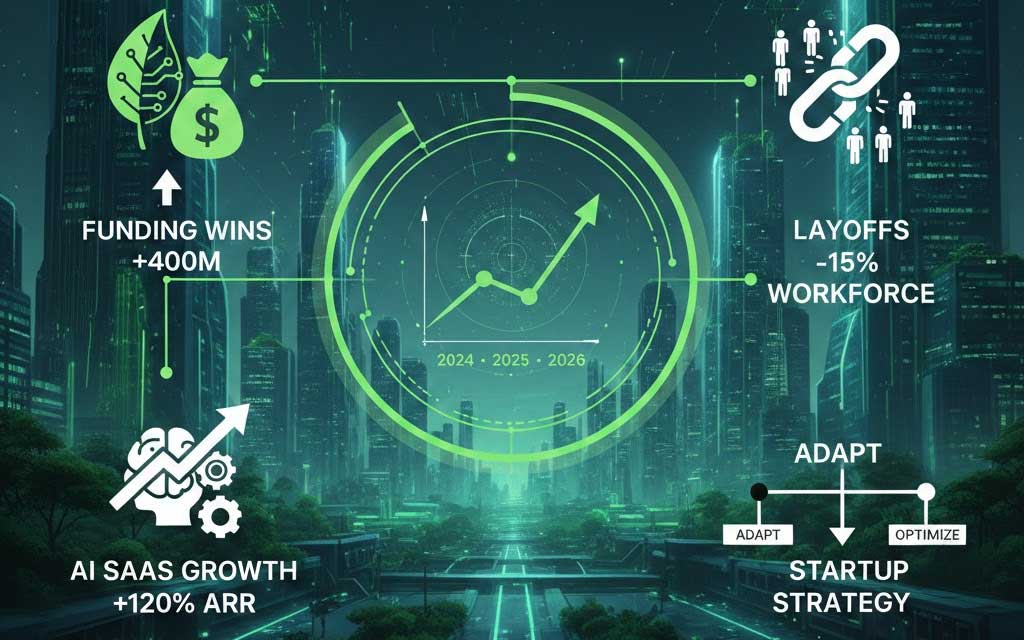
The 2026 Opportunity: Green Tech Meets AI SaaS – Funding Wins, Layoff Lessons, and Startup Strategies arrives at a critical inflection point. While traditional SaaS faces turbulence—triggered by AI disruption fears and a February 2026 selloff wiping out significant market value—green tech sustains robust funding momentum. BloombergNEF’s 2025 energy transition investment record of $2.3 trillion (up 8% YoY) continues fueling climate solutions, creating fertile ground for AI-native SaaS that optimizes energy, tracks emissions, and enables net-zero transitions (BloombergNEF, 2026).
This convergence offers forward-thinking founders a resilient path: build AI-powered tools that solve real climate challenges, leverage subsidies, and avoid legacy SaaS pitfalls.
Introduction: SaaS Turmoil vs. Green Tech Resilience in 2026
February 2026 saw a sharp SaaS selloff, with software stocks losing nearly $1-2 trillion in market cap amid fears that frontier AI agents (e.g., Anthropic’s Claude tools) could disrupt enterprise software layers (Reuters, February 4, 2026; Fortune, February 2026). Investors question traditional SaaS moats as AI automates workflows in legal, sales, marketing, and analytics—prompting margin pressure and pricing scrutiny (CNBC, February 6, 2026).
Major players felt the pain:
- Salesforce laid off fewer than 1,000 employees in early February, impacting marketing, product, data analytics, and Agentforce AI teams amid executive changes (Business Insider, February 9, 2026).
- Workday cut about 400 jobs (2% of workforce) to align with priorities, following prior reductions (The Register, February 4, 2026).
These moves reflect broader AI disruption: legacy SaaS struggles with slower growth and investor skepticism, while AI-native models promise efficiency gains but threaten incumbents (Fortune, February 13, 2026).
Contrast this with green tech: Funding remains strong. HAMR Energy closed a $10M Series A in February 2026 from Qantas, Airbus, and thyssenkrupp Uhde to scale low-carbon liquid fuels via green hydrogen and residues (HAMR Energy, February 11, 2026). Concrete Chemicals secured €350M for sustainable materials, and the Netherlands announced €8bn in green subsidies. Programs like Cascade and SET Award 2026 highlight energy/climate tech competitions (SET Award site, 2026).
This dichotomy creates 2026’s prime opportunity: AI SaaS tailored to climate tech thrives by addressing verifiable needs (e.g., carbon tracking, energy optimization) while riding the $2.3T transition wave.
SaaS Challenges: Layoff Lessons from February 2026
The February selloff exposed vulnerabilities:
- AI as Disruptor → Tools like Anthropic’s agent plugins automate tasks across SaaS silos, eroding subscription value (Reuters, February 2026).
- Margin Squeeze → Slower revenue growth (e.g., Workday’s subscription growth fell to 15-17%) meets higher AI investment costs (Fortune, February 13, 2026).
- Investor Sentiment → Software indices down 20%+ YTD, with “SaaSpocalypse” fears overblown but signaling adaptation needs (Forbes, February 6, 2026).
Lessons for startups:
- Avoid over-reliance on code moats—AI commoditizes basic features.
- Prioritize domain-specific value (e.g., climate compliance).
- Bootstrap or seek non-dilutive funding to weather volatility.
Green Tech Funding Momentum: Key 2026 Wins
Despite macro pressures, climate tech attracts capital for tangible impact:
- HAMR Energy ($10M Series A) → Backed by aviation giants for low-carbon methanol/SAF production from forestry residues (Hydrogen Insight, February 12, 2026).
- Concrete Chemicals (€350M) → Scaling low-carbon building materials.
- Dutch €8bn Subsidies → Supporting green hydrogen, renewables, and industrial decarbonization.
- Cascade/SET Calls → Global competitions spotlight AI-climate innovations (SET Award 2026).
YC’s climate batch features AI SaaS like Rimba (compliance platform) and supply-chain carbon trackers (YC, 2026). Aggregate climate tech funding exceeds $31B across thousands of startups (Seedtable, 2026).
These wins underscore investor preference for solutions with policy tailwinds, measurable ROI, and AI acceleration.
How AI-Native SaaS Thrives in Climate Tech
AI SaaS in green niches offers defensibility through data moats, regulatory alignment, and impact:
- Agentic Tools for Energy Optimization → Platforms use AI agents to forecast demand, arbitrage grids, and reduce waste—critical for AI data centers and EVs.
- Sustainable Platforms → Carbon accounting SaaS automates Scope 3 tracking, compliance (e.g., EU CBAM), and reporting.
- Examples:
- Rimba: AI for industrial regulation compliance.
- Carbon Analytics: Supply-chain emission SaaS.
- Holy Grail: Electron-based CO2 capture with AI monitoring.
Benefits: Higher retention via mission-driven value, access to grants/subsidies, and alignment with corporate net-zero mandates.
Startup Strategies: Bootstrap AI SaaS in Green Niches
To succeed in 2026:
- Bootstrap Smartly → Start with open-source LLMs, validate MVPs via pilots in energy/agriculture.
- Leverage Subsidies/Grants → Apply to Dutch programs, US IRA credits, EU Horizon—non-dilutive capital.
- YC/Accelerator Lists → Target climate-focused batches for mentorship/funding.
- Build Data Moats → Aggregate proprietary climate datasets for AI training.
- Focus on ROI → Demonstrate 20-50% energy savings or compliance cost reductions.
Tool/Funding Comparison List
- Traditional SaaS → High burn, VC-dependent, AI disruption risk (e.g., Salesforce layoffs).
- AI-Green SaaS → Lower churn, subsidy access, impact appeal (e.g., YC climate startups).
- Funding Sources → HAMR-style strategic (Airbus/Qantas), grants (€8bn Dutch), competitions (SET 2026).
- Valuation Edge → Climate metrics boost multiples amid ESG mandates.
For more on AI applications, see our AI sustainability series. Explore green energy innovations.
Conclusion: Seize the 2026 Convergence
2026 rewards founders bridging AI efficiency with green imperatives. While SaaS incumbents adapt painfully, AI-native climate tools capture funding, talent, and impact. Act now: Validate in high-need niches, secure non-dilutive support, and build for measurable decarbonization.
The transition isn’t optional—it’s accelerating, offering outsized rewards to those who align tech with planetary progress.
FAQ
What caused the February 2026 SaaS selloff? AI tools (e.g., Anthropic agents) sparked fears of workflow disruption, wiping out $1-2T in market cap (Reuters/Fortune, 2026).
Best green tech startup funding sources in 2026? Strategic rounds (e.g., HAMR $10M from Airbus/Qantas), subsidies (€8bn Dutch), accelerators (YC climate, SET Award).
How can startups bootstrap AI SaaS in green tech? Use open LLMs for MVPs, pilot with corporates, leverage grants for non-dilutive growth.
Is AI disrupting all SaaS or just legacy? Primarily legacy; AI-native tools in regulated niches like climate thrive (CNBC, 2026).
Why invest in green AI SaaS now? $2.3T transition momentum + corporate net-zero needs create durable demand (BloombergNEF).
The future doesn’t wait — and neither should your feed. If this got you thinking, there’s plenty more where that came from. Browse our latest at VFutureMedia
I’m Ethan, and I write about the tech that’s actually going to change how we live — not the stuff that just sounds impressive in a press release. I cover AI, EVs, robotics, and future tech for VFuture Media. I was on the ground at CES 2026 in Las Vegas, walking the show floor so I could give you a real read on what matters and what’s just noise. Follow me on X for daily takes. and stick around.



Leave a Comment