
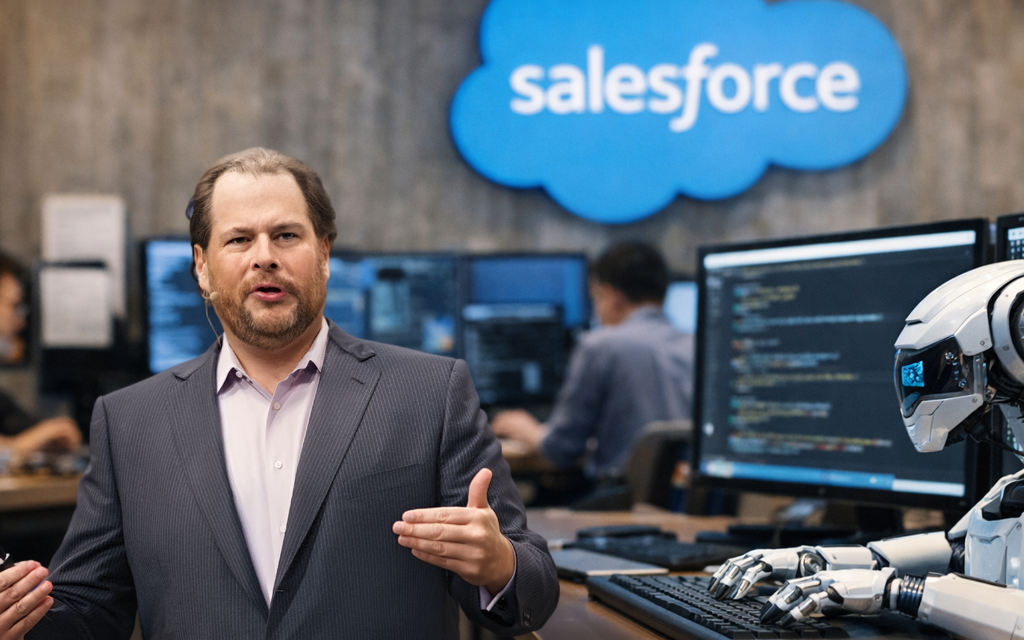
In a striking statement that highlights the accelerating impact of AI on the tech workforce, Salesforce CEO Marc Benioff declared that the company will not hire any more software engineers in fiscal year 2026. The reason? Dramatic productivity improvements driven by AI coding agents and Salesforce’s own Agentforce platform.
Benioff made the comments in recent interviews and earnings discussions, building on his earlier 2025 remarks where he first revealed the engineering hiring pause. “I’m not hiring more engineers in fiscal year 2026 because I was using AI coding agents,” he stated, emphasizing that internal AI tools have boosted engineering productivity by 30% or more — and in some cases up to 50% — allowing the existing team of approximately 15,000 engineers to deliver far greater output.
The Context: From 2025 Hiring Freeze to 2026 Continuation
Salesforce first signaled this shift in late 2024 and early 2025, announcing it would add zero new software engineers in calendar year 2025. The company instead redirected hiring toward sales and customer success roles, growing its account executive team by up to 20%.
Now entering FY2026 (which began February 1, 2026 for Salesforce), Benioff is doubling down. He attributes the sustained pause directly to the success of Agentforce — Salesforce’s flagship agentic AI platform — and other internal AI coding assistants that are handling significant portions of software development work.
Key highlights from Benioff’s statements:
- Engineering headcount remains “mostly flat” despite company growth.
- AI is now performing 30–50% of technical work in engineering, coding, support, and service functions.
- The company has already seen “incredible” engineering velocity thanks to these tools.
- Focus is shifting toward selling and deploying Agentforce to customers rather than expanding internal engineering teams.
How AI Coding Agents Are Transforming Salesforce
Salesforce has heavily invested in Agentforce, allowing customers and internal teams to build autonomous AI agents that handle complex workflows. Internally, these agents — along with generative AI coding tools — are augmenting or replacing repetitive coding tasks, debugging, documentation, and even architecture decisions.
Benioff has described the results as “pretty awesome,” noting that the productivity gains have been so substantial that adding more human engineers is unnecessary for the foreseeable future. Instead of growing headcount, Salesforce is leveraging AI to do more with its existing talent.
This approach aligns with broader industry trends. Multiple tech leaders have reported similar productivity jumps from tools like GitHub Copilot, Cursor, Devin, and custom internal agents. Salesforce appears to be among the first major enterprise software companies to publicly commit to a long-term engineering hiring slowdown based on these gains.
Implications for the Tech Industry and Future of Work
Benioff’s announcement is sending ripples across Silicon Valley and beyond:
For Software Engineers Experienced engineers who master AI tools are becoming dramatically more productive. However, junior and mid-level roles focused on routine coding face increasing pressure. The era of large engineering teams scaling through headcount growth may be shifting toward smaller, highly augmented teams.
For Tech Companies Other CEOs are watching closely. If Salesforce can maintain or accelerate innovation with flat engineering headcount, it sets a new benchmark for efficiency. This could lead to wider adoption of AI-first development practices and slower overall tech hiring in 2026–2027.
For the Creator Economy and Agentic AI Benioff continues to position Agentforce as the “only thing that really matters” at Salesforce. The company aims to help customers build their own AI agents, potentially creating a flywheel where internal efficiency gains translate into explosive external revenue.
Broader Economic Signal This reflects a potential “white-collar productivity revolution.” While blue-collar automation has been discussed for decades, AI is now visibly impacting high-skill knowledge work — starting with software engineering.
At VFuture Media, we track how artificial intelligence is reshaping every industry. Marc Benioff’s candid remarks underscore a pivotal truth: AI is not just a productivity tool — it is becoming a strategic substitute for headcount in the most competitive talent market on earth.
Challenges and Open Questions
While the productivity numbers sound compelling, questions remain:
- Can AI fully replace the creative, strategic, and complex problem-solving aspects of software engineering?
- How will this affect innovation velocity over the long term?
- What does this mean for talent acquisition, upskilling, and the millions of students currently pursuing computer science degrees?
Benioff has previously downplayed fears of mass unemployment, arguing that AI will create new roles and opportunities even as it augments existing ones. Yet his hiring stance suggests a clear near-term contraction in traditional engineering demand at large enterprises.
The Road Ahead for Salesforce and AI-Driven Companies
Salesforce reports strong adoption of Agentforce, with thousands of customers already building agents and ambitions to reach one billion agents produced annually. The company’s strategy appears clear: use AI internally to drive efficiency, then sell that same AI capability externally to enterprises worldwide.
As fiscal year 2026 unfolds, all eyes will be on whether Salesforce can sustain its growth trajectory without expanding its core engineering workforce — and whether other tech giants will follow suit.
Ready to understand the AI-powered future of work?
Subscribe to VFuture Media for ongoing coverage of AI agents, the transformation of software engineering, future of work trends, and breakthrough technologies shaping 2026 and beyond. Share your thoughts in the comments: Will AI coding agents lead to fewer engineering jobs industry-wide, or will they simply make every engineer superhuman?
Tags: Marc Benioff Salesforce, AI Coding Agents, Salesforce Agentforce, No More Engineers Hiring 2026, AI Productivity Gains, Future of Software Engineering, Agentic AI, Tech Hiring Trends 2026



Leave a Comment