
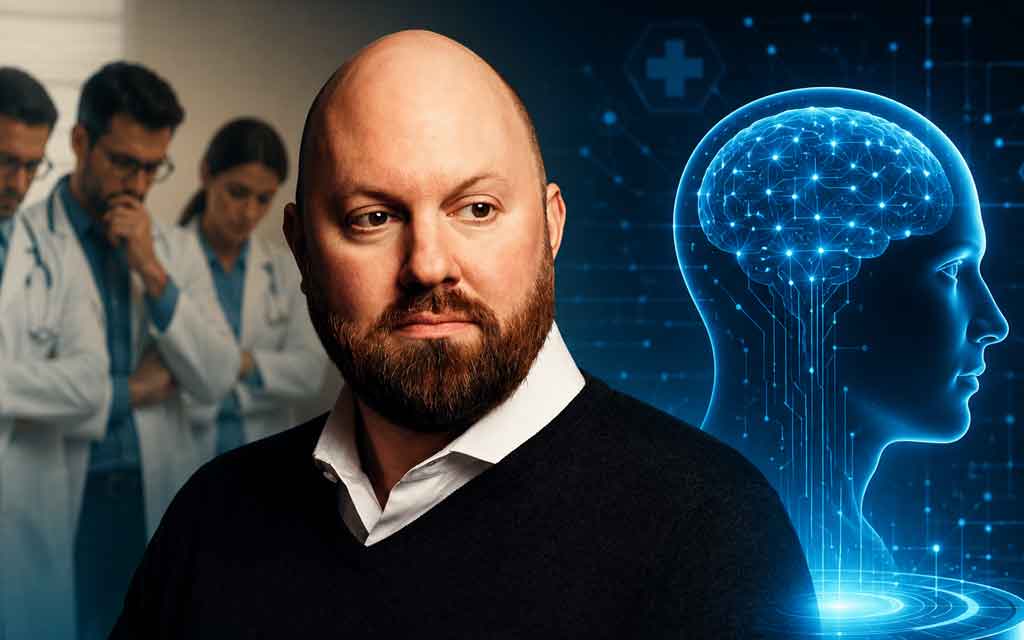
Venture capitalist Marc Andreessen just made one of the boldest claims yet about artificial intelligence in healthcare.
In a June 2026 interview with the New York Post, the a16z co-founder declared:
“Doctor ChatGPT is a better doctor than 99% of doctors.”
He didn’t mince words. Andreessen argued that AI can already outperform the vast majority of human physicians — especially when it comes to handling the overwhelming amount of medical knowledge and complex drug interactions that real doctors struggle to keep up with.
The statement has gone viral, sparking fierce debate across tech, medical, and policy circles. Is this hype from a major AI investor, or is there real substance behind it?
Here’s a clear breakdown of what Andreessen actually said, why he believes it, and what the current evidence shows.
Why Marc Andreessen Thinks AI Is Already a Superior Doctor
Andreessen’s argument rests on a few key points:
- No human can keep up with medical literature. Thousands of new papers are published every week. Even the best doctors cannot read and retain everything relevant to their field.
- Complex patients need perfect information. Many older patients have 5–10 medical conditions and take multiple medications. Tracking dangerous drug interactions is extremely difficult for humans but trivial for AI.
- Consistency and lack of fatigue. AI doesn’t get tired, emotional, or biased. It can instantly cross-reference millions of data points.
- Real-world adoption is already happening. Andreessen highlighted OpenEvidence, one of his portfolio companies, which he says is being widely used by doctors as an AI medical assistant.
He emphasized that patients should want their doctors to have access to the best AI tools — not resist them.
What Is OpenEvidence?
OpenEvidence is an AI platform designed specifically for clinicians. It gives doctors fast, evidence-based answers drawn from peer-reviewed medical literature rather than general web data.
According to Andreessen, the tool is already “sweeping the medical field.” Many physicians reportedly use it daily to look up the latest research, check drug interactions, and support complex diagnostic decisions.
This is part of a broader trend: doctors are increasingly turning to specialized AI tools to augment their practice rather than replace their judgment.
What Does the Research Actually Say About AI vs. Doctors?
Andreessen’s claim is provocative, but the scientific evidence paints a more nuanced picture.
Here’s what recent studies show:
Diagnostic Accuracy
- ~52% overall diagnostic accuracy.
- Similar to non-experts but below medical specialists.
- Based on a 2025 meta-analysis of 83 studies.
Structured Cases
- Often matches or outperforms doctors in structured scenarios.
- Can perform better in controlled clinical settings.
- Based on the Harvard/Beth Israel 2026 study.
Emergency Care
- Frequently misses critical emergency cases.
- Performs significantly worse in real-world triage.
- Supported by multiple 2026 analyses.
Drug Interactions
- Excellent at identifying drug interactions.
- Often outperforms the average human clinician.
- One of AI’s strongest capabilities.
Empathy & Communication
- Improving but still limited.
- Generally inferior to skilled human doctors.
- Human empathy remains a major advantage.
Physical Examination
- Cannot perform physical examinations.
- Has no hands or sensory perception.
- A fundamental limitation of current AI systems.
Key takeaways from 2025–2026 research:
- A major meta-analysis found generative AI models achieved only 52.1% diagnostic accuracy overall.
- AI performs best when it has complete information and clear questions.
- It struggles with incomplete data, rare conditions, and situations requiring physical examination or nuanced judgment.
- The strongest results come from AI + human doctor collaboration, not AI alone.
The Realistic Future: AI as a Super Co-Pilot
Most experts agree that the near-term future is not “AI replaces doctors” but “AI makes good doctors great.”
Here’s how AI is already transforming medicine in 2026:
- Administrative relief — Reducing burnout by handling paperwork and documentation.
- Diagnostic support — Helping doctors consider rare conditions they might otherwise miss.
- Drug safety — Flagging dangerous interactions in polypharmacy patients.
- Specialist access — Bringing expert-level knowledge to rural or under-resourced areas.
- Continuous learning — Keeping doctors updated on the latest research in real time.
Andreessen himself framed it this way: patients should want their doctors to use state-of-the-art AI tools. The goal is augmentation, not replacement.
Risks and Limitations We Can’t Ignore
While the potential is enormous, serious concerns remain:
- Hallucinations — AI can confidently give wrong or dangerous advice.
- Accountability — Who is responsible when AI makes a mistake?
- Bias — Models can inherit biases from training data.
- Over-reliance — Doctors might trust AI too much and stop thinking critically.
- Regulation — Medical AI is moving faster than laws and medical licensing boards.
These are not theoretical problems. Real incidents of AI giving harmful medical advice have already been documented.
What This Means for Patients and the Healthcare System
For patients, this shift could mean:
- Faster, more accurate second opinions
- Better management of complex chronic conditions
- Potentially lower costs and fewer medical errors over time
For doctors, it means their role is evolving. The best physicians of the future will likely be those who effectively combine deep human expertise with powerful AI tools.
For the healthcare system, AI offers one of the best hopes of improving outcomes while controlling costs in an industry that consumes nearly 20% of the U.S. economy.
The Bottom Line
Marc Andreessen’s claim that “Doctor ChatGPT is better than 99% of doctors” is provocative and overstated in its current form. Current AI still falls short of expert physicians in many real-world scenarios.
However, he is directionally correct on several important points:
- AI already outperforms most doctors at rapid knowledge synthesis and drug interaction checking.
- Specialized medical AI tools are being adopted quickly by real clinicians.
- The gap between the best human doctors and the best AI-augmented doctors is widening fast.
The future of medicine is not human or AI — it is human + AI.
The doctors who embrace these tools responsibly will likely deliver significantly better care than those who resist them.
Frequently Asked Questions
Is ChatGPT actually a doctor now? No. ChatGPT and similar models are not licensed physicians. They cannot examine patients, order tests, or prescribe medication legally in most places.
Should I use AI for medical advice instead of seeing a doctor? No. AI can be a useful research tool, but it is not a substitute for professional medical care.
Which AI tools are doctors actually using? Tools like OpenEvidence, specialized clinical decision support systems, and certain features inside Epic and other electronic health record systems are seeing real adoption.
Will AI eventually replace doctors? Most experts believe AI will transform the role of doctors rather than eliminate them. The human elements of care — empathy, physical examination, ethical judgment, and accountability — remain irreplaceable for the foreseeable future.
Ready to explore more on the future of AI and healthcare? Check out our coverage on how AI is reshaping diagnostics, drug discovery, and the doctor-patient relationship.


Leave a Comment