
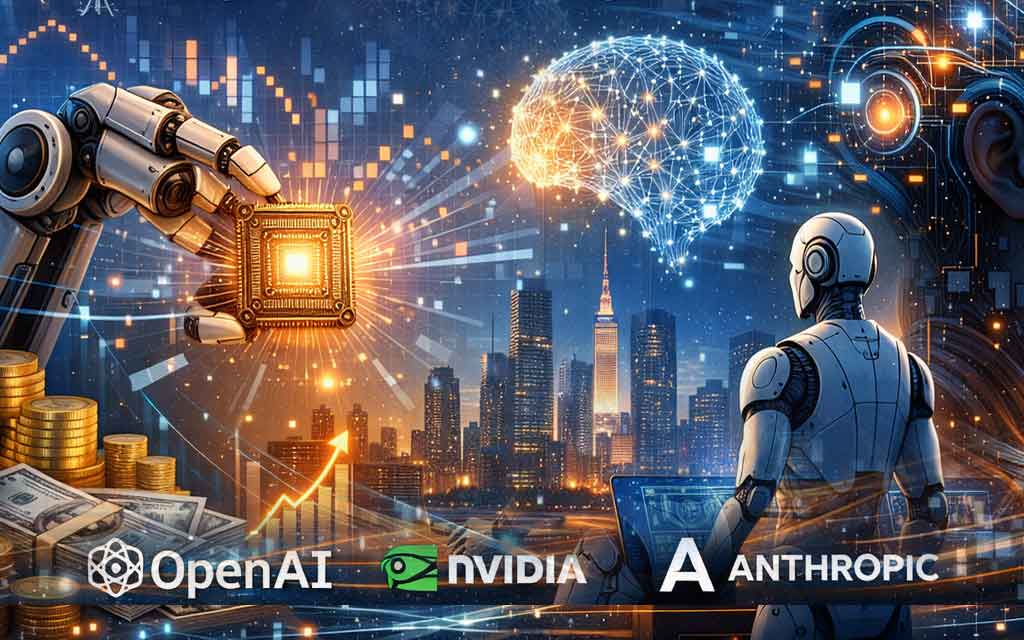
The AI sector is barreling toward a potential inflection point in the first half of 2026, with massive capital inflows, hardware efficiency leaps, and frontier model scaling converging in ways that could reshape industries faster than many organizations anticipate. Morgan Stanley’s recent report has amplified the narrative, warning of a “massive AI breakthrough” driven by unprecedented compute accumulation at leading U.S. labs—leaving “most of the world isn’t ready for it.”
Analysts point to robust scaling laws still holding, with 10x compute potentially doubling intelligence in large language models (echoing comments from figures like Elon Musk). OpenAI’s GPT-5.4 “Thinking” model has already demonstrated strong performance, scoring around 83% on economically relevant benchmarks like GDPVal, matching or exceeding human experts on key tasks. The bank highlights how concentrated compute deployments could trigger non-linear capability jumps, including advances toward recursive self-improvement and agentic systems.
Record-Breaking Funding Rounds Fuel the Race
OpenAI and Anthropic are at the center of this capital surge, signaling investor confidence in sustained frontier progress despite eye-watering valuations.
- Anthropic closed a $30 billion Series G in February 2026 at a $380 billion post-money valuation—more than doubling its September 2025 mark of around $183 billion. The round was led by GIC and Coatue, with co-leads including D.E. Shaw Ventures, Dragoneer, Founders Fund, ICONIQ, and MGX. Microsoft and NVIDIA also participated earlier with significant commitments (part of broader ~$15 billion strategic packages). Funds target frontier research, product development (e.g., Claude advancements in enterprise and coding), and infrastructure expansion. Revenue run rate had already topped $9 billion by late 2025, reflecting strong enterprise traction.
- OpenAI followed with an even larger $110 billion raise in late February 2026 at a $730 billion pre-money / $840 billion post-money valuation—one of the largest private funding rounds ever. Amazon led with $50 billion, while SoftBank and NVIDIA each contributed $30 billion. This builds on prior rounds (including a ~$40 billion raise in 2025 at $300 billion valuation) and supports global scaling, inference compute partnerships, and broader accessibility. Additional investors are expected. The deal underscores “circular” ecosystem bets where hyperscalers and chipmakers fund model developers who, in turn, drive demand for their infrastructure.
These sums dwarf most historical tech raises and highlight a top-heavy market: a handful of leaders are pulling in corporate capital at scale to bankroll the enormous compute and energy needs of training and inference.
NVIDIA’s Hardware Advancements Power the Infrastructure Layer
NVIDIA remains the indispensable enabler, with efficiency gains and next-gen platforms directly addressing the bottlenecks that could otherwise slow the predicted 2026 leap.
- The company launched the Rubin platform in early 2026, featuring new chips and extreme co-design across Vera CPU, Rubin GPU, NVLink 6, and networking components. It promises up to 10x lower inference token cost versus Blackwell and 4x fewer GPUs for training Mixture-of-Experts (MoE) models—critical for scaling advanced reasoning and agentic AI economically.
- Broader claims include 5x AI performance boosts in new chips, with full production ramps. NVIDIA is also investing heavily in open-weight models (~$26 billion over five years) and ecosystem plays, while maintaining dominant market share in training/inference (still ~90%+ in many segments). CEO Jensen Huang has discussed shifts toward specialized inference, CPUs returning to focus, and acquisitions like Groq to bolster capabilities.
Energy and power constraints loom large—Morgan Stanley and others flag potential U.S. power deficits (e.g., 9–18 GW shortages by 2028)—driving urgency around efficiency, new data center builds, and even nuclear/renewable tie-ins. NVIDIA’s roadmap aims to deliver more performance per watt and per dollar, helping labs deploy the massive compute Morgan Stanley cites as the breakthrough catalyst.
New Models and Broader Ecosystem Momentum
Discussions around new models from OpenAI (GPT series extensions), Anthropic (Claude iterations emphasizing safety and enterprise), Google (Gemini upgrades), and others—including Chinese players like Alibaba’s Qwen and DeepSeek—continue to dominate. Trends point to:
- Agentic AI and multi-step reasoning improvements.
- Better memory/context handling.
- Multimodal capabilities.
- Efficiency-focused variants for broader deployment.
Open-source and efficient models are gaining ground, potentially democratizing access while frontier labs push capabilities. Physical AI/robotics, scientific discovery acceleration (e.g., via autonomous labs), and enterprise adoption (digital twins, coding agents) round out the narrative. NVIDIA’s physical AI and robotics focus, alongside investments across the stack, ties hardware gains to real-world applications.
Why This Matters: A “Transformative Leap” with Risks
Morgan Stanley frames 2026 H1 as a pivotal window where compute scale could yield surprising capability jumps, amplifying productivity but also disruption (labor shifts, energy demands, infrastructure gaps). Most companies may lag in readiness—needing rapid upgrades in talent, systems, and strategy. Yet the bank also sees AI as a deflationary force and growth driver, potentially contributing significantly to global productivity.
Challenges include:
- Soaring energy/infrastructure costs.
- Geopolitical angles (AI sovereignty, chip access).
- Valuation sustainability in a market where a few players capture outsized funding.
For investors and businesses, the story centers on AI infrastructure beneficiaries, adopters with pricing power, and those positioned for both offense (capability gains) and defense (disruption resilience).
This convergence—record funding into OpenAI/Anthropic, NVIDIA’s efficiency breakthroughs, and analyst warnings of an imminent non-linear jump—paints a high-stakes tech story for 2026. The world may not be fully ready, but the buildout is accelerating rapidly. Expect volatility, but also breakthroughs that could redefine what’s possible in reasoning, automation, and discovery




Leave a Comment