
By VFuture Media Team | April 21, 2026 | 12 min read
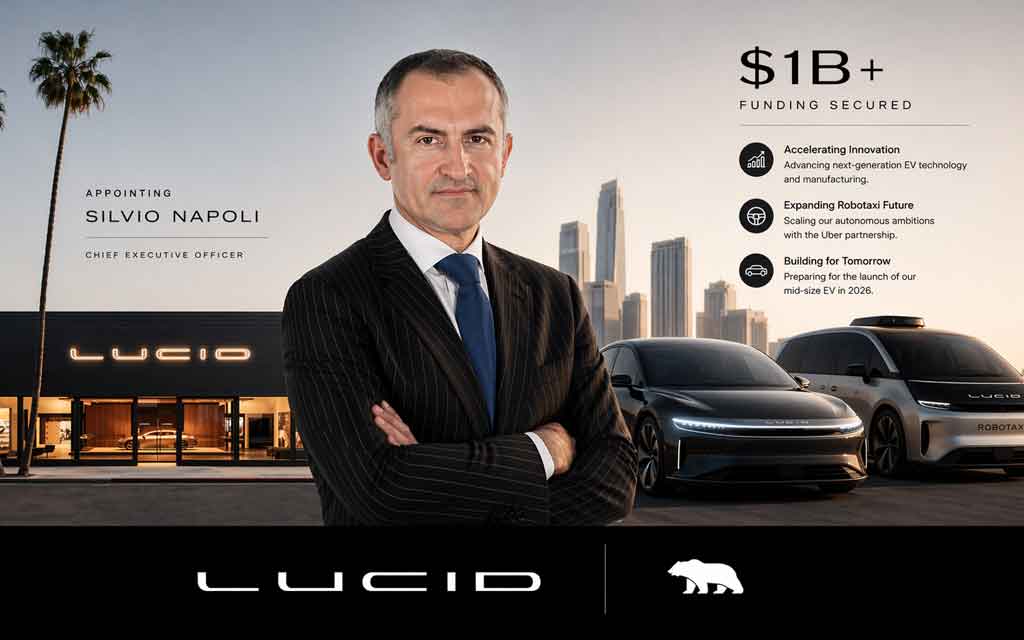
In a decisive move to strengthen leadership and financial position, Lucid Motors announced on April 14, 2026, the appointment of Silvio Napoli as its new Chief Executive Officer along with over $1 billion in fresh funding. This development marks a pivotal moment in latest EV news, as the premium electric vehicle maker shifts focus toward sustainability, robotaxi opportunities, and more accessible models while navigating a challenging market.
At VFuture Media, we closely track breakthroughs in EV news, startup funding rounds, and the evolving landscape of luxury and autonomous electric mobility. Here’s a comprehensive look at Lucid’s latest updates, what they mean for the company’s future, and their broader implications for the EV industry in 2026 and beyond.
Leadership Change: From Interim to Industrial Expertise
Lucid named Silvio Napoli, a seasoned industrial executive with over 31 years at Swiss elevator and escalator giant Schindler Holding AG, as its permanent CEO. Napoli will succeed interim CEO Marc Winterhoff, who has held the role since February 2025 following the departure of longtime leader Peter Rawlinson. Winterhoff will transition back to his previous position as Chief Operating Officer.
This external hire signals Lucid’s desire for operational discipline and long-term business resilience rather than pure automotive or tech expertise. Napoli’s background in global manufacturing, supply chain optimization, and scaling complex industrial operations is expected to help Lucid improve production efficiency, cost control, and execution — areas where the company has faced criticism in the past.
The appointment comes after a prolonged search and reflects Lucid’s strategic pivot toward sustainable growth amid softer EV demand in certain segments.
Funding Breakdown: $1B+ War Chest Secured
Simultaneously with the CEO announcement, Lucid revealed multiple funding components totaling more than $1 billion:
- $550 million from Saudi Arabia’s Public Investment Fund (PIF), Lucid’s majority shareholder, through the purchase of convertible preferred stock.
- $200 million additional commitment from Uber Technologies, bringing Uber’s total investment in Lucid to $500 million. As part of the expanded deal, Uber has committed to purchasing at least 35,000 robotaxi-ready versions of Lucid’s upcoming mid-size vehicle.
- $300 million gross proceeds from an underwritten public offering of common stock, expected to close around April 15, 2026.
This fresh capital brings much-needed stability and resources for Lucid to execute on its ambitious roadmap, including ramping up production, developing new models, and advancing autonomous and robotaxi initiatives.
Strategic Shift: Robotaxi Ambitions and Mid-Size Models
The Uber partnership highlights Lucid’s growing focus on robotaxi and mobility-as-a-service opportunities. The additional 25,000+ robotaxi-ready vehicles (on top of previous commitments) will be based on Lucid’s upcoming mid-size platform, expected to launch by the end of 2026 or early 2027.
This mid-size model is positioned as more affordable and higher-volume than Lucid’s current luxury sedans (Air) and SUVs (Gravity). It aims to broaden Lucid’s appeal beyond ultra-premium buyers while leveraging the company’s strengths in efficient electric powertrains and sleek design.
Key elements of Lucid’s refreshed strategy include:
- Transition from pure luxury play to a more diversified portfolio.
- Emphasis on software-defined vehicles and autonomy integration.
- Stronger operational focus under new leadership to achieve profitability.
Lucid has faced production and sales challenges in recent quarters, but the combination of new capital, experienced leadership, and robotaxi partnerships could help turn the tide.
Technical Strengths That Position Lucid for Success
Lucid has long been praised for its superior battery efficiency, long range, and luxurious interiors. The Air sedan, for example, consistently ranks among the most efficient EVs on the market. These engineering advantages will carry over to the new mid-size platform and robotaxi variants, potentially offering better range and lower energy costs than competitors in the autonomous space.
With funding secured, Lucid can accelerate development of:
- Next-generation battery and powertrain technologies.
- Advanced driver-assistance and full autonomy features suitable for commercial fleets.
- Manufacturing optimizations at its Arizona factory and potential future facilities.
Challenges in the 2026 EV Landscape
The broader EV news context in April 2026 shows a mixed picture: some automakers are scaling back due to demand softness, policy changes (including the expiration of certain incentives), and high interest rates, while others like Lucid continue investing for the long term.
Lucid must address:
- Execution risks in bringing new models to market on time and on budget.
- Intense competition from Tesla’s robotaxi efforts, Waymo, and emerging Chinese players.
- Building consumer and investor confidence after previous delays and leadership transitions.
- Navigating a market where affordable and practical EVs are gaining traction faster than ultra-luxury options.
However, the strong backing from PIF and the strategic Uber partnership provide a buffer and clear path forward.
Market Reaction and Analyst Perspectives
Following the announcements, Lucid’s stock saw positive movement as investors welcomed the leadership clarity and capital infusion. Analysts view this as a stabilizing step that could position Lucid better for the anticipated growth in autonomous mobility services.
The robotaxi angle is particularly noteworthy — if Lucid can deliver high-quality, efficient vehicles for Uber’s fleet, it could generate recurring revenue streams beyond traditional vehicle sales.
Future Outlook: What’s Next for Lucid Motors?
With fresh leadership and funding in place, Lucid’s priorities for the remainder of 2026 and into 2027 include:
- Smooth onboarding of Silvio Napoli and alignment on operational goals.
- Accelerated development and testing of the mid-size EV platform.
- Ramp-up of robotaxi-ready vehicle production for Uber.
- Continued refinement of existing models (Air and Gravity) while expanding the ecosystem.
- Potential international market expansion and infrastructure partnerships.
Success here could help Lucid evolve from a niche luxury EV maker into a more resilient player in both premium consumer and commercial autonomous segments.
Why This Matters for EV Enthusiasts and the Industry
For EV fans, Lucid’s updates represent continued innovation in efficient, high-quality electric vehicles even as the market matures. The move toward mid-size and robotaxi applications shows the industry’s shift from early-adopter luxury to broader, practical applications of EV technology.
In the wider EV news ecosystem, Lucid’s story underscores the importance of strong financial backing, experienced leadership, and strategic partnerships in a competitive and sometimes volatile sector. It also highlights how robotaxis — powered by advanced AI and electric platforms — could become a major growth driver.
This April 2026 development reinforces that well-capitalized players with clear visions can push forward despite short-term headwinds.
What’s your view? Does Lucid’s new CEO and funding give you more confidence in the brand? Would you consider a Lucid robotaxi or mid-size EV in the future? Share your thoughts in the comments below.
Explore more in-depth coverage on VFuture Media:
Subscribe to the VFuture Media newsletter for weekly EV news, funding updates, AI breakthroughs, and mobility insights delivered directly to you.
Sources: Official Lucid Motors announcements, WSJ, TechCrunch, Electrek, Reuters, and industry reports as of April 21, 2026.


Leave a Comment