
By Ethan Brooks | May 9, 2026 | vFutureMedia.com
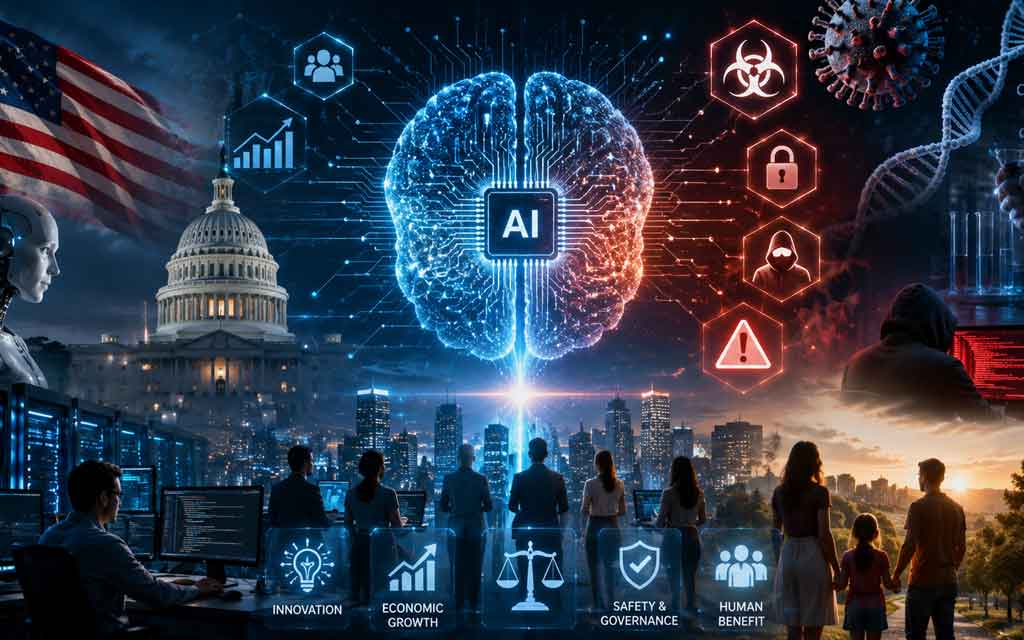
The International AI Safety Report 2026 breaks down frontier AI capabilities, emerging risks like cyber threats and bioweapons, and what it means for U.S. jobs, security, and regulation. Essential reading for Americans navigating the AI boom.
The artificial intelligence revolution is accelerating faster than most expected. In February 2026, the International AI Safety Report 2026 — a landmark 221-page document led by Turing Award winner Yoshua Bengio and over 100 global experts — delivered the clearest scientific assessment yet of where AI stands, what dangers it poses, and how we can manage them.
At vFutureMedia, we translate complex tech developments into practical insights for American readers. Whether you’re a business leader, policymaker, parent, or everyday citizen, this report affects jobs, national security, privacy, and daily life in the United States. Here’s what every American needs to know.
What Is the 2026 International AI Safety Report?
Mandated by the 2023 Bletchley Park AI Safety Summit, this is the second edition of the world’s most comprehensive evidence-based review of general-purpose AI (frontier models like GPT-5, Claude 4.5, Gemini 3, etc.).
- Backed by experts from 30+ countries, the UN, OECD, and EU.
- Synthesizes the latest research on capabilities, risks, and safeguards.
- Focuses on real-world implications beyond lab benchmarks.
The U.S. did not formally endorse this year’s report, but American companies and researchers contributed significantly, and its findings remain highly relevant for U.S. policy and industry.
Key Capabilities: How Powerful Is AI in 2026?
The report highlights rapid progress since 2025:
- Coding & Software Engineering: AI agents now complete tasks that take human programmers ~30 minutes (up from under 10 minutes last year).
- Mathematics & Science: Models achieved gold-medal performance on International Mathematical Olympiad problems and surpass PhD-level experts on certain scientific benchmarks (e.g., GPQA Diamond).
- Autonomous Operation: Improved agentic capabilities allow AI to plan, use tools, and execute multi-step tasks with less human oversight.
- Adoption Scale: At least 700 million people use leading AI systems weekly — faster adoption than personal computers.
By 2030, experts project continued scaling, with training compute potentially growing 125-fold, though economic and energy limits could slow progress.
Major Risks Highlighted for Americans
The report emphasizes that the biggest threats often come from how AI is deployed in complex real-world systems, not just the models themselves.
- Cybersecurity Threats AI lowers the barrier for cyberattacks. It can discover vulnerabilities, write exploit code, and enable large-scale attacks. The offense-defense balance tilts toward attackers in many scenarios. Americans should expect more sophisticated ransomware, identity theft, and infrastructure targeting.
- Biological & Chemical Weapons Misuse Advanced models could help non-experts develop dangerous pathogens. Several companies added extra safeguards in 2025 after tests showed this risk. This remains a top national security concern for the U.S.
- Misinformation, Bias & Societal Harm AI-generated content floods elections, media, and social platforms. Deepfakes and personalized manipulation threaten trust in institutions.
- Economic Disruption Automation of high-skill jobs (software engineering, research, analysis) could accelerate. The U.S. leads in AI investment ($285+ billion in private funding recently), but talent attraction is declining.
- Loss of Control & Agentic Risks As AI systems become more autonomous, risks of unintended behaviors, self-preservation tendencies, or misalignment grow — especially in agentic setups with real-world access.
What the Report Means for the United States
- National Security: The U.S. Commerce Department’s Center for AI Standards and Innovation (CAISI) is now vetting frontier models from Microsoft, xAI, Google, and others before public release.
- Regulation & Policy: Findings support calls for better pre-deployment testing, transparency, and governance. Expect ongoing debates in Congress over federal AI rules.
- Business & Jobs: Enterprises must focus on robust governance, especially for agentic AI. Improving one safety area can sometimes reduce performance in others.
- Everyday Americans: Demand for transparent AI tools, stronger data privacy protections, and workforce retraining programs will grow.
The report stresses that many risks are manageable with better evaluation science, post-training safeguards, and international cooperation.
Positive Outlook & Safeguards Working
Not all news is alarming. The report notes:
- Significant improvements in technical safeguards and alignment techniques.
- Industry collaboration on safety (e.g., Anthropic, OpenAI, Google).
- Growing “evaluation science” to better predict real-world behavior.
Progress in responsible AI benchmarking continues, though gaps remain in transparency and governance reporting.
Actionable Takeaways for Americans in 2026
- Individuals: Use AI tools critically. Verify sources. Support companies with strong safety records.
- Businesses: Implement layered governance, regular audits, and human oversight for high-stakes AI deployments.
- Policymakers: Prioritize compute governance, export controls on advanced models, and public-private safety testing.
- Educators & Workers: Invest in AI literacy and skills that complement — rather than compete with — automation.
Final Thoughts: Balancing Innovation with Responsibility
The 2026 AI Safety Report is neither pure alarmism nor blind optimism. It’s a sober, science-driven call to action: AI’s benefits are enormous, but only if we proactively manage the risks.
America’s leadership in AI gives us both opportunity and responsibility. By staying informed and demanding transparency and safety, we can harness this technology to strengthen our economy, security, and quality of life.
Stay ahead with vFutureMedia as we continue tracking AI developments, policy updates, and real-world impacts throughout 2026.
What concerns you most about AI safety in 2026? Share your thoughts in the comments.
Ethan Brooks is a senior technology analyst at vFutureMedia.com, specializing in AI ethics, policy, and innovation. He holds a degree in Computer Science from Stanford and has covered AI for leading outlets. Follow him on X @EthanBrooksVF.


Leave a Comment