
By VFuture Media Staff Published: May 25, 2026 San Francisco, California
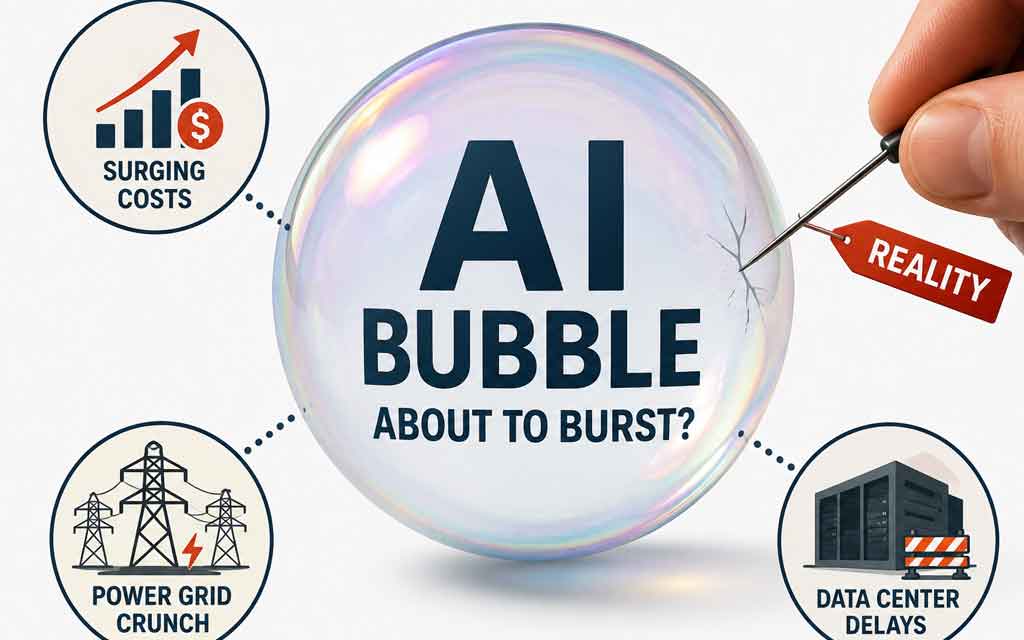
The AI gold rush that has powered trillion-dollar valuations and reshaped American ambition is hitting a hard wall of reality. Skyrocketing operational costs, exploding token bills at companies like Microsoft and Uber, and severe data center power constraints are raising urgent questions: Has the AI boom turned into a bubble — and is it on the verge of bursting?
What began as a story of limitless potential is now revealing its hidden price tag. From enterprise budgets evaporating in months to half of planned 2026 U.S. data centers facing delays or cancellations, the infrastructure fueling AI is under immense strain.
The Cost Crisis Ignites
In recent weeks, alarming reports have surfaced from the heart of Silicon Valley and beyond:
- Microsoft quietly canceled most internal licenses for Anthropic’s powerful Claude Code tool in its Experiences + Devices division (behind Windows, Teams, and Surface). Engineers are being redirected to cheaper in-house options like GitHub Copilot CLI. The culprit? Unpredictable, usage-based token pricing that sent bills soaring as adoption exploded.
- Uber burned through its entire 2026 AI budget by April — just four months in. After rolling out Claude Code to ~5,000 engineers, adoption hit 84% for agentic tasks, with heavy users costing $500–$2,000 per month each. CTO Praveen Neppalli Naga admitted the company is “back to the drawing board” on AI spending assumptions.
These aren’t isolated hiccups. Across Fortune 500 companies, AI budgets that once seemed generous are proving inadequate as agentic AI (multi-step, autonomous workflows) consumes 10–20x more tokens than simple queries. Even as per-token prices drop, total spend is exploding due to hyper-adoption.
The Data Center Power Crunch
The bigger storm is brewing in the physical world. America’s AI ambitions are slamming into the limits of electricity, land, and infrastructure:
- Nearly half of U.S. data centers planned for 2026 are being delayed or canceled due to electrical grid limitations, transformer shortages, and skyrocketing energy costs.
- Power demand from data centers is projected to surge dramatically. U.S. data centers already consume around 4.4% of national electricity, with forecasts showing this could reach 6.7–12% by 2028. Globally, data center electricity use could hit 945 TWh by 2030.
- Tech giants are pouring hundreds of billions into capex — hyperscalers alone are on track for massive 2026 spending — but many projects lack the actual power hookups needed to go live. In some regions, utilities simply can’t keep up, forcing companies to explore on-site generation, delayed timelines, or even space-based solutions.
This creates a dangerous mismatch: Massive financial bets on AI growth are colliding with hard physical constraints.
Bubble or Necessary Shakeout?
The Bear Case (Bubble Risk): Critics like Michael Burry and various economists warn of over-investment reminiscent of the dot-com era. Trillions are flowing into infrastructure while current revenues from pure AI products remain in the tens of billions. If productivity gains don’t materialize fast enough to justify the debt and capex, a painful correction could hit valuations, jobs in construction/tech, and even spill into broader financial markets.
The Bull Case (Structural Growth): Optimists argue this isn’t a classic bubble. Demand is real and pre-committed in many cases. AI infrastructure will compound over time as models improve and new applications emerge. Power and land are constraints, not proof of unsustainability — winners will be those who secure resources earliest. Long-term contracts with hyperscalers provide some buffer against sudden collapse.
What Comes Next for America’s AI Leadership
The current squeeze could accelerate innovation in efficiency: cheaper models, on-device AI, better pricing structures, and creative power solutions (including Musk’s SpaceXAI vision of orbital data centers). It may also force more disciplined ROI tracking from enterprises.
Yet the risks are real. A sharp slowdown in buildout could delay AI progress, impact national competitiveness against global rivals, and create stranded assets worth hundreds of billions.
VFuture Media Analysis (U.S. Focus): The AI story has always been one of extremes — breathtaking breakthroughs shadowed by equally dramatic challenges. Today, the U.S. stands at a crossroads: the cost and power crises are exposing the fragility of unchecked hype, but they also represent a maturing phase where only the strongest players and smartest strategies will thrive.
Will this lead to a spectacular burst, a controlled correction, or simply a painful but temporary growth spurt? The next 12–18 months — marked by Q2 earnings, IPO filings, and grid upgrade progress — will tell. One thing is clear: The age of “spend first, optimize later” in AI is ending. The winners will be those who master both the technology and its economics.
This story is developing rapidly. VFuture Media will continue tracking AI infrastructure, enterprise adoption, and market signals shaping America’s technological future.



Leave a Comment