
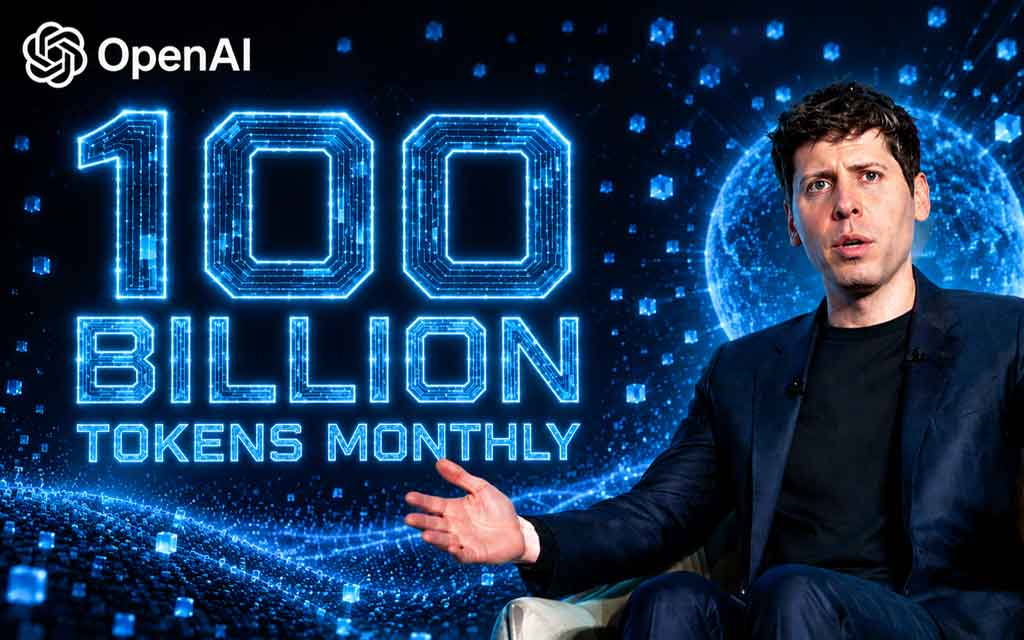
OpenAI CEO Sam Altman just dropped a jaw-dropping stat during a livestream on enterprise adoption: the company’s top internal “token leader” consumes roughly 100 billion tokens per month. Even more surprising? That staggering number still doesn’t make them the highest user in the world.
“To my embarrassment, that’s not the token leader in the world. We found someone that used even more,” Altman said.
The revelation highlights just how dramatically AI usage has scaled — and how quickly costs and infrastructure demands are becoming central concerns for both AI labs and the enterprises adopting their technology at breakneck speed.
What Exactly Is a “Token” in AI?
Before diving deeper, it helps to understand what tokens actually are. In large language models like those powering ChatGPT and OpenAI’s API, a token is the basic unit of text the model processes.
On average:
- 1 token ≈ 4 characters of English text
- Or roughly 0.75 words
So 100 billion tokens per month is an almost incomprehensible volume of text being generated, analyzed, reasoned over, and acted upon. It’s equivalent to processing entire libraries of books, massive codebases, or running thousands of complex agentic workflows every single day.
Tokens are the raw currency of modern AI. Every prompt, every completion, every tool call, every agent step, and every retrieval-augmented generation (RAG) operation consumes them.
From 100,000 to 100 Billion Tokens: A Million-Fold Leap
Altman provided crucial historical context. Just six years ago, OpenAI’s heaviest user was burning through only about 100,000 tokens per month.
That means usage by the top internal user has grown one million times in roughly six years.
This isn’t gradual adoption — it’s an explosion. It reflects how deeply AI has moved from experimentation and side projects into core business operations, research, software engineering, strategy, and customer workflows.
OpenAI has also identified at least one external customer using even more tokens monthly than its own top internal user. While the identity wasn’t disclosed, the scale suggests major enterprises or AI-native companies running massive, always-on systems.
Who Are These Token Leaders?
The top token consumers likely fall into a few categories:
- Internal power users at OpenAI — engineers and researchers pushing model limits, running massive evaluations, training-related inference, or building advanced agent systems.
- Enterprise giants — consulting firms like McKinsey & Company (which received a formal OpenAI award for surpassing 100 billion tokens) using AI for client strategy, research synthesis, and operational automation at global scale.
- AI-native startups and agent companies — organizations running thousands of autonomous or semi-autonomous AI agents 24/7 for coding, research, customer support, or data processing.
- Heavy individual power users — developers and researchers practicing “tokenmaxxing” (more on this below).
The existence of an external user exceeding OpenAI’s own top internal consumer underscores how broadly the technology has diffused beyond the lab that created it.
The Rise of “Tokenmaxxing” Culture
Altman specifically called out an emerging “tokenmaxxing” culture inside tech companies. This involves internal leaderboards tracking how many tokens employees or teams are consuming — essentially gamifying heavy AI usage as a badge of productivity and ambition.
It’s the AI-era equivalent of hustle culture or biohacking: the person or team burning the most tokens is celebrated for getting the most out of the tools.
While this drives usage (and revenue for OpenAI), it also accelerates the shift toward AI as a primary work multiplier rather than a helpful assistant.
The Cost Reckoning Is Here
With usage at this scale, cost has rapidly become a top concern.
Altman noted that cost complaints are now the second-most common issue he hears from enterprise customers — right behind the challenge of simplifying AI workflows and integrating them into existing systems. Just a short time ago, cost barely registered in conversations.
Heavy token consumption translates directly into multimillion-dollar monthly bills for the biggest users. One widely discussed anecdote involved a CFO who was stunned by a $500 million IT bill in a single month tied to AI usage.
The next wave Altman is preparing companies for — “constant running proactive AI” — will make cost management even more critical. These are autonomous agents that don’t wait for human prompts. They continuously monitor inboxes, markets, code repositories, customer interactions, and internal systems, then take or suggest actions.
Proactive AI promises enormous productivity gains but can burn tokens (and dollars) at a relentless pace if not carefully governed.
Infrastructure and Compute Challenges
Explosive demand also surfaces hard infrastructure limits.
Altman highlighted “the infrastructure challenge ahead of us.” Even as AI labs want to meet every customer’s needs, compute constraints (GPUs, energy, data center capacity) create ceilings on how much demand they can actually serve.
This is one reason competition remains fierce. Reports indicate Anthropic has recently overtaken OpenAI in corporate spending in some datasets, showing enterprises are actively multi-homing and choosing based on price, performance, and integration ease.
What This Means for Businesses in 2026
The 100-billion-token milestone isn’t just a fun statistic — it’s a signal of where enterprise AI is heading:
- AI is becoming infrastructure, not a tool. Organizations hitting these volumes have embedded models deeply into daily operations.
- Cost visibility and governance are now board-level issues. Companies need real-time token monitoring, model routing (using cheaper models for simple tasks), prompt optimization, and clear budgets.
- Proactive/agentic systems will multiply usage. The shift from chat interfaces to always-on agents changes the economics dramatically.
- Winners will optimize relentlessly. The companies that master efficient AI usage — not just maximum usage — will capture the biggest advantages.
- Security and oversight become harder. Always-running agents require new guardrails around actions, data access, and spending limits.
The Bottom Line
Sam Altman’s candid admission reveals both the incredible progress and the new realities of the AI era. A single user (or small team) inside OpenAI now processes more tokens in a month than the entire company’s heaviest user did six years ago. And someone, somewhere, is using even more.
This level of consumption demonstrates how transformative the technology has become — but it also foreshadows the hard work ahead around cost control, infrastructure scaling, and responsible deployment of proactive AI systems.
The token economy is no longer theoretical. It’s here, it’s massive, and the companies that learn to harness it efficiently will define the next chapter of the AI revolution.
FAQs
What does 100 billion tokens actually represent? It’s an enormous volume of AI processing — roughly equivalent to analyzing or generating text on the scale of millions of pages or running highly complex, multi-step AI agent workflows continuously.
How much does 100 billion tokens cost? Exact pricing varies by model and whether tokens are input or output. Heavy enterprise users at this scale routinely face multimillion-dollar monthly bills. One reported case involved a $500 million IT spend tied to AI in a single month.
Who is OpenAI’s top token user? Altman did not name the individual or team. It is almost certainly an internal engineer or researcher running large-scale evaluations, agent systems, or research workloads.
Is “tokenmaxxing” a real trend? Yes. Altman explicitly referenced internal leaderboards and a culture of competing on token consumption as a measure of productivity and ambition inside tech organizations.
What is “proactive AI” or “constant running AI”? AI systems that operate autonomously without constant human prompting — continuously monitoring data sources, making suggestions, or taking approved actions. This next phase is expected to dramatically increase token consumption.
Should companies be worried about token costs? Yes — but also excited. The key is governance: monitoring usage, optimizing prompts and model selection, setting budgets, and designing workflows that deliver high value per token spent.
Will token usage keep growing? Almost certainly. As models improve, prices per token trend downward over time, and agentic/proactive systems mature, overall consumption is expected to rise significantly through 2026 and beyond.
For more on enterprise AI trends, proactive agents, and the economics of scaling AI, explore our latest coverage in the AI & Future Tech section.




Leave a Comment