
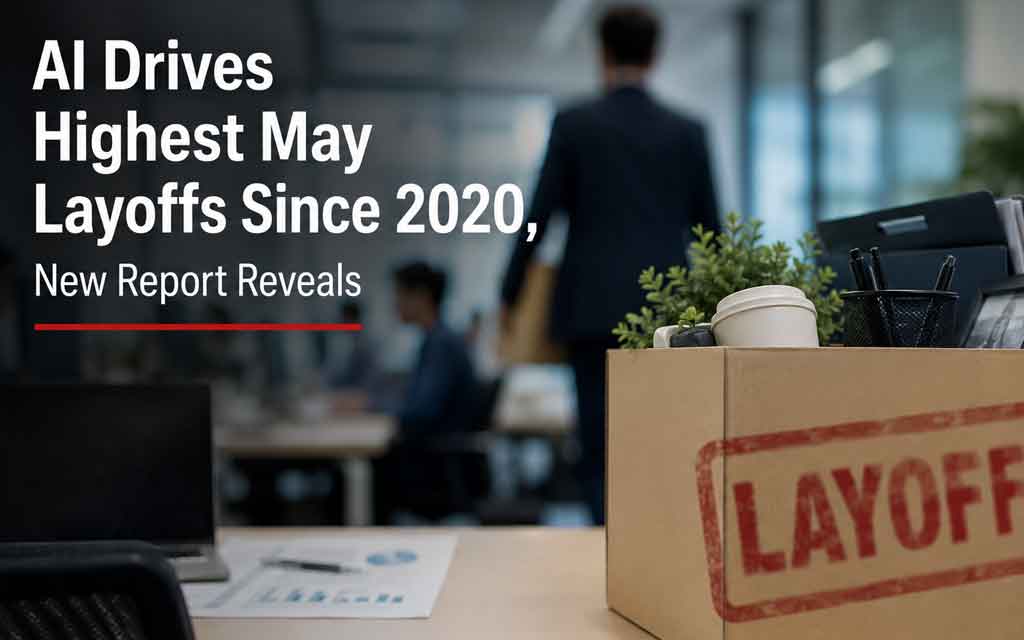
According to a new CNN analysis, AI was a major driver behind the highest number of layoffs in May since 2020. While overall job cuts remain below pandemic peaks, the role of artificial intelligence in accelerating workforce reductions has become impossible to ignore.
Tech companies, financial firms, and service industries are increasingly using AI to automate tasks that previously required human workers — from coding and customer support to data analysis and content creation.
The Numbers Behind the Headline
May 2026 saw a notable spike in announced job cuts across the U.S. economy. While exact figures vary by source, multiple tracking organizations reported the highest monthly total for May in six years.
Key observations from recent reports:
- Tech and AI-related sectors accounted for a disproportionately large share of cuts.
- Many companies explicitly cited AI-driven efficiency and automation as reasons for reducing headcount.
- The trend is no longer limited to big tech — it has spread to finance, media, customer service, and even some manufacturing roles.
This marks a shift from 2023–2025, when most layoffs were attributed to post-pandemic corrections, rising interest rates, or overhiring. In 2026, AI has emerged as a central justification.
How AI Is Directly Driving Layoffs
Companies are using AI in several ways that reduce the need for human workers:
- Software Development: AI coding assistants (like GitHub Copilot, Cursor, and Claude) allow fewer engineers to produce more code.
- Customer Support: AI chatbots and voice agents are handling a growing percentage of inquiries.
- Content & Media: Generative AI is replacing roles in writing, graphic design, video editing, and basic journalism.
- Data Analysis & Operations: AI tools are automating reporting, forecasting, and routine decision-making.
- HR & Administrative Tasks: Resume screening, scheduling, and basic HR functions are increasingly automated.
Many executives now openly discuss “AI productivity gains” as a reason they can operate with smaller teams.
Sectors Most Affected
| Sector | AI Impact Level | Common Layoff Reasons | Examples of Affected Roles |
|---|---|---|---|
| Technology | Very High | AI coding tools, automation | Software engineers, QA, support |
| Finance | High | AI trading, fraud detection, analysis | Analysts, back-office staff |
| Media & Content | High | Generative AI for writing & design | Writers, editors, designers |
| Customer Service | High | AI chatbots & voice agents | Call center agents |
| Marketing | Medium-High | AI content generation & analytics | Content creators, basic analysts |
| Manufacturing | Medium | AI-powered robotics & predictive maintenance | Some assembly & inspection roles |
The Other Side: AI Is Also Creating Jobs
It’s important to note that AI is not only destroying jobs — it’s also creating new ones. Roles in high demand include:
- AI engineers and prompt engineers
- AI ethics and safety specialists
- Data labelers and quality assurance for AI systems
- AI integration and implementation specialists
- Cybersecurity professionals focused on AI systems
However, the net effect in the short term appears to be negative for many mid-level and routine white-collar jobs. The jobs being created often require different (and sometimes higher) skill sets than the ones being eliminated.
Why This Trend Is Accelerating in 2026
Several factors are contributing to the current wave:
- Maturing AI Tools: 2025–2026 saw major improvements in AI coding, reasoning, and agentic capabilities.
- Corporate Pressure for Efficiency: After years of high spending on AI infrastructure, companies now want to see returns through cost savings.
- Investor Expectations: Wall Street is rewarding companies that demonstrate AI-driven margin improvement.
- Competitive Pressure: If competitors are using AI to reduce costs, other companies feel forced to follow.
What This Means for Workers
The rise in AI-related layoffs carries important implications:
- Skill Shift is Critical: Workers in roles vulnerable to automation need to upskill quickly in AI literacy, complex problem-solving, and human-centric skills.
- Job Security is Changing: Even high-skill roles are not immune if AI can perform parts of the work faster and cheaper.
- Reskilling Becomes Essential: Governments, companies, and individuals must invest more heavily in continuous learning.
Outlook: What Comes Next?
Most analysts expect AI-driven job displacement to continue through 2027 and beyond, though the pace may vary. The key variables will be:
- How quickly companies can integrate AI into their operations
- Whether new AI-created jobs can absorb displaced workers
- Government policy responses (retraining programs, potential regulations)
- Overall economic conditions
While AI is unlikely to cause mass unemployment on the scale of the Great Depression, it is clearly reshaping the labor market faster than many anticipated — particularly in white-collar and knowledge work sectors.
Final Thought The CNN report on May 2026 layoffs serves as a clear signal: AI is no longer just a productivity tool — it has become a major force in corporate cost-cutting and workforce restructuring. Companies that adapt thoughtfully may thrive, while those slow to evolve — or workers who don’t upskill — risk being left behind.
The AI revolution is delivering on efficiency. The question now is how society manages the human cost of that efficiency.




Leave a Comment