

UN Warns: AI Could Soon Consume More Water Than the Entire World Needs to Drink
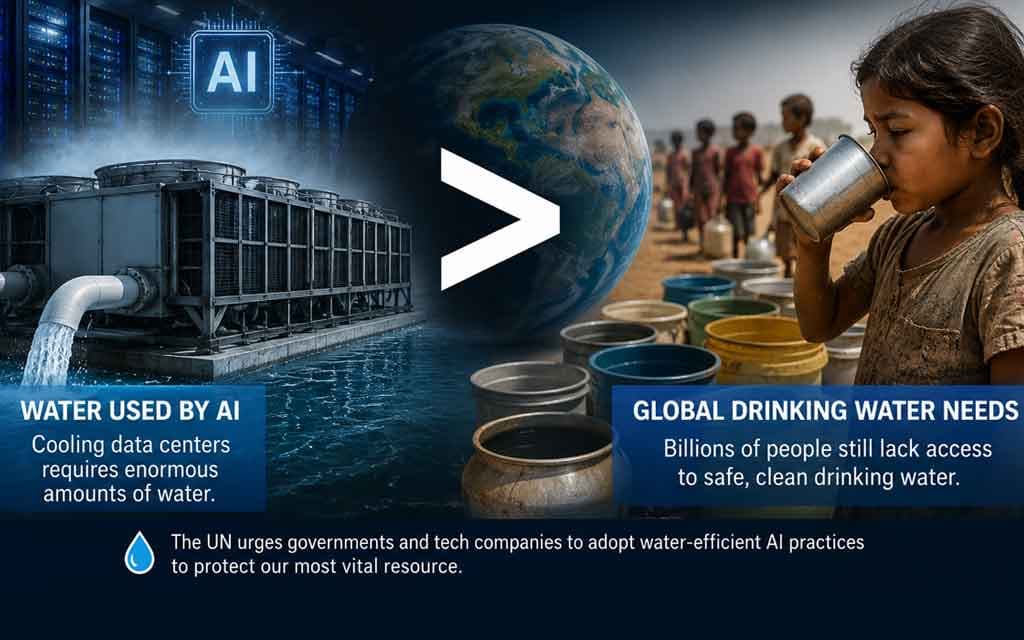
NEXT_PUBLIC_GOOGLE_ADSENSE_ID to enableThe United Nations has issued a stark warning: artificial intelligence could soon use more fresh water than all the drinking water consumed by every person on Earth combined.
This alarming projection highlights one of the most overlooked environmental costs of the AI boom — the massive water consumption required to cool the data centers powering today’s most advanced AI models.
How AI Uses So Much Water
Most people think of AI’s environmental impact in terms of electricity consumption. However, water usage is equally critical.
Here’s why AI is so water-intensive:
- Data Center Cooling: AI servers generate enormous heat. Data centers use water-based cooling systems (evaporative cooling) to keep temperatures under control.
- Training Large Models: Training frontier models like GPT-4, Claude, or Gemini can consume millions of liters of water.
- Inference at Scale: Every time millions of users interact with ChatGPT, Grok, or other AI tools, servers run 24/7, requiring continuous cooling.
According to multiple studies and reports, a single AI query can use significantly more water than a traditional Google search — sometimes up to 10 times more depending on the model and location.
The Scale of the Problem
Recent data paints a concerning picture:
- Training GPT-3 alone was estimated to have consumed over 700,000 liters of water.
- By 2027, AI data centers in the United States alone could consume as much water as half of the United Kingdom’s total water usage.
- Global projections suggest that by the end of the decade, AI-related water consumption could reach levels comparable to the annual drinking water needs of entire countries.
The UN warning specifically highlights that unchecked growth in AI infrastructure could push water usage beyond sustainable levels in many regions — especially in areas already facing water stress.
UN Warning in Context
The United Nations has raised concerns about AI’s resource footprint as part of broader discussions on sustainable technology development. While AI offers tremendous benefits in climate modeling, healthcare, and efficiency, its physical infrastructure demands are growing faster than many anticipated.
Key points from recent analyses:
- Data centers already account for a significant and rising share of global electricity and water use.
- AI is accelerating this trend dramatically because of the computational intensity of large language models and generative AI.
- Many data centers are located in regions with limited water resources, creating local environmental pressure.
Comparison: AI Water Use vs Human Drinking Water
To put the numbers in perspective:
- The average person drinks about 2–3 liters of water per day.
- Global human drinking water consumption is roughly 8–10 billion liters per day.
- Some projections suggest that by 2027–2028, AI data centers could exceed this daily global drinking water figure in water withdrawal (though much of it is evaporated or recycled, the strain on local supplies remains real).
This doesn’t mean AI will literally take drinking water away from people. However, it does mean competition for water resources in certain regions, higher costs for water treatment, and increased pressure on already stressed ecosystems.
Why This Matters Now
Several factors are making the water issue more urgent in 2026:
- Explosive Growth of AI — More companies are training and deploying larger models than ever before.
- Data Center Expansion — Tech giants are building massive new facilities, many in water-stressed areas.
- Lack of Transparency — Not all companies disclose detailed water usage data.
- Climate Change — Droughts and water scarcity are worsening in many parts of the world.
Major tech companies like Microsoft, Google, and Meta have all reported sharp increases in water consumption in recent years, largely attributed to AI workloads.
What Tech Companies Are Doing (and Not Doing)
Some positive steps include:
- Investing in more efficient cooling technologies (liquid cooling, immersion cooling).
- Building data centers in cooler climates or near abundant water sources.
- Exploring alternative cooling methods that use less or no water.
However, critics argue that progress is too slow compared to the speed of AI development. Many companies prioritize performance and speed-to-market over environmental sustainability in their AI strategies.
The Path Forward
Solving AI’s water problem will require action on multiple fronts:
- Technological Innovation: Development of waterless or low-water cooling systems.
- Better Location Planning: Building data centers in regions with sustainable water access.
- Transparency and Regulation: Mandatory reporting of water usage by large AI operators.
- Efficiency Improvements: Making AI models more computationally efficient so they require less infrastructure.
Some experts believe that without significant changes, water could become one of the biggest constraints on AI growth — alongside energy and chip supply.
Bottom Line
The UN’s warning about AI water consumption is a timely reminder that the AI revolution has a physical footprint. While AI promises to solve many global challenges, its own infrastructure demands — particularly water and energy — are creating new problems that must be addressed.
As AI becomes more deeply integrated into daily life, society will need to balance its benefits against its environmental costs. Water usage is no longer a secondary concern — it is rapidly becoming a central issue in the future of artificial intelligence.
The question is no longer just how powerful AI can become, but at what environmental cost.
NEXT_PUBLIC_GOOGLE_ADSENSE_ID to enable

