

Uber Cuts 23% of Its People Team, Claims Layoffs Are “Unrelated to AI”
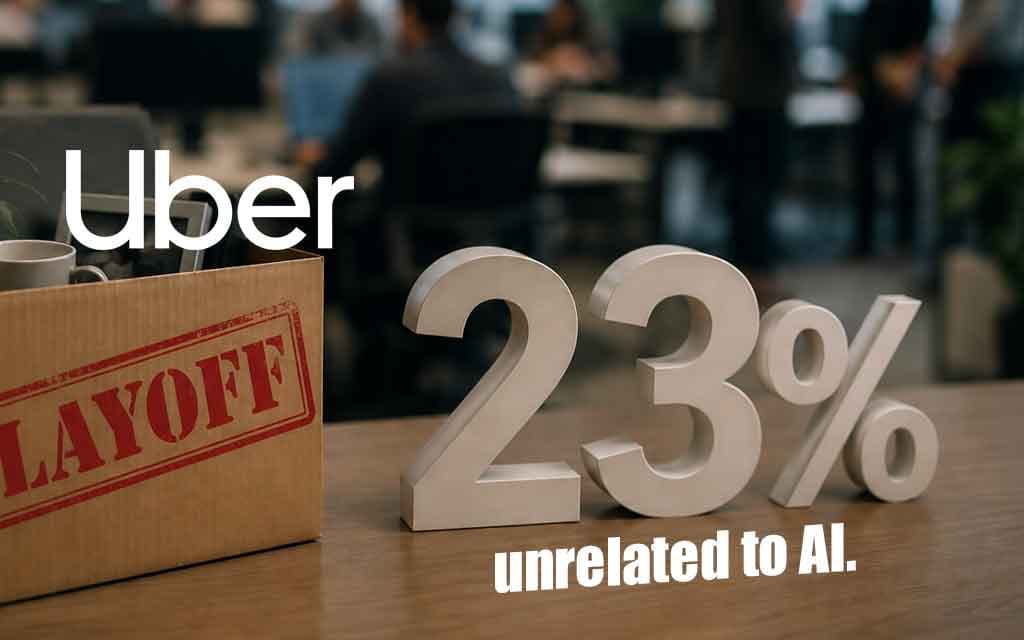
NEXT_PUBLIC_GOOGLE_ADSENSE_ID to enableUber Technologies is laying off 23% of its People and Places division — the team responsible for human resources, recruitment, workplace facilities, and company culture. The company insists the cuts have nothing to do with artificial intelligence.
The move, announced this week, affects a relatively small portion of Uber’s overall workforce (less than 1% of its roughly 34,000 global employees). However, it has sparked fresh debate about whether AI is quietly driving efficiency gains — and job reductions — even when companies publicly say otherwise.
What Uber Is Actually Doing
Uber’s new president, Jill Hazelbaker, is leading a restructuring effort aimed at simplifying the company’s organizational structure. The People and Places division is being streamlined, resulting in the elimination of nearly one-quarter of its roles.
Key points from Uber’s statement:
- The cuts are part of an internal reorganization.
- They are not related to AI-driven efficiencies.
- The changes will not affect Uber’s driver and delivery partners.
- The goal is to make teams more agile and reduce complexity.
This comes at a time when Uber has been aggressively investing in AI tools across its engineering and operations teams.
The AI Context Uber Is Downplaying
While Uber claims these specific layoffs are unrelated to AI, the broader picture tells a more nuanced story:
- Uber reportedly burned through its entire 2026 AI budget in just the first four months of the year.
- The company has since introduced spending caps on AI coding tools (such as Claude and Cursor) for employees.
- Many tech companies have used AI productivity gains as justification for reducing headcount in support and administrative functions.
HR and recruitment teams are among the functions most vulnerable to AI automation. Tools for resume screening, candidate matching, employee onboarding, and even performance management are becoming increasingly sophisticated.
By cutting 23% of its People division while simultaneously accelerating AI adoption elsewhere, Uber may be achieving efficiency gains without directly attributing job losses to technology.
Why Companies Say “Unrelated to AI”
Tech firms often avoid linking layoffs directly to AI for several reasons:
- Public perception: They don’t want to be seen as replacing humans with machines.
- Regulatory and legal concerns: Explicitly tying job cuts to AI could invite scrutiny.
- Employee morale: Framing cuts as “restructuring” feels less threatening than “AI replacement.”
- Investor narrative: Companies prefer to highlight AI as a growth driver rather than a cost-cutting tool.
Uber’s approach fits a growing pattern seen across Silicon Valley in 2025–2026.
What This Means for the Tech Industry
Uber’s move highlights an important trend:
Administrative and support roles are increasingly at risk as AI tools mature. While engineering and product teams are using AI to become more productive, back-office functions like HR are seeing direct headcount reductions.
This creates a two-speed reality in tech:
- High-skill technical roles are evolving (with AI assistance).
- Many mid-level operational and people-focused roles are being consolidated or eliminated.
For workers in HR, recruiting, and workplace operations, the message is clear: AI literacy and the ability to work alongside intelligent systems will become essential for job security.
The Bigger Picture at Uber
Despite the targeted cuts in its People division, Uber continues to invest heavily in AI across its core business. The company is using AI for:
- Dynamic pricing
- Route optimization
- Fraud detection
- Autonomous vehicle development (through its partnership with Waymo and its own efforts)
- Customer support automation
This suggests Uber sees AI as a long-term growth and efficiency engine — even if it’s reluctant to connect it directly to near-term workforce reductions.
Bottom Line
Uber’s decision to cut 23% of its People and Places team while claiming the move is “unrelated to AI” reflects the careful messaging many tech companies are adopting in 2026.
Whether the layoffs were directly caused by AI or simply enabled by greater efficiency elsewhere in the organization, the outcome is the same: fewer human roles are needed to manage Uber’s workforce.
As AI tools continue to improve, more companies will likely follow Uber’s example — quietly reducing headcount in administrative functions while publicly attributing changes to “restructuring” or “simplification.”
The era of AI-driven efficiency without AI-attributed layoffs appears to be well underway.
NEXT_PUBLIC_GOOGLE_ADSENSE_ID to enable

