

Elon Musk’s Plan for a Million Satellites as a Massive Space Data Center Network
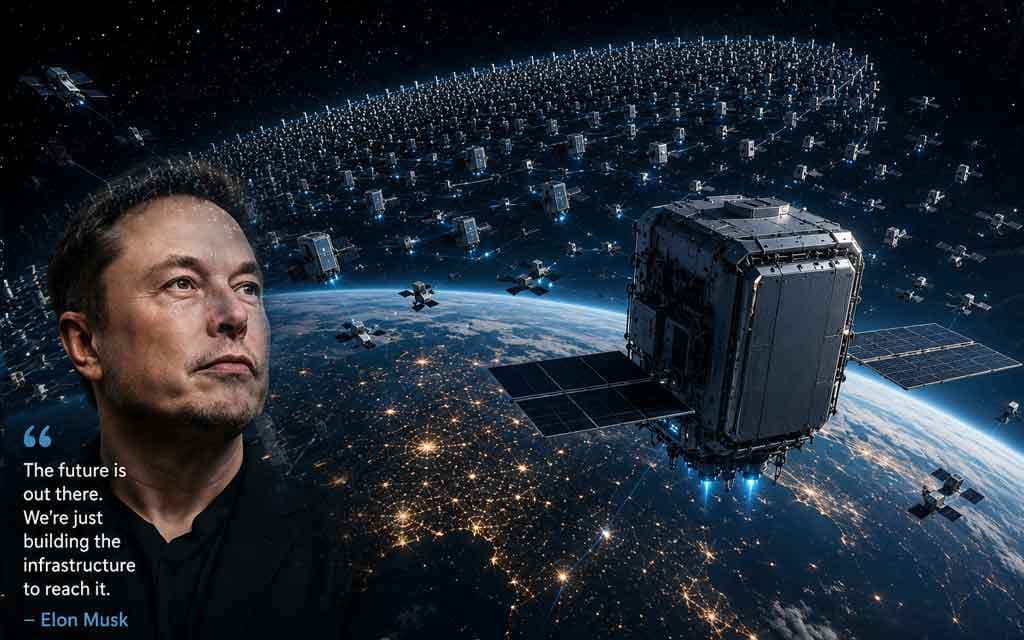
NEXT_PUBLIC_GOOGLE_ADSENSE_ID to enableElon Musk is reportedly exploring plans to launch up to one million satellites into Earth’s orbit to create a massive orbital data center network. The estimated cost of putting this infrastructure into space could reach $2 trillion or more.
While SpaceX has not made an official announcement about a full “space data center” constellation of this scale, the idea aligns with Musk’s long-term vision of expanding Starlink and leveraging space for computing infrastructure — especially as AI demands grow exponentially.
Why Put Data Centers in Space?
Traditional data centers on Earth face major limitations:
- Cooling costs: They consume enormous amounts of electricity and water just to stay cool.
- Land and energy constraints: Building massive new facilities is becoming harder and more expensive.
- Latency and global coverage: Some applications need ultra-low latency or coverage in remote areas.
Space offers potential advantages:
- Natural cooling in the vacuum of space (though radiation and thermal management are still challenges).
- Abundant solar power with constant sunlight in certain orbits.
- Global coverage without the need for undersea cables or terrestrial infrastructure in every region.
Some experts believe orbital data centers could eventually handle AI training, inference, or specialized workloads that benefit from being in space.
The Scale: One Million Satellites
Putting one million satellites into orbit would be an unprecedented engineering feat:
- Current Starlink constellation: ~6,000+ satellites (as of mid-2026).
- SpaceX’s long-term plans: Tens of thousands more for global broadband.
- A million-satellite network would be 10x–20x larger than even the most ambitious current proposals.
Cost Breakdown (Rough Estimates):
- Launch cost per satellite (using Starship): Potentially as low as $100,000–$500,000 in high volume.
- Total launch cost for 1 million satellites: $100 billion to $500 billion+.
- Manufacturing, ground stations, and operations: Could push the total project cost toward $1–2 trillion over many years.
This would make it one of the most expensive infrastructure projects in human history — comparable to building multiple global internet networks from scratch.
Connection to AI and Computing Demand
The driver behind this idea appears to be explosive growth in AI compute demand.
- Training and running frontier AI models requires enormous amounts of energy and cooling.
- Some analysts project that AI data centers could consume as much electricity as entire countries within the next decade.
- Putting part of this infrastructure in orbit could theoretically bypass some terrestrial limitations (power availability, land use, and cooling).
Musk has repeatedly said that AI will require “insane” amounts of compute. A space-based network could be one way to scale that infrastructure beyond Earth’s constraints.
Major Challenges
Despite the vision, this concept faces enormous hurdles:
- Space Debris Risk A million satellites would dramatically increase collision risks in low Earth orbit. Kessler syndrome (cascading collisions) becomes a real concern at this scale.
- Launch Capacity Even with Starship’s high capacity, launching a million satellites would require thousands of successful launches over many years.
- Maintenance and Upgrades Satellites in orbit are difficult and expensive to repair or upgrade. Most would need to be replaced every 5–10 years.
- Latency and Data Transfer While space offers global coverage, sending data back and forth between Earth and orbit adds latency for many applications.
- Regulatory and Geopolitical Issues International agreements on orbital slots, spectrum usage, and space traffic management would be extremely complex.
- Radiation and Reliability Electronics in space face constant radiation, which can cause errors in computing systems.
Current Status
As of June 2026:
- SpaceX is focused on expanding Starlink for broadband internet.
- There have been discussions and patents around space-based computing, but nothing at the scale of one million satellites for data centers has been officially confirmed.
- The $2 trillion figure appears to be an upper-bound estimate for a full-scale orbital computing network rather than a confirmed budget.
It’s possible Musk is thinking about this as a long-term (2030s+) vision rather than a near-term project.
Why This Matters
If successful, an orbital data center network could:
- Significantly expand global computing capacity.
- Reduce pressure on Earth’s energy and water resources for data centers.
- Create new business models (space-based AI inference, edge computing from orbit).
- Further cement SpaceX’s dominance in the space economy.
However, it also raises important questions about space sustainability, militarization of orbit, and who controls this new layer of digital infrastructure.
Bottom Line
Elon Musk’s reported plan to build a million-satellite data center network in space represents one of the most ambitious infrastructure ideas in the AI era. While the technical and financial challenges are immense, the underlying driver — explosive demand for AI compute — is very real.
Whether this specific vision materializes or not, the broader trend is clear: as AI continues to scale, humanity will increasingly look beyond Earth for the infrastructure needed to power it.
The next decade will likely see growing experimentation with space-based computing, even if a full million-satellite network remains a distant goal.
NEXT_PUBLIC_GOOGLE_ADSENSE_ID to enable

