
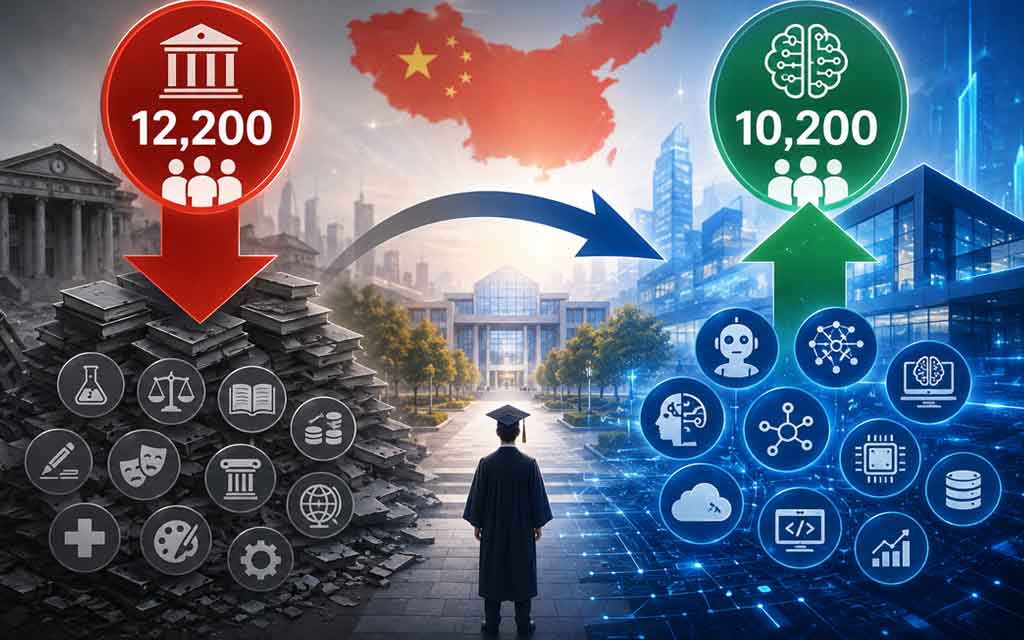
Chinese universities have revoked or suspended over 12,200 undergraduate programs between 2021 and 2025 while adding 10,200 new ones focused on AI, robotics, and advanced tech. Here’s what’s being cut, why it’s happening now, and what it means for students and the future of work in the AI age.
China is undertaking one of the most aggressive overhauls of higher education in modern history. Between 2021 and 2025, Chinese universities revoked or suspended 12,200 undergraduate degree programs while introducing 10,200 new ones. That means more than 30% of the country’s university programs have been adjusted in just five years.
The cuts have hit arts, humanities, foreign languages, and management fields hardest — areas officials now call “obsolete” in an era of rapid AI advancement and shifting job market demands. At the same time, new programs in artificial intelligence, embodied intelligence, semiconductors, robotics, and intelligent creative technologies are expanding fast.
This is not a random pruning. It is a deliberate national strategy to align higher education with China’s push for technological self-reliance and leadership in AI-driven “new quality productive forces.”

Artificial Intelligence Education Concept Featuring Graduation Cap on Lightbulb Held by Robotic Hand Stock Illustration – Illustration of engineering, skill: 396927713
The Big Numbers: What the Data Shows
According to Ministry of Education data cited by Xinhua and reported by the South China Morning Post, the scale of change is massive:
- 12,200 programs revoked or suspended (2021–2025)
- 10,200 new programs added
- Heavily concentrated cuts in: arts, humanities, foreign languages, and management
- New programs focused on: AI, robotics, semiconductors, advanced manufacturing, embodied intelligence, and intelligent media/creative technologies
Some of the most frequently eliminated majors nationwide (2020–2024 data) include:
- Information management and information systems (160 programs cut)
- Public administration (138)
- Information and computational science (123)
- Marketing (104)
- Product design (93)
These fields often involve tasks now heavily automated or augmented by AI — data processing, basic content creation, routine analysis, and standardized design work.
Spotlight: Communication University of China’s Bold Restructuring
One of the highest-profile moves came from the Communication University of China (CUC), a top institution for media and arts. In 2025, the university eliminated or merged 16 undergraduate majors and tracks, including:
- Photography
- Comics
- Visual communication design
- New media art
- Fashion design
- Translation
- Several economics and management programs
In their place, CUC introduced new programs such as “intelligent imaging art,” “intelligent audiovisual engineering,” and “intelligent engineering and creative design.”
Liao Xiangzhong, the university’s party secretary and a member of the Chinese People’s Political Consultative Conference, explained the rationale during the 2026 Two Sessions: the future belongs to an era of “human-machine cooperation.” He noted that translation has already been “largely replaced by AI” and called a four-year major in it “a huge waste of national resources.” Traditional photography, he said, must evolve because “today everyone can be a self-media creator.”
The changes are part of an eight-year restructuring. Many programs weren’t fully eliminated but merged into broader, technology-infused disciplines.
The decision sparked intense debate on Chinese social media, with some praising the pragmatism and others worrying about the loss of traditional creative and humanities education.
Why Now? AI, Youth Unemployment, and National Priorities
Several converging factors are driving the overhaul:
- AI is already transforming entry-level and mid-level work — Tools can now handle modeling, rendering, basic translation, data analysis, content generation, and routine design tasks that once required human graduates.
- Youth unemployment remains stubbornly high — Above 16% for young people, with many graduates struggling to find roles matching their degrees.
- National strategic goals — China wants to lead in AI, semiconductors, robotics, and embodied intelligence (AI integrated into physical systems like robots and autonomous machines). Education must supply the talent pipeline.
- Oversupply in certain fields — Decades of rapid university expansion created too many graduates in saturated areas like management, marketing, and some humanities disciplines.
Experts like Chu Zhaohui, a senior researcher at the National Institute of Education Sciences, caution that simply swapping old majors for new ones isn’t enough. He advocates for more flexible systems where students can build personalized skill profiles rather than locking into narrow, quickly outdated tracks.
What’s Being Added: The New AI-Era Majors
Universities are rapidly launching programs aligned with Beijing’s priorities. Examples include:
- Embodied intelligence (multiple universities)
- Intelligent imaging art and intelligent audiovisual engineering (CUC)
- AI education and digital drama
- Low-altitude economy-related fields
- Advanced semiconductor and robotics programs
Nine universities have already added “embodied intelligence” majors. These programs aim to prepare students for the next wave of AI that moves beyond chatbots into real-world physical systems.

China has started a grand experiment in AI education. It could reshape how the world learns. | MIT Technology Review
Global Implications: Lessons for the US and the West
China’s approach stands in contrast to ongoing debates in the United States and Europe about the role of humanities and liberal arts in an AI world. While some American universities are expanding AI and data science offerings, few are making cuts on this scale or framing traditional degrees as broadly “obsolete.”
Key takeaways for global observers:
- Speed matters. China is moving faster than most Western systems to retool education for AI-augmented work.
- Human + machine skills are the new baseline. The emphasis on “human-machine cooperation” suggests the winners will be those who can direct, critique, and creatively collaborate with AI systems — not just those who code.
- Flexibility may beat specialization. As one expert noted, the old model of “study one major, get one job for life” is disappearing everywhere.
- Creativity and critical thinking remain valuable — but they may need to be taught differently, integrated with technology rather than in opposition to it.
For American students and parents, the message is clear: pure technical skills or pure liberal arts may both be insufficient. The most resilient paths likely combine deep domain knowledge with AI literacy, adaptability, and strong human skills (communication, ethics, complex problem-solving).
What This Means for Students and Parents
If you or your child is choosing a major or considering graduate studies:
- Prioritize adaptability over narrow vocational training.
- Look for programs that explicitly teach AI collaboration, data literacy, and human skills.
- Consider interdisciplinary options (e.g., AI + creative fields, AI + business, AI + healthcare).
- View an undergraduate degree as a foundation for lifelong learning rather than a finished product.
China’s reforms show that even prestigious creative and media programs are not immune to disruption. The same forces are reshaping job markets worldwide.
FAQs
Is China really eliminating 12,000 degrees overnight? No. The 12,200 figure represents the cumulative total of programs revoked or suspended between 2021 and 2025. It is a multi-year, systematic adjustment.
Which fields are safest? Fields combining technical skills with human judgment, creativity, ethics, or physical-world application (AI ethics, robotics, healthcare AI, advanced manufacturing, complex systems thinking) appear to be expanding.
Will AI completely replace creative jobs? Officials and alumni at institutions like CUC argue that tools change the nature of work but don’t eliminate the need for human creativity and oversight — they just raise the bar for what humans must bring.
Should Western universities copy this model? Most experts say a more balanced, flexible approach is wiser. Cutting humanities too aggressively risks losing the very critical thinking and ethical reasoning skills needed to govern powerful AI systems responsibly.
The Bottom Line
China is treating higher education as critical infrastructure for its AI ambitions. By aggressively pruning programs it views as misaligned with future job markets and national priorities, the country is sending a clear signal: in the AI era, universities must evolve as fast as the technology itself — or risk becoming irrelevant.
For students everywhere, the lesson is the same: the most valuable skill may no longer be mastering one narrow field, but learning how to continuously adapt alongside increasingly capable machines.




Leave a Comment