
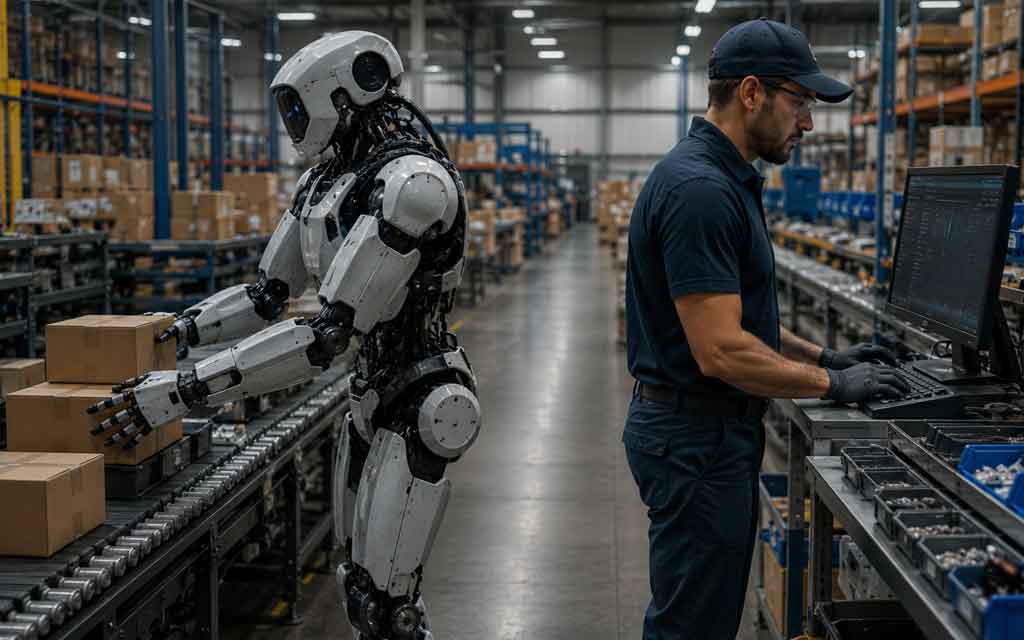
Boston Dynamics’ Atlas humanoid robot advances rapidly with new production deployments and factory training in 2026. Explore how AI-powered humanoids like Atlas are reshaping manufacturing, jobs, and the future of work in the US and beyond.
Published: June 17, 2026 | Updated: June 17, 2026 By: vFuture Media Tech Desk
Introduction: From Viral Demos to Factory Floors
Humanoid robots are no longer science fiction—they’re entering real-world deployment in 2026. Boston Dynamics’ flagship Atlas robot is leading the charge, with recent demonstrations and factory training highlighted in a fresh 60 Minutes segment. As AI integrates deeper into physical systems, American innovation in robotics promises to boost manufacturing resurgence while raising questions about workforce transformation.
For US businesses, investors, and tech watchers, this marks a pivotal year where humanoid robots transition from labs to productive roles in factories, logistics, and beyond.
Recent Progress on Boston Dynamics Atlas (2026 Updates)
- January 2026 CES Reveal: Boston Dynamics unveiled the production-ready electric Atlas, announcing immediate manufacturing. Initial 2026 deployments targeted Hyundai and Google DeepMind.
- Ongoing Deployments: Atlas units are now training at Hyundai facilities, learning real-world tasks like part sequencing and machine tending through AI and simulation.
- June 2026 Spotlight: 60 Minutes visited Boston Dynamics’ headquarters to showcase Atlas learning Hyundai factory workflows, demonstrating improved balance, dexterity, and whole-body control powered by advanced AI.
The robot features electric actuation, enhanced grippers, and integration with NVIDIA and DeepMind technologies for better reasoning and task adaptation.
Why Atlas Stands Out in the Humanoid Race
Atlas excels in dynamic movements (parkour, flips, precise manipulation) and is designed for enterprise applications. Partnerships with Hyundai (for scale) and NVIDIA (Jetson Thor compute + Isaac Lab simulation) accelerate its capabilities.
Key 2026 Advancements:
- Full-body AI control for complex industrial tasks.
- Safety and reliability features for human-robot collaboration.
- Rapid skill acquisition via simulation-to-real transfer.
This aligns with broader industry momentum: NVIDIA’s physical AI push, Figure AI production ramps, and Tesla Optimus developments.
US-Focused Implications: Jobs, Manufacturing, and Economy
For American audiences, humanoid robots represent an opportunity to reshore manufacturing, address labor shortages, and maintain technological leadership against global competitors (especially China).
Economic Impact:
- Manufacturing Boost: Robots handle repetitive/dangerous tasks, allowing humans to focus on higher-value work.
- Job Creation: New roles in robot maintenance, programming, and oversight—plus supply chain jobs.
- Investment Wave: Billions flowing into US robotics firms, supported by policy emphasis on domestic tech.
Challenges:
- Workforce adaptation and reskilling needs.
- Ethical/safety questions around human-robot interaction.
- High initial costs, though scaling is expected to reduce them.
Comparison of Leading Humanoid Robots (Mid-2026)
| Robot | Developer | Key Strengths | 2026 Status | Primary Focus |
|---|---|---|---|---|
| Atlas | Boston Dynamics | Dynamic movement, factory tasks | Production & deployments | Industrial/Auto |
| Optimus | Tesla | Affordability, integration | Internal testing ramp | Manufacturing/Home |
| Figure 03 | Figure AI | General-purpose, production scale | High-rate manufacturing | Versatile tasks |
| GR00T | NVIDIA partners | Simulation + AI foundation | Reference platforms | Research/Dev |
Future Outlook: 2026 and Beyond
Analysts predict accelerated adoption in 2026–2027, with fleets in automotive, logistics, and potentially consumer settings. Synergies with frontier AI models (like those from Anthropic/OpenAI) could enable more autonomous operation.
For the US: This tech could drive productivity gains, support national security (e.g., defense applications), and position America as the leader in physical AI. Watch for more pilots, regulatory frameworks, and public market entries in robotics.
What This Means for You:
- Investors: Monitor robotics supply chain (NVIDIA, actuators, sensors) and pure-play companies.
- Businesses: Evaluate pilot programs for labor efficiency.
- Workers: Opportunities in AI-robotics skills training.
FAQ
Q: When will Atlas robots be widely available? A: Initial commercial fleets in 2026, with broader scaling in 2027+.
Q: Will humanoids replace human jobs? A: Primarily augment—handling unsafe/repetitive work while creating new tech roles.
Q: How does AI power these robots? A: Through simulation training, vision-language-action models, and edge computing for real-time decisions.
Conclusion: Boston Dynamics’ Atlas and the broader humanoid robotics surge in 2026 represent a major leap toward AI-powered physical intelligence. As these machines learn to work alongside humans, the US stands to gain significant economic and innovative advantages. The future of work is evolving rapidly—stay ahead with vFuture Media’s ongoing coverage.
Sources: Boston Dynamics official announcements, CBS 60 Minutes, NVIDIA updates, industry reports (as of June 17, 2026). For informational purposes only.




Leave a Comment