
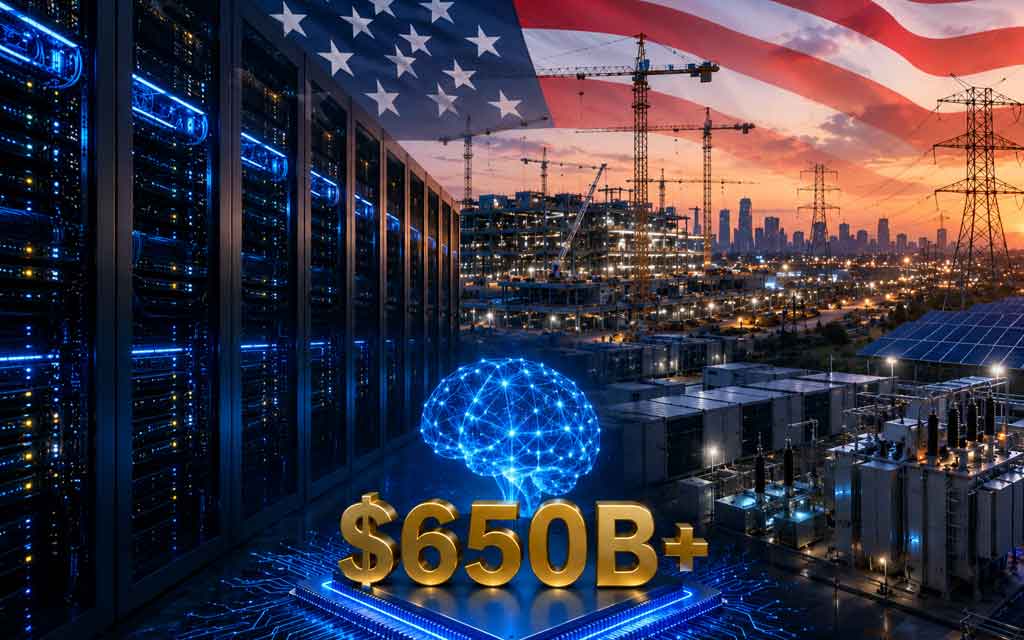
Hyperscalers are pouring over $650 billion into US data centers in 2026 to power the AI boom. Latest updates on massive projects, energy demands, economic impact, and investment opportunities for American investors and communities.
Introduction: The Infrastructure Backbone of the AI Revolution
The United States is experiencing an unprecedented data center construction boom in 2026, driven by explosive demand for AI training and inference. Hyperscalers including Microsoft, Google, Amazon, Meta, and Oracle are collectively committing over $650–750 billion this year alone to expand capacity across the country.
For American investors, tech workers, and local economies, this buildout represents massive job creation, energy infrastructure upgrades, and long-term technological leadership — but it also brings challenges around power supply and sustainability.
Scale of the 2026 Data Center Boom
- Investment Total: $650B+ in new and expanded facilities, according to industry trackers.
- Major Players:
- Microsoft: Aggressive expansion tied to OpenAI and Azure AI growth.
- Google: Massive builds in multiple states for Gemini and cloud services.
- Amazon (AWS): Continuing dominance with new hyperscale campuses.
- Meta and Oracle: Heavy investments in AI-specific infrastructure.
- Geographic Hotspots: Northern Virginia (Data Center Alley), Texas, Arizona, Ohio, and emerging Midwest/Southeast markets.
These facilities are far larger and more power-hungry than previous generations, often spanning millions of square feet with advanced cooling and direct AI accelerator support (NVIDIA, custom chips).
Energy and Infrastructure Impact
The AI-driven demand is straining — and accelerating — US power grids:
- Power Consumption: Data centers could consume 8–10% of US electricity by 2030, with 2026 marking a sharp acceleration.
- Renewable Push: Many projects include on-site solar, wind, and battery storage; hyperscalers are signing massive clean energy PPAs.
- Nuclear Revival: Interest in small modular reactors (SMRs) and restarting plants to provide reliable baseload power.
- Grid Upgrades: Billions flowing into transmission lines and substations, creating opportunities for utilities and energy companies.
Economic and Job Benefits for the US
- Job Creation: Construction, operations, maintenance, and supporting roles — tens of thousands of high-paying positions.
- Local Economies: Tax revenue boosts for counties and states, plus related growth in real estate, logistics, and tech services.
- National Security: Strengthens domestic AI infrastructure, reducing reliance on foreign data centers.
Comparison Table: Data Center Boom by Company (2026)
Microsoft
- Major Investment Focus: OpenAI/Azure AI
- Key Locations: VA, TX, Midwest
- Expected Capacity Impact: Largest single-year expansion
- Major Investment Focus: Gemini & Cloud
- Key Locations: Multiple US regions
- Expected Capacity Impact: Significant AI compute growth
Amazon AWS
- Major Investment Focus: General + AI workloads
- Key Locations: Nationwide
- Expected Capacity Impact: Continued market leadership
Meta
- Major Investment Focus: AI training & social features
- Key Locations: Various
- Expected Capacity Impact: High-density GPU clusters
Oracle
- Major Investment Focus: Enterprise AI cloud
- Key Locations: Emerging markets
- Expected Capacity Impact: Specialized high-performance
Investment Opportunities
- Direct Plays: Data center REITs (e.g., Equinix, Digital Realty), construction firms, and cooling technology companies.
- Energy Sector: Utilities, nuclear operators, renewable developers, and transmission companies.
- Supporting Tech: NVIDIA (accelerators), Broadcom, and suppliers of power equipment and chips.
- Risks: Regulatory hurdles, power shortages in certain regions, and high capital intensity.
Challenges Ahead
- Power Availability: Delays in some projects due to grid constraints.
- Environmental Concerns: Water usage for cooling and overall carbon footprint.
- Community Pushback: Local opposition in some areas over noise, traffic, and land use.
Future Outlook
The 2026 data center boom is just the beginning of a multi-year supercycle. By the end of the decade, AI infrastructure spending could exceed $1 trillion annually in the US. This positions America as the clear global leader in AI compute while driving innovation in energy, construction, and related technologies.
For US readers: Whether you’re an investor, job seeker, or policymaker, the data center explosion will shape the economy for years to come.
FAQ
Q: How much electricity will data centers use in 2026? A: A significant jump, potentially adding demand equivalent to several large cities.
Q: Which states benefit most? A: Virginia, Texas, and Arizona lead, but Midwest and Southeast are gaining fast.
Q: Is this a good investment opportunity? A: Strong long-term potential in related sectors, but research company-specific execution and risks.
Conclusion: America’s $650B+ data center buildout in 2026 is the physical foundation powering the AI revolution. It brings massive economic benefits, technological edge, and energy innovation while highlighting the need for smart infrastructure planning. This boom cements the US position at the forefront of the global AI race — watch closely as projects break ground across the country.
Sources: BloombergNEF, Reuters, Data Center Dynamics, company earnings reports, and industry analyses (as of June 17, 2026). For informational purposes only; not investment advice.




Leave a Comment