
Introduction: Record Global Growth Meets US Divergence
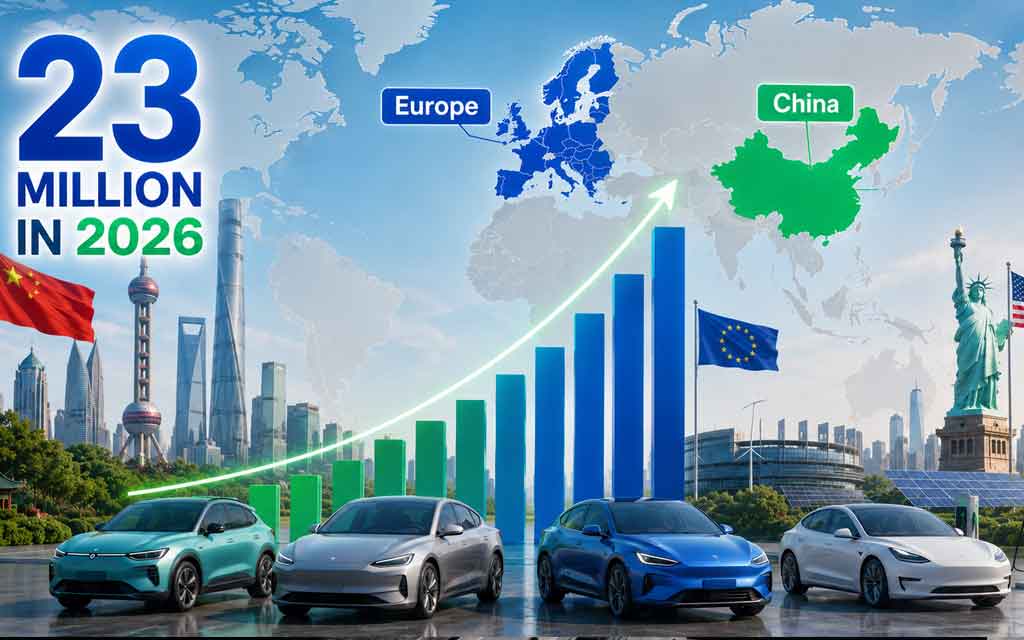
The electric vehicle revolution continues its global momentum in 2026, with BloombergNEF (BNEF) and the International Energy Agency (IEA) forecasting another record year for EV sales. Over 23 million passenger EVs are expected to be sold worldwide — an 11% increase from 2025 — representing 27-28% of all new car sales.
However, a clear divide has emerged: explosive growth in China and Europe contrasts with a slowdown in the United States, where policy changes, consumer preferences for trucks/SUVs, and a shift toward hybrids are reshaping the market. For American consumers and investors, this presents both challenges and opportunities in the evolving auto landscape.
Key 2026 Forecasts from BNEF and IEA
- Global Sales: 23+ million EVs, up 11% YoY (BNEF); ~28% of total car sales (IEA).
- Market Share: Expected to reach 27% globally (BNEF), with over half of passenger vehicles projected to be electric by 2035.
- Regional Breakdown:
- China: Dominant leader with ~55% EV share in 2025, continuing strong growth toward 60% in 2026 despite some moderation.
- Europe: Strongest growth among major markets, with ~20-30% YoY increases and one in three cars expected to be electric.
- United States: Flat to declining share, hovering around 10-12% of new sales, impacted by policy shifts.
These projections reflect robust global supply chains, falling battery costs, and policy support in key regions, even as some markets face headwinds.
Why the US Market Is Slowing
US EV sales remained relatively stable at around 10% market share in 2025 (~1.5 million units) but face pressure in 2026 due to several factors:
- Elimination of federal EV tax credits and reduced charging infrastructure support.
- Rollbacks on fuel efficiency standards and other incentives.
- Strong consumer preference for hybrids, SUVs, and trucks amid lower gasoline taxes and longer average driving distances.
- Automakers (Ford, GM, Stellantis) pivoting toward more flexible hybrid/gas lineups for profitability.
Hybrids have seen significant surges (e.g., +36% in early 2026), offering a practical bridge for many American buyers concerned about range, charging access, and upfront costs.
Global vs. US EV Market Comparison (2026 Outlook)
Global
- Projected EV Sales Share: 27-28%
- Key Drivers: China dominance, Europe regulations, falling costs
- Challenges: Policy variability
China
- Projected EV Sales Share: ~55-60%
- Key Drivers: Massive domestic market, exports
- Challenges: Temporary incentive pauses
Europe
- Projected EV Sales Share: ~30-33%
- Key Drivers: CO2 standards, new affordable models
- Challenges: Tariffs on imports
US
- Projected EV Sales Share: ~10-12%
- Key Drivers: Tesla leadership, hybrid pivot
- Challenges: Policy rollbacks, infrastructure gaps
Opportunities for American Drivers and Investors
Despite the national slowdown, pockets of strength remain:
- Hybrids as a Sweet Spot: Many automakers are doubling down here, delivering better efficiency without full EV commitment.
- Tesla and Domestic Players: Continued innovation in autonomy (e.g., Cybercab) and affordable models could boost US competitiveness.
- Long-Term Tailwinds: Battery prices continue to fall globally; high gas prices in certain periods can reignite EV interest.
- Investment Angle: Global supply chain plays (batteries, minerals), European/Chinese exporters, and US manufacturers adapting with hybrid tech.
Emerging markets in Southeast Asia and Latin America are also accelerating, creating broader investment diversification opportunities.
Future Outlook: Convergence or Continued Divergence?
By 2035, BNEF projects over 50% of passenger vehicles globally to be electric. The US could catch up if consumer economics improve (e.g., via lower EV prices and better charging networks) or if policies shift again. In the near term, hybrids are likely to dominate American roads as a pragmatic choice.
Analysts emphasize that while growth rates are moderating in some areas, the overall trajectory remains upward due to technological progress and economics.
FAQ
Q: How many EVs will be sold globally in 2026? A: Over 23 million passenger EVs according to both BNEF and IEA.
Q: Is the US EV market dead? A: No — sales remain substantial, with hybrids filling the gap and long-term potential intact.
Q: What should US buyers consider in 2026? A: Evaluate total cost of ownership (hybrids vs. EVs), local incentives, driving habits, and available charging.
Conclusion: Global EV adoption is hitting new records in 2026, underscoring the unstoppable momentum of electrification worldwide. While the US navigates a period of transition and hybrid emphasis, American innovation and market forces position the country for future gains. For drivers and investors, staying informed on regional trends and emerging technologies will be key to navigating this dynamic sector.
Sources: BloombergNEF Electric Vehicle Outlook 2026, IEA Global EV Outlook 2026, Reuters, industry reports (as of June 17, 2026). For informational purposes only; not investment advice.




Leave a Comment