
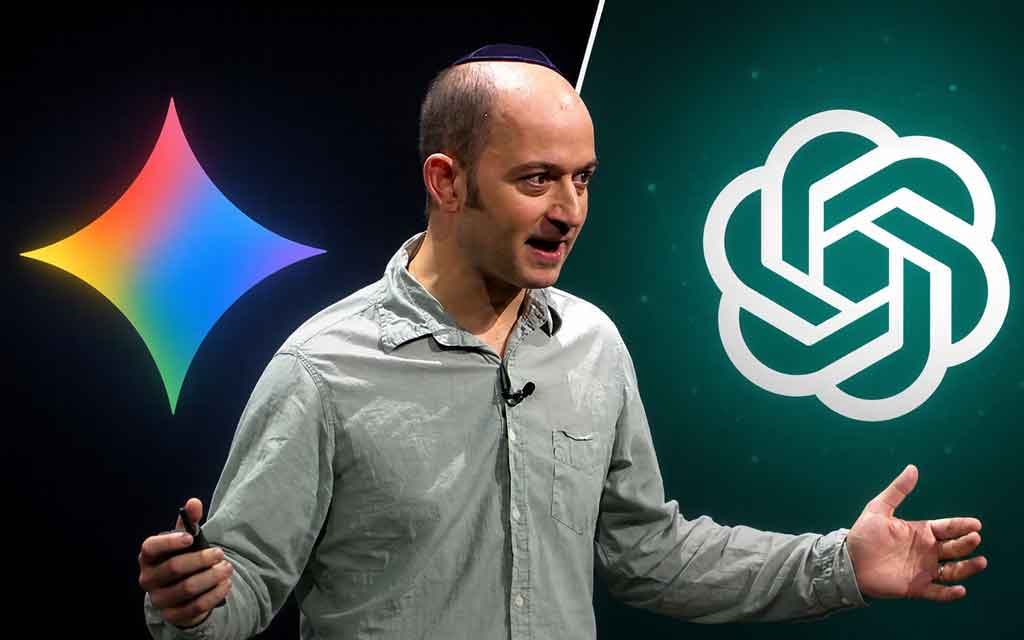
Google Gemini co-lead Noam Shazeer is leaving for OpenAI. The Transformer paper co-author and Character.AI founder joins the ChatGPT maker less than two years after a $2.7B return to Google. What this means for the AI race.
Google’s push to close the gap with OpenAI just suffered a high-profile setback. Noam Shazeer, Vice President of Engineering and co-lead of the Gemini AI models, announced Wednesday that he is leaving Google to join OpenAI.
The move comes less than two years after Google reportedly paid around $2.7 billion to bring Shazeer and key Character.AI talent back into the fold in 2024.
Who Is Noam Shazeer?
Noam Shazeer is one of the most influential figures in modern AI. He co-authored the landmark 2017 paper “Attention Is All You Need”, which introduced the Transformer architecture — the foundation for nearly every major large language model today, including GPT, Gemini, Claude, and Llama.
His contributions also include pioneering work on Mixture-of-Experts (MoE) architectures, which power efficient scaling in many frontier models. Before founding Character.AI, Shazeer worked at Google for over two decades, where he helped build early dialogue systems like Meena.
In 2021, he left Google to co-found Character.AI, which quickly became one of the most popular AI chatbot platforms, especially among younger users. Google’s 2024 deal to reacquire the team was one of the largest talent acquisitions in AI history.
The Announcement
In a post on X, Shazeer wrote:
“I’m excited to share that I’ll be joining OpenAI and look forward to working with the exceptional team there. I’m incredibly proud of the amazing team at Google and everything we’ve built together.”
OpenAI leadership welcomed him warmly. CEO Sam Altman noted it had taken about 10 years to finally team up. Chief Research Officer Mark Chen highlighted Shazeer’s deep expertise in model architecture and his history of groundbreaking innovations.
Google has not issued a detailed public statement beyond expressing gratitude for his contributions.
Why This Move Matters
This is more than just another executive departure — it’s a significant blow in the escalating AI talent war.
For OpenAI
- Gains a proven architect with experience scaling models at Google’s infrastructure level.
- Strengthens its research bench as it prepares for an IPO and pushes toward more advanced reasoning systems.
- Signals that top researchers see OpenAI as the place to build the next generation of frontier models.
For Google
- Loses a key technical leader on Gemini at a critical time.
- Gemini has made progress in closing the capability gap with GPT-4o and o1 models, but losing Shazeer raises questions about continuity in model architecture decisions.
- Highlights ongoing challenges in retaining top AI talent despite massive compensation packages.
The AI industry has seen repeated waves of talent movement between Google, OpenAI, Anthropic, Meta, and startups. Shazeer’s move underscores that even multi-billion-dollar retention deals have limits when researchers believe another lab offers better alignment with their vision or greater impact.
Timeline of Noam Shazeer’s AI Journey
- 2000s–2021: Long tenure at Google, early work on dialogue systems and neural networks.
- 2017: Co-authors the Transformer paper (“Attention Is All You Need”).
- 2021: Leaves Google to co-found Character.AI.
- 2024: Google brings him and key team members back in a reported $2.7 billion deal; appointed co-lead of Gemini.
- June 2026: Announces departure from Google to join OpenAI.
Broader Implications for the AI Race
- Talent > Everything Else In frontier AI, the highest-leverage resource isn’t just compute or data — it’s the small number of people who deeply understand how to push model capabilities forward. Shazeer’s move reinforces that labs are competing fiercely for these individuals.
- OpenAI’s Momentum The company is already IPO-bound and aggressively hiring. Adding someone of Shazeer’s caliber strengthens its position as it competes with Google, Anthropic, xAI, and others.
- Google’s Challenge Alphabet has invested heavily in AI (including the Gemini rebrand and integration across Search, Android, and Cloud). Retaining and attracting top researchers remains a persistent challenge amid internal bureaucracy concerns that have driven talent out in the past.
- What Comes Next for Gemini? Google will need to quickly stabilize the Gemini leadership team. The model has shown steady improvements, but losing a co-lead this senior could slow momentum in the short term.
What’s Next?
Shazeer is expected to take on a senior role focused on architecture research at OpenAI. Given his background, he will likely contribute to the next wave of model scaling, efficiency improvements, and reasoning capabilities.
The move also raises questions about whether more Character.AI alumni or other Google researchers might follow similar paths.
Bottom Line
Noam Shazeer’s departure from Google to OpenAI is one of the most significant AI talent moves of 2026. It highlights both OpenAI’s continued ability to attract elite researchers and the intense competition defining the current phase of the AI race.
For Google, it’s a reminder that even the largest checks and most ambitious projects don’t guarantee retention of top technical talent. For the industry, it’s another data point showing that the real battle is increasingly being fought in research labs and on whiteboards — not just in data centers.
The AI talent war shows no signs of slowing down.
Sources: Reuters, CNBC, Bloomberg, company statements, and public posts as of June 18, 2026.




Leave a Comment