
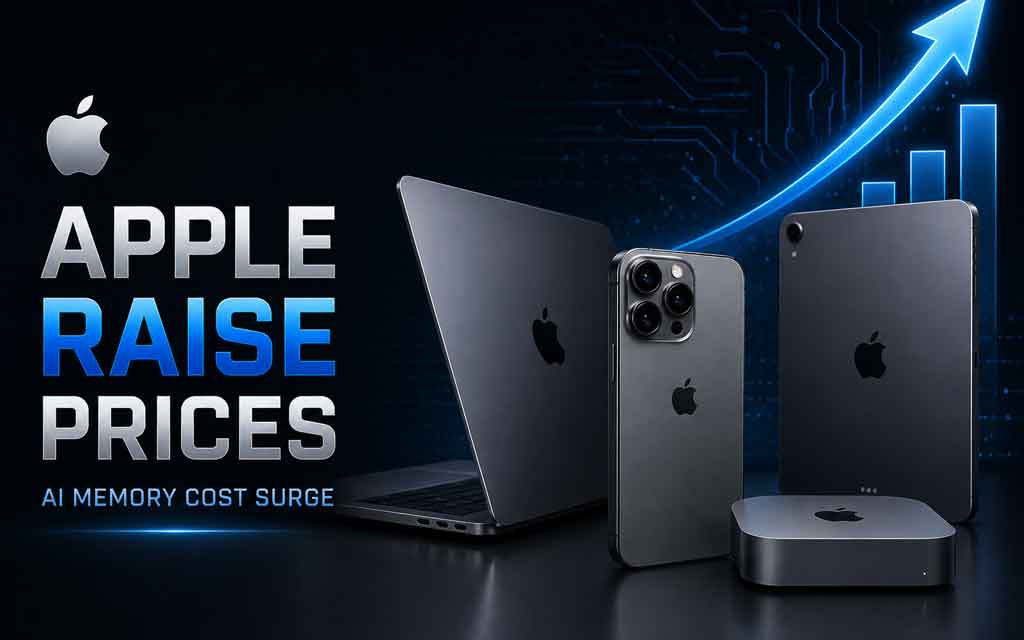
In a blunt exclusive interview with The Wall Street Journal published June 17, 2026, Apple CEO Tim Cook confirmed what many analysts had suspected: Apple will raise prices on its flagship products. “Unfortunately, price increases are unavoidable,” Cook stated. He added, “We’re doing our best to mitigate the huge increases that are being passed to us, and we’ve been trying to shield our customers from the increases, but the situation has become unsustainable.”
The reason? An unprecedented surge in the cost and constrained supply of memory (DRAM) and storage (NAND) chips — driven almost entirely by the explosive buildout of AI data centers by hyperscalers like Google, Microsoft, Meta, and Amazon.
This marks a rare moment of public candor from Cook just months before he steps down as CEO on September 1, 2026, handing the reins to John Ternus. For American consumers eyeing a new iPhone 18, Mac, or iPad, it signals higher prices ahead — potentially starting with Macs and iPads in the coming months and hitting the iPhone 18 series this fall.
Why Memory Costs Are Surging: The AI Effect
The global memory market is experiencing its most severe imbalance in decades. AI training and inference workloads require enormous amounts of high-bandwidth memory (HBM). Memory manufacturers — primarily Samsung, SK Hynix, and Micron — have shifted production capacity toward these high-margin AI chips.
As a result:
- Spot and contract prices for standard DRAM and NAND have quadrupled in some cases since last year.
- Consumer electronics are now competing for leftover supply against multi-year, prepaid contracts from AI giants.
- Industry forecasts show DRAM and NAND supply growth lagging demand well into 2027 (and possibly longer according to some analysts).
Cook described the situation vividly: “There’s less supply at a time when consumers want devices and the memory guys are passing along huge price increases.” He called it a “hundred-year flood” in his more than 40 years in the industry.
Apple spends low tens of billions of dollars annually on memory and storage — making it one of the largest buyers in the world. Yet even Apple’s scale is being outmatched by the capital expenditure pouring into AI infrastructure.
Which Products Will See Price Increases?
Cook declined to specify timing, magnitude, or exact models. However, clear signals point to broad impact:
- Macs and iPads — Price adjustments could arrive sooner. Apple already quietly raised the entry price of the Mac Mini last month by discontinuing the lowest storage configuration.
- iPhone 18 series (expected September 2026) — Most analysts expect the biggest potential increases here, especially on Pro and Pro Max models that require more DRAM for advanced on-device Apple Intelligence features. One estimate suggested the iPhone 18 Pro could need a $200–$270+ increase just to maintain current margins.
- Storage and RAM upgrades — Historically a high-margin area for Apple; higher component costs may narrow those margins or push base configurations higher.
Other PC makers (Dell, HP, Lenovo) are already passing on similar cost increases, reinforcing that this is an industry-wide phenomenon, not Apple-specific.
Apple’s Strategy: Using Its Balance Sheet
Unlike smaller competitors, Apple has options. Cook emphasized the company’s willingness to deploy its massive cash reserves to help expand memory supply. “We’re willing to use our balance sheet to help be a part of the solution,” he said. “Obviously, more capacity is needed.”
However, Apple has no plans to build its own memory fabs. “We can’t do everything,” Cook noted. “We know what we’re good at.”
This pragmatic approach — leveraging purchasing power and financial strength while competing for supply — has defined Apple’s supply-chain leadership for years. The current environment is testing that model like never before.
What This Means for American Consumers
Should you buy now or wait?
- If you need a device soon (especially a Mac or iPad) — Consider purchasing current inventory or taking advantage of any remaining education or trade-in deals. Price hikes on existing models could appear with little warning.
- iPhone 18 buyers — Expect the September launch to carry higher starting prices or more expensive storage tiers. Apple’s loyal customer base has historically accepted premium pricing for ecosystem lock-in and longer device lifespans (many users keep iPhones 3–4+ years).
- Refurbished and older models — These may become more attractive as new prices rise, potentially extending the life of current devices.
Apple has long positioned its products as premium investments. Higher component costs may accelerate that narrative: “Buy once, keep longer.”
The Bigger Picture: AI’s Hidden Tax on Consumer Tech
This memory crunch reveals a deeper truth about the AI revolution. The same technology transforming productivity, creativity, and scientific discovery is also reshaping the economics of the devices we use every day.
On-device AI features (Apple Intelligence, advanced Siri, on-device image generation, etc.) require significantly more RAM than previous generations. This creates a double pressure: higher component costs and higher baseline specs needed to deliver the AI experience Apple promises.
Industry analysts at firms like Morgan Stanley have modeled potential 10–15% price increases across premium smartphones and PCs this year. While the impact on overall inflation may be modest, the effect on individual household budgets for big-ticket tech purchases is very real.
Historical Context: Apple Has Absorbed Costs Before
Apple has a strong track record of shielding customers from component inflation when possible. During the 2021–2022 chip shortage, the company largely held iPhone and Mac prices steady while many competitors raised theirs. The current situation appears different in both scale and duration — described by Cook as unlike anything in four decades.
FAQs About Apple’s Price Increases
When will the price hikes take effect? Macs and iPads could see changes in the coming months. The iPhone 18 lineup (September 2026) is the most likely major inflection point. Exact timing remains at Apple’s discretion.
How much will prices rise? Cook gave no numbers. Analyst estimates for the iPhone 18 Pro range from modest increases to $200+ depending on configuration. Storage and RAM upgrades are also likely to cost more.
Will base models be affected? Very possibly. Apple may raise entry-level prices, reduce base storage/RAM, or both — similar to the recent Mac Mini adjustment.
Does this affect Apple Watch, AirPods, or other accessories? Cook’s comments focused on products with significant DRAM and NAND content (iPhone, iPad, Mac). Accessories with lighter memory needs may see less impact.
Will Apple Intelligence features be affected? Higher memory costs could influence how aggressively Apple pushes on-device AI or the minimum specs required for full functionality.
Outlook: A New Era of Tech Economics
Tim Cook’s unusually direct language signals that the AI boom is no longer a distant future trend — it is actively reshaping supply chains and consumer pricing today. While new memory fabs will eventually come online (wafer capacity is projected to grow ~30% by 2027), the reallocation toward AI-specific memory means consumer electronics may face structurally higher costs for years.
For Apple, the challenge is maintaining its premium positioning and customer loyalty while navigating input costs that are, in Cook’s words, “unsustainable” to fully absorb.
For consumers, the message is clear: the era of ever-more-capable devices at stable or declining prices may be pausing — at least until memory supply and AI-driven demand find a new equilibrium.
Bottom line: Apple’s next iPhone, Mac, or iPad will likely cost more. The question is no longer if — but how much and when. Plan your upgrades accordingly.
What are your thoughts? Are you planning to buy before potential price hikes hit, or will you wait for the iPhone 18 series? Let us know in the comments.




Leave a Comment