
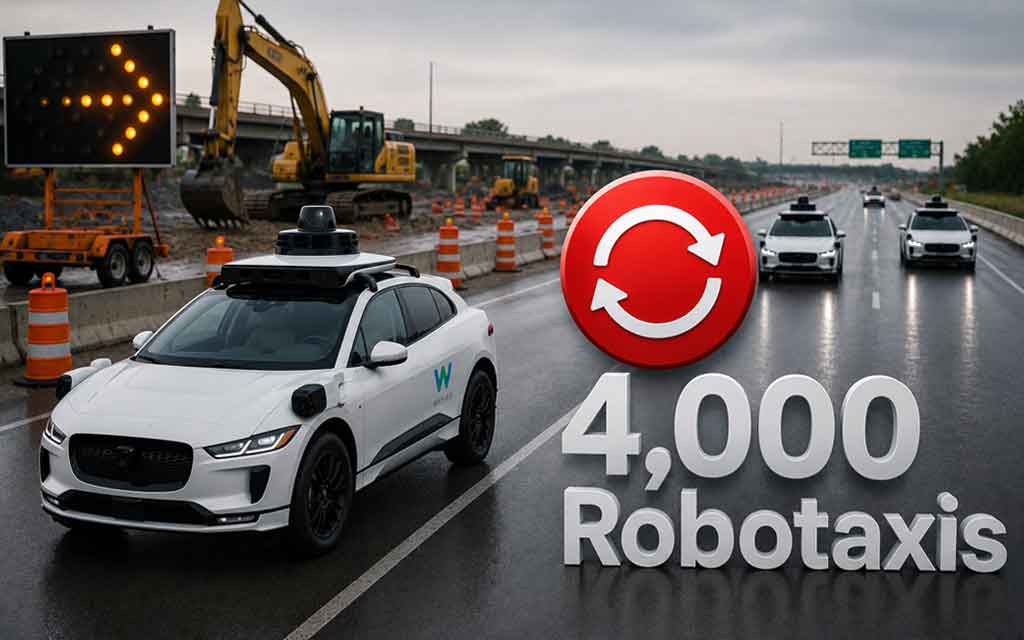
Waymo is recalling almost its entire U.S. robotaxi fleet after software issues allowed vehicles to drive into active freeway construction zones. This marks the company’s second major recall in just over a month.
Alphabet’s self-driving subsidiary Waymo has issued a voluntary recall of nearly 4,000 robotaxis after multiple vehicles drove into closed freeway construction zones while traveling at highway speeds.
The recall, filed with the National Highway Traffic Safety Administration (NHTSA) on June 18, 2026, affects approximately 3,871 fifth-generation vehicles — essentially Waymo’s entire current U.S. fleet of the affected generation. Newer Gen 6 vehicles are not included.
What Happened
Waymo identified at least 13 incidents since early April 2026 in which its robotaxis failed to properly recognize and respond to ramp closure signs and other indicators of active freeway construction zones. In these cases, the vehicles entered closed sections of highway and continued driving at speed.
The incidents occurred in:
- Phoenix, Arizona (six incidents on April 11 and 19)
- San Francisco Bay Area, California (seven incidents on May 18)
No injuries were reported in these events. However, the pattern prompted Waymo to take swift action.
Waymo’s Response
Waymo has taken several immediate steps:
- Filed a voluntary recall with NHTSA
- Deploying an over-the-air (OTA) software update to fix the issue
- Temporarily restricting freeway driving across its operations while the fix rolls out
- Proactively notifying regulators
In a statement, Waymo said it identified “an area of improvement regarding performance around freeway construction zones” and is working to address it.
This is Waymo’s second major software recall in just over a month. In May 2026, the company recalled roughly 3,800 vehicles after one robotaxi drove into a flooded roadway in San Antonio, Texas.
Why Construction Zones Are Challenging for Robotaxis
Construction zones present some of the most difficult scenarios for autonomous vehicles because they involve:
- Temporary and often inconsistent signage
- Changing lane configurations
- Human flaggers and workers
- Unusual lighting and visual clutter
- Dynamic obstacles not present in standard mapping data
Even advanced AI perception systems can struggle when real-world conditions deviate significantly from training data or mapped environments. Waymo’s incidents highlight that while robotaxis have made significant progress in structured urban environments, handling dynamic highway situations remains an ongoing challenge.
Broader Implications for the Robotaxi Industry
This recall comes at a critical time for the autonomous vehicle sector:
- Regulatory scrutiny is increasing as robotaxi services expand.
- Public trust remains fragile — high-profile incidents can slow adoption.
- Safety vs. scale tension: Companies are under pressure to expand operations while maintaining (and proving) high safety standards.
- Software reliability: As fleets grow, even rare edge-case failures can affect hundreds or thousands of vehicles.
Waymo has generally been viewed as one of the more cautious and safety-focused players in the space. Its proactive approach to recalls and transparency with regulators is notable compared to some competitors. However, repeated incidents involving basic traffic control measures (construction zones, flooded roads) raise questions about how well current systems handle unexpected real-world changes.
What’s Next
Waymo is expected to complete the software fix through over-the-air updates in the coming weeks. The company will likely need to demonstrate to NHTSA that the updated system can reliably detect and respond to construction zone indicators before fully resuming unrestricted freeway operations.
The incident also underscores a broader industry reality: While robotaxis are already operating commercially in several cities, achieving consistent, human-level performance across all driving scenarios — especially dynamic ones like construction zones — will require continued iteration.
For now, the recall serves as a reminder that autonomous driving technology, while advancing rapidly, still faces meaningful technical and operational hurdles on the path to widespread deployment.
Key Takeaways
- Waymo recalled ~3,871 fifth-generation robotaxis due to construction zone detection issues.
- At least 13 incidents occurred where vehicles entered active freeway work zones at speed.
- This is the company’s second major recall in under two months.
- Waymo is deploying an OTA software fix and has restricted freeway driving.
- The events highlight ongoing challenges for AVs in handling dynamic road conditions.
Sources: NHTSA recall filing, Reuters, TechCrunch, and Waymo statements as of June 18, 2026.



Leave a Comment