
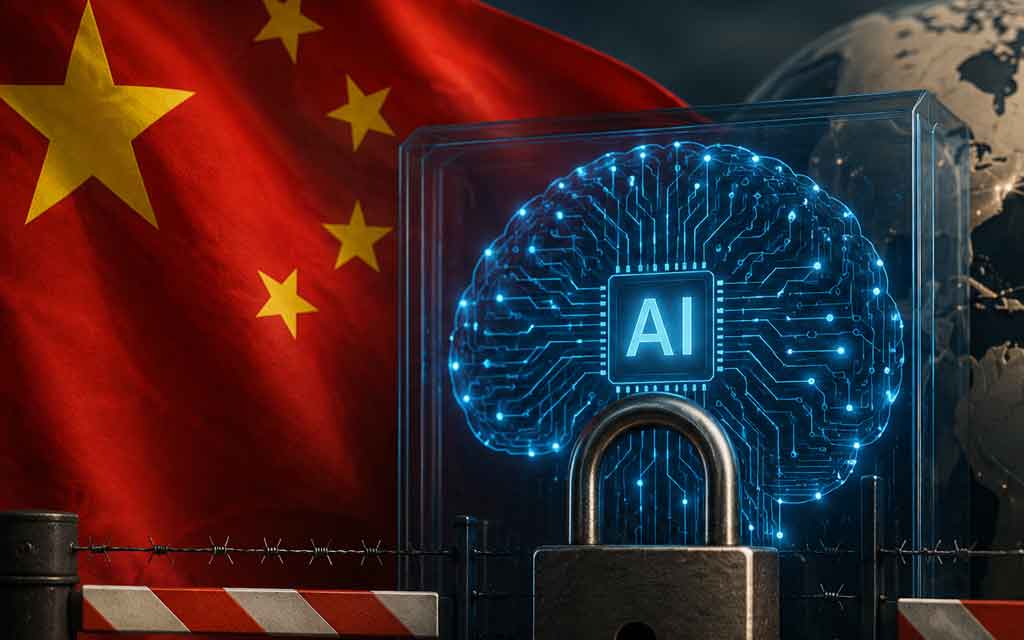
China is tightening controls on overseas access to its most advanced AI models. Beijing has reportedly held talks with companies like Alibaba, ByteDance, and Zhipu AI to limit foreign access amid escalating US-China tech tensions.
China is taking new steps to restrict overseas access to its most advanced artificial intelligence models, according to recent reports. This move marks a significant escalation in Beijing’s efforts to protect its AI technology amid intensifying competition with the United States.
What China Is Doing
China’s Ministry of Commerce has reportedly held discussions with major domestic AI companies — including Alibaba, ByteDance, and Zhipu AI — to explore ways to limit foreign access to cutting-edge AI models.
The proposed measures reportedly include:
- Restricting overseas access to both closed-source and open-weight frontier AI models
- Designating leaks of advanced AI technology as national security crimes with harsher penalties
- Further restricting foreign investment in sensitive Chinese AI startups
These discussions are part of a broader strategy to prevent the outflow of critical AI technology and know-how.
Why China Is Taking This Step
Beijing’s move comes against the backdrop of ongoing US export controls on advanced AI chips and growing concerns in China about technology leakage.
Key drivers include:
- National security concerns — AI is viewed as a strategic technology critical to both economic and military advantage.
- Response to US restrictions — Washington has imposed increasingly tight controls on advanced semiconductors and AI-related technology going to China.
- Protecting domestic advantage — China wants to ensure its leading AI capabilities remain primarily within its borders and are not easily accessed or replicated abroad.
By limiting overseas access, China aims to maintain a technological edge while reducing the risk of its most powerful models being used or reverse-engineered by foreign entities.
Which Models Could Be Affected?
While details are still emerging, the restrictions are expected to target China’s most advanced models, particularly those considered “frontier” level. This could include:
- High-capability large language models from companies like Alibaba’s Tongyi Qianwen series
- Advanced models from Zhipu AI and other leading Chinese labs
- Potentially future open-weight releases from major Chinese developers
It remains unclear whether existing open-source models will be retroactively affected or if the rules will apply mainly to new, more powerful systems.
Implications for Global AI Development
This development has several potential consequences:
Potential Global Impact of China’s AI Restrictions
- Global AI Access: Reduced availability of leading Chinese AI models, making access more difficult for foreign researchers and companies.
- Open-Source AI: Chinese open-weight model releases could slow as developers become more cautious about sharing advanced AI technologies.
- U.S.–China Tech Decoupling: Further fragmentation of the global AI landscape, with two increasingly separate AI ecosystems emerging.
- International Collaboration: Cross-border AI research and development may become more restricted, making global partnerships harder to maintain.
- Chinese AI Companies: Greater focus on the domestic market, with increased emphasis on serving Chinese businesses, developers, and consumers.
Comparison with US Policy
Interestingly, this move mirrors steps taken by the United States. In recent months, the US has also moved to restrict access to advanced AI models (such as certain Anthropic models) through export control mechanisms.
Both superpowers are now actively working to keep their most powerful AI capabilities from flowing freely across borders — a clear sign that AI has become one of the most contested domains in the ongoing technological and geopolitical rivalry.
What Happens Next?
The discussions are still at an early stage, and it is not yet clear how strictly or quickly any new rules will be implemented. However, the direction is clear: China is moving toward greater control over its advanced AI technology.
For global companies, researchers, and developers who rely on Chinese AI models, this could mean:
- Reduced access to the latest Chinese systems
- Greater uncertainty around future open-source releases from China
- A need to diversify AI model sources
Bottom Line
China’s decision to restrict overseas access to its cutting-edge AI models represents another major step in the fragmentation of the global AI landscape. As both the US and China tighten controls, the world is increasingly moving toward separate AI ecosystems rather than a single, open global standard.
This development will be closely watched by tech companies, governments, and researchers worldwide.



Leave a Comment