
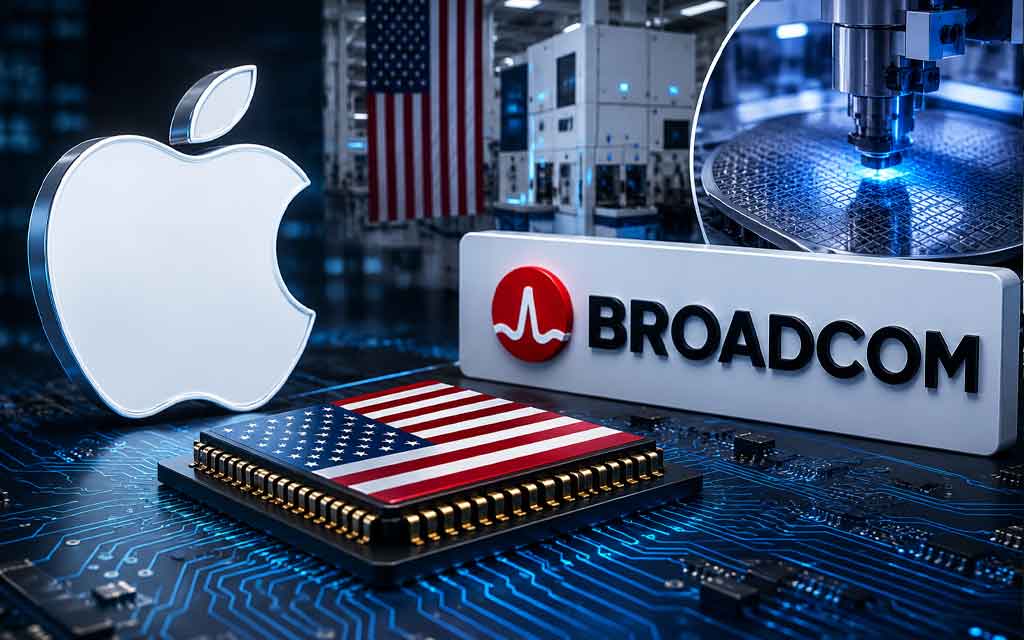
Apple has announced plans to invest $30 billion in US chip manufacturing. Here’s what the investment means for Apple’s supply chain, US semiconductor industry, and global tech competition.
Apple is making one of its largest-ever commitments to American semiconductor manufacturing, with plans to invest $30 billion in US chip production. The move is part of Apple’s broader strategy to strengthen its domestic supply chain and reduce reliance on overseas manufacturing.
Key Details of Apple’s Investment
According to reports, Apple’s $30 billion investment will support:
- Expansion of advanced chip production in the United States
- Increased collaboration with US-based semiconductor facilities
- Development of next-generation chips for iPhones, Macs, and other Apple devices
This investment builds on Apple’s earlier commitments, including support for TSMC’s Arizona fabrication plants. However, the new $30 billion figure represents a significant scaling up of Apple’s US manufacturing footprint.
Why Apple Is Investing Heavily in US Chips
Apple’s decision is driven by several strategic factors:
- Supply Chain Resilience Geopolitical tensions, particularly around Taiwan and China, have pushed Apple to diversify its manufacturing base. The company wants to reduce risk in its highly complex supply chain.
- US Government Incentives The CHIPS and Science Act has provided substantial subsidies and tax credits for semiconductor manufacturing in the US. Apple is positioning itself to take full advantage of these incentives.
- Advanced Chip Demand Apple’s growing focus on AI features, on-device processing, and high-performance silicon (such as its M-series and A-series chips) requires access to cutting-edge manufacturing nodes. Securing US capacity helps ensure long-term supply.
- Political and Regulatory Pressure There has been increasing pressure on major tech companies to bring more manufacturing back to the United States.
Where the Money Is Going
While Apple has not disclosed the full breakdown, the investment is expected to support:
- TSMC’s Arizona facilities (which produce chips for Apple)
- Potential partnerships with other US semiconductor players
- Research and development in advanced packaging and chip design
- Workforce development and training programs
This move aligns with Apple’s long-term goal of producing more components closer to its largest market (the United States).
Impact on the US Semiconductor Industry
Apple’s $30 billion commitment is significant for the broader US chip ecosystem:
Edit
Potential Impact on Key Stakeholders
Nvidia
- Faces long-term competitive pressure.
- Could see reduced demand from Chinese AI laboratories as domestic alternatives mature.
Huawei
- Stands to benefit from increased domestic competition.
- DeepSeek could emerge as a major rival in the AI inference chip market.
China’s AI Sector
- Gains greater technological self-sufficiency.
- Helps reduce the impact of U.S. export controls on advanced AI technologies.
Global AI Race
- Further fragments the global AI ecosystem.
- Accelerates the technological split between U.S. and Chinese AI industries.
DeepSeek
- Gains a major strategic advantage.
- Achieves full-stack control over both AI models and hardware, strengthening its long-term competitiveness.
GadgetKey AI FeaturesBest ForPrice Range (Est.)Plaud NotePinAI voice recording + transcriptionProfessionals & students$150–200RingConn Gen 2Advanced health insights + AI coachingHealth & fitness tracking$200–300New AI EarbudsReal-time translation + noise cancellationTravelers & multilingual users$150–250AI Voice MouseVoice commands + smart productivityProductivity users$80–120
AI Gadgets at a Glance
Plaud Note
- Key AI Features: AI-powered voice recording, transcription, meeting summaries
- Best For: Professionals, students, journalists
- Estimated Price: $150–200
RingConn Gen 2
- Key AI Features: Advanced health insights, sleep analysis, AI wellness coaching
- Best For: Health and fitness tracking
- Estimated Price: $200–300
New AI Earbuds
- Key AI Features: Real-time language translation, AI noise cancellation, voice enhancement
- Best For: Travelers, multilingual users, remote workers
- Estimated Price: $150–250
AI Voice Mouse
- Key AI Features: Voice commands, AI shortcuts, smart productivity controls
- Best For: Productivity users, office professionals
- Estimated Price: $80–120
Microsoft Gaming Layoffs by Year
2023
- Layoff Impact: Approximately 1,900 jobs cut
- Notable Details: Workforce reduction followed the Activision Blizzard acquisition.
2024
- Layoff Impact: Hundreds of additional employees affected
- Notable Details: Studio closures, project cancellations, and organizational restructuring.
2025–2026
- Layoff Impact: Ongoing targeted workforce reductions
- Notable Details: Continued focus on operational efficiency, streamlining teams, and reducing management layers.
ModelCompanyStatus (July 2026)U.S. Approval StatusGPT-5.6OpenAILimited → Broad rolloutReportedly grantedClaude Fable 5AnthropicExpanding accessRecently clearedClaude Mythos 5AnthropicLimited to partnersCleared for partnersSeed 2.1ByteDanceAlready releasedN/A
AI Models Status (July 2026)
GPT-5.6
- Company: OpenAI
- Status (July 2026): Limited access expanding toward a broader rollout
- U.S. Approval Status: Reportedly granted
Claude Fable 5
- Company: Anthropic
- Status (July 2026): Access expanding following its return
- U.S. Approval Status: Recently cleared
Claude Mythos 5
- Company: Anthropic
- Status (July 2026): Limited availability for partner organizations
- U.S. Approval Status: Cleared for approved partners
Seed 2.1
- Company: ByteDance
- Status (July 2026): Already released and broadly available
- U.S. Approval Status: N/A
AreaExpected ImpactUS Chip ManufacturingBoost to domestic production capacityTSMC ArizonaStronger business case for expansionJob CreationThousands of high-tech manufacturing jobsTechnology LeadershipHelps US maintain edge in advanced nodesSupply Chain SecurityReduces vulnerability to global disruptions
Expected Impact of Apple’s U.S. Chip Investment
U.S. Chip Manufacturing
- Expected Impact: Significant boost to domestic semiconductor production capacity.
TSMC Arizona
- Expected Impact: Strengthens the business case for continued expansion and advanced chip manufacturing in Arizona.
Job Creation
- Expected Impact: Supports the creation of thousands of high-tech manufacturing and engineering jobs.
Technology Leadership
- Expected Impact: Helps the United States maintain its leadership in advanced semiconductor technologies and next-generation chip production.
Supply Chain Security
- Expected Impact: Reduces reliance on overseas manufacturing and improves resilience against global supply chain disruptions.
The investment also sends a strong signal to other tech giants and reinforces the momentum behind the US government’s push to rebuild its semiconductor industry.
Comparison with Other Tech Giants
Major U.S. Chip Investments by Big Tech
Apple
- Recent U.S. Chip Investment: $30 billion
- Focus Area: Advanced Apple Silicon for iPhone, Mac, iPad, and future AI devices.
- Recent U.S. Chip Investment: Multi-billion-dollar investment
- Focus Area: Tensor Processing Units (TPUs), custom AI accelerators, and cloud infrastructure.
Amazon
- Recent U.S. Chip Investment: Significant ongoing investment
- Focus Area: Custom silicon for AWS, data centers, AI training, and inference chips.
Microsoft
- Recent U.S. Chip Investment: Strategic partnerships and custom chip development
- Focus Area: AI infrastructure, cloud computing, and proprietary AI accelerators.
Apple’s investment stands out due to its scale and direct focus on consumer device chips rather than just data center/AI infrastructure.
What This Means for Apple’s Future
This investment strengthens Apple’s position in several ways:
- Greater control over its most critical components
- Faster innovation cycles through closer collaboration with US fabs
- Reduced geopolitical risk in its supply chain
- Stronger negotiating power with suppliers
It also positions Apple as a key player in America’s semiconductor resurgence, alongside companies like Intel, TSMC, and Samsung.
Final Thoughts
Apple’s $30 billion investment in US chip manufacturing is more than just a financial commitment — it’s a strategic realignment. As the company continues to push into AI, custom silicon, and more advanced devices, securing reliable, high-end chip production in the United States has become a top priority.
This move is expected to have ripple effects across the global semiconductor industry and further accelerate the reshoring of advanced manufacturing to the US



Leave a Comment