
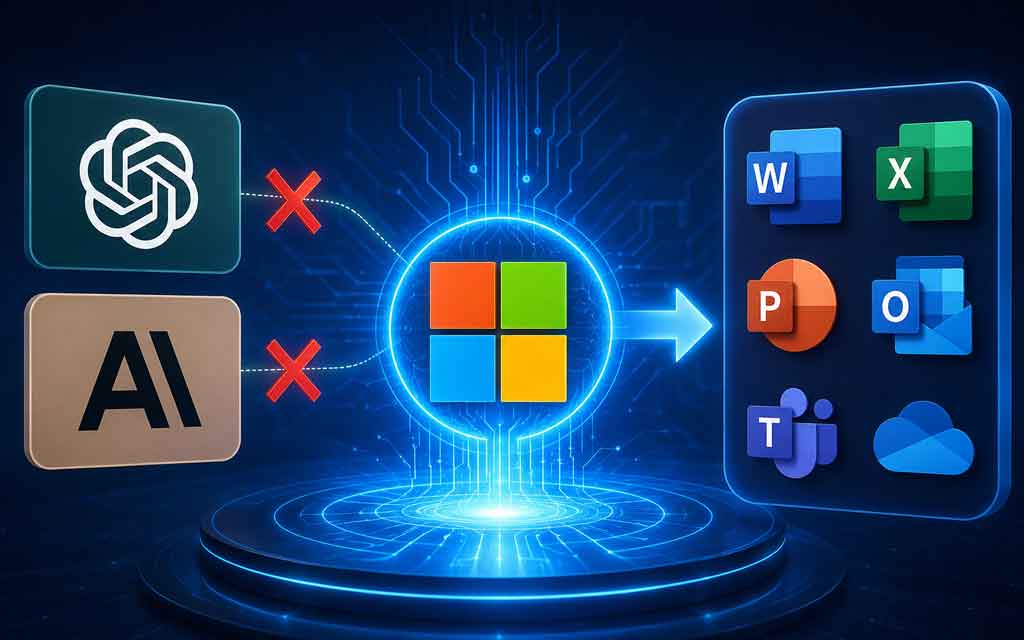
Microsoft is reportedly planning to replace OpenAI and Anthropic models with its own in-house AI models across Excel, Outlook, Teams, and other Microsoft 365 apps. Here’s what this means.
Microsoft is making a major strategic shift by moving away from OpenAI and Anthropic models in its core productivity applications. The company plans to increasingly use its own internally developed AI models in Excel, Outlook, Teams, Word, and other Microsoft 365 tools.
This marks one of the clearest signs yet that Microsoft is reducing its heavy dependence on external AI providers.
Why Microsoft Is Building Its Own AI Models
Microsoft has been quietly developing its own AI model family (internally referred to as MAI models). At its Build 2026 conference, the company showcased several in-house models, including:
- MAI-Code-1-Flash (for coding tasks)
- MAI-Thinking-1 (reasoning model)
- Various models for speech, image generation, and voice
The decision to prioritize these models stems from several factors:
- Cost control — Reducing expensive API usage from OpenAI and Anthropic
- Customization — Better integration with Microsoft’s ecosystem and data
- Independence — Avoiding over-reliance on a single partner (OpenAI)
- Performance & Latency — On-device and cloud models optimized specifically for Microsoft 365 workloads
Which Products Will Be Affected?
According to reports, Microsoft intends to replace or significantly reduce the use of third-party models in the following applications:
Microsoft 365 Apps: AI Model Transition
Excel
- Current AI Usage: Data analysis, formula assistance, Copilot
- Planned Change: Transition to Microsoft’s in-house AI models
- Expected Impact: High
Outlook
- Current AI Usage: Email summarization, drafting, smart replies
- Planned Change: Replace OpenAI/Anthropic models with Microsoft’s own AI
- Expected Impact: High
Teams
- Current AI Usage: Meeting summaries, transcription, action items
- Planned Change: Shift toward Microsoft’s internal AI models
- Expected Impact: Medium–High
Word
- Current AI Usage: Writing assistance, rewriting, document editing
- Planned Change: Gradual replacement with in-house AI models
- Expected Impact: Medium
PowerPoint
- Current AI Usage: Slide generation, presentation design, content suggestions
- Planned Change: Increased reliance on Microsoft’s proprietary AI models
- Expected Impact: Medium
Microsoft is not completely cutting off OpenAI overnight. Instead, it is following a gradual transition strategy, testing its own models alongside existing ones before full replacement.
Background: Microsoft-OpenAI Relationship
Microsoft has been OpenAI’s biggest investor and partner since 2019, pouring billions into the company. In return, it gained exclusive access to OpenAI’s technology for its products.
However, tensions have grown in recent years as:
- OpenAI’s valuation and independence increased
- Microsoft began developing its own competing models
- Both companies started exploring alternative partnerships
This move by Microsoft is seen as a natural evolution toward greater self-sufficiency in AI.
Implications
For Microsoft:
- Greater control over AI features and pricing
- Potential cost savings at scale
- Ability to optimize models specifically for enterprise use cases
- Reduced risk if OpenAI’s direction changes
For OpenAI & Anthropic:
- Loss of significant revenue from Microsoft 365 integrations
- Need to accelerate their own enterprise offerings
- Increased pressure to differentiate their models
For Users:
- Potentially better integration and consistency across Microsoft apps
- Possible improvements in speed and privacy (especially with on-device AI)
- Uncertainty during the transition period
What This Means for the AI Industry
Microsoft’s decision highlights a growing trend among big tech companies: building proprietary AI stacks instead of relying entirely on external providers.
We’re seeing similar moves from:
- Google (developing its own models alongside Gemini)
- Meta (open-source + internal models)
- Apple (on-device AI focus)
The era of one company powering everyone else’s AI features appears to be ending.
Outlook
Microsoft is not expected to completely drop OpenAI models immediately. The transition will likely happen in phases over the next 12–18 months, starting with less critical features before moving to core capabilities in Excel and Outlook.
This strategic shift positions Microsoft as a more independent AI player while still maintaining a relationship with OpenAI for specific high-end use cases.




Leave a Comment